
The basic idea of organizing is to get rid of stuff you don’t need, and then place the items to keep in an appropriate spot out of the way where they can be found again when needed. However, mental attachments to our belongings can trick us into retaining items long past their usefulness or value, which leads to clutter and confusion.
 In her best-selling book, The Life-Changing Magic of Tidying Up, Marie Kondo created a systematic approach to organizing home and office spaces that can be quickly implemented by anyone. While most people read the book for the nuts and bolts of how to organize a closet or drawer, the book shares a deeper Zen-like philosophy which resonates beyond the mere allocation of our stuff. Marie calls it the KonMari Method™. From her web site:
The KonMari Method™ is a way of life and a state of mind that encourages cherishing the things that spark joy in people’s lives.
Belongings are acknowledged for their service and thanked before being let go of, if they no longer spark joy.
People are drawn to this philosophy not only due to its effectiveness, but also because it places great importance on being mindful, introspective, and optimistic.
See more at her web site Konmari.com and check out the book from your library.
 .
. This is a question of great interest to behavioral economist Dan Ariely. So much so that he did several experiments which aimed to probe deep into how people assign value to the work they do. The results of the experiments were shared in a TED Talk. From the video description:
 The quest for greater efficiency and productivity in our work is a noble endeavor. However, in every quest there is an obstacle in the way of success. In this case, it is our own unconscious default behavior that sabotages our best efforts at change and keeps us stuck at square one.
 his recent book,
  Let’s be blunt, your head is a crappy office space. In the moment, it can be very seductive to believe that you can remember anything that comes across your plate. In practice, our minds drop important items regularly. That is why a system that takes the burden of remembering off your mind is very important. In a recent blog post, David Allen reflects on this point:
 1. It feels weird to keep stuff on your mind
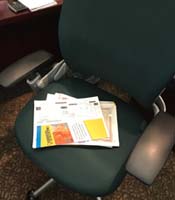 The inbox is designed to capture new information and works best when new input is regularly processed and organized. Once an inbox fills with clutter, new input quickly gets lost. People see that messy inbox as a graveyard and avoid it like a real one. Therefore, they will find ways around the dysfunctional inbox and a favorite option is to use the chair. They assume that the person will see it before they sit down!
 Efficient Librarian