Discipline Over Default

brianknightThe quest for greater efficiency and productivity in our work is a noble endeavor.  However, in every quest there is an obstacle in the way of success.  In this case, it is our own unconscious default behavior that sabotages our best efforts at change and keeps us stuck at square one.

In a recent blog post, Brian Kight of Focus 3 describes the difference between a disciplined way of thinking versus a default way and how adopting the former can help you achieve your goals.

“Discipline over default means thinking and acting discipline-driven rather than default-driven, a core practice of our training. The unfortunate fact is that most people behave default-driven and don’t even realize it. Choosing to be discipline-driven over default-driven isn’t a one-time decision, it’s an everyday decision. … Default is the enemy of discipline. It’s the self-perpetuating chasm between you and your goals, and that should frustrate you.

Read the rest of the Focus 3 blog post to learn more about how engage in a more discipline-driven approach to work and life.

Bad Choices

The word “algorithm” has a mysterious quality to it, as if only someone with an advanced degree in mathematics on computer science can understand its meaning.  However, an algorithm is actually a process or set of rules to be followed in calculations or other problem-solving operations. In fact, we use algorithms every day to make decisions in life, but we just don’t know it.

Inbadchoices his recent book, Bad Choices: How Algorithms can Help you Think Smarter and Live Happier, author Ali Almossawi cleverly and playful employs basic logic to solve real world daily task problems such as organizing socks, quickly finding your size in a rack of clothes, knowing when to visit the store for supplies, and solve a maze. Almossawi states:

“It is my hope that this book impresses on you the ability to better think about decisions throughout your life and better understand what trade offs they come with. … Much like critical thinking, algorithmic thinking is a highly capable tool that has the potential to impact behavior for the better.”

Pick up a copy of Bad Choices at your local library.

Going the Distance to Mind Like Water

(Sorry for the delay in postings due to Hurricane Irma.)

gtdcoverLet’s be blunt, your head is a crappy office space.  In the moment, it can be very seductive to believe that you can remember anything that comes across your plate.  In practice, our minds drop important items regularly.  That is why a system that takes the burden of remembering off your mind is very important.  In a recent blog post, David Allen reflects on this point:

There is a light-year of difference between a system that has merely a lot of our stuff objectified, and one that has 100%. Few people have experienced what I’m talking about, because there are few people who have ever gotten to a 100% empty head—absolutely every project, action item, and potential commitment we have made with ourselves and others externalized in an easily reviewable format.

Read the rest of the post at the GTD Blog.

5 Signs You’re Getting Better at GTD

The game of productivity and efficiency work can sometimes be hard to score.  As this is a skill to be mastered, it is helpful to identify key stages of progress in order to feel a sense of achievement.  In a recent blog post, Coach Kelly Forrister identified five key markers of a proficient GTD practice.

gtd-logo1. It feels weird to keep stuff on your mind
Capturing what has your attention is a key practice with GTD. Getting better at GTD means you are capturing what’s on your mind when it shows up, moment-by-moment and keeping something ON your mind, well, it just feels weird.

Read the other four signs on the Getting Things Done web site.

Why is there stuff on my chair?

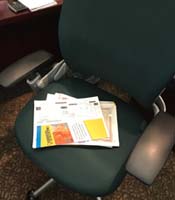
Have you ever come back to your desk to discover that someone left a note on your chair?  I am sure most office workers regularly encounter this situation.  I believe the reason people leave notes on their colleague’s chairs is that they do not trust that person’s inbox.

messy-chairThe inbox is designed to capture new information and works best when new input is regularly processed and organized. Once an inbox fills with clutter, new input quickly gets lost. People see that messy inbox as a graveyard and avoid it like a real one. Therefore, they will find ways around the dysfunctional inbox and a favorite option is to use the chair.  They assume that the person will see it before they sit down!


To avoid having your colleagues turn your chair into an inbox, try working the one on your desk more efficiently.  Clean it out every 24-48 hours to stay fresh for new input.  Be warned, some people are now programmed to bypass even a clean inbox and automatically go for the chair. When this happens to me, I tell that colleague that I will sit on the item, literally and figuratively. Then I politely point them to my inbox and ask that they place it there instead for timely processing.  It keeps the chair much more comfortable that way.


New Guidelines on Passwords

cleandesk

Passwords are an unfortunate reality of our online lives. With the average person having multiple accounts for everything from email, credit cards, shopping sites, and more, and each one requiring a different password to protect it. In the past, the guidelines for passwords instructed people to string together complex sets of characters that were often hard to remember on the assumption that it would be more secure. However, new research shows otherwise. A recent NPR story explains why:

“The traditional guidance is actually producing passwords that are easy for bad guys and hard for legitimate users,” says Paul Grassi, senior standards and technology adviser at NIST, who led the new revision of guidelines.

The organization suggests keeping passwords simple, long and memorable. Phrases, lowercase letters and typical English words work well, Grassi tells NPR’s Audie Cornish. Experts no longer suggest special characters and a mixture of lower and uppercase letters. And passwords never need to expire.”

Read the full article on the NPR web site. Then create a new project titled “simplify my passwords” to start making better, safer passwords for yourself.

Brief Introduction to David Allen

davidallenJust came across a short video interview (5 mins) with Getting Things Done author David Allen.  In the video, he provides a brief background around how he came to productivity work,  why he wrote his bestselling book, and the one big idea that guides his life.  You also get to see his apartment in Amsterdam and his “guard” dog as a bonus.

The video is posted on YouTube at: https://www.youtube.com/watch?v=LTe1pD71Hlk&feature=youtu.be

Enjoy!

What is an Efficient Librarian?

stackswithlightBelow is an section from an article I have submitted to Public Libraries magazine on the concept of The Efficient Librarian. I intend to expand on this topic in future posts.
The role of a library worker has changed due to the twin disruptions of the Internet and diminished budgets.  With more information available from our smart devices than can be contained in our physical collections, we are no longer the guardians and gatekeepers of knowledge.  With less money available, setting clear budget priorities is essential.  We are in a period of professional re-evaluation where we cannot afford to be passive observers.  We must actively lead the change.
An Efficient Librarian is an elite knowledge worker navigating the complexity of the post Internet information world.  She combines the skill sets of a librarian with the best productivity and efficiency practices to become a powerful consultant and decision maker.  To start on the path, an Efficient Librarian recognizes and masters three types of engagement:
  1. Defining and organizing personal workflow systems
  2. Identifying and making improvements to their organization’s service chains
  3. Invoking the power of “next action” thinking
By mastering each type, an Efficient Librarian is able to reduce unnecessary stress, bring focus to her work, create stronger organizational systems around her, and drive sustained momentum for positive change.

If it only takes 2 minutes …

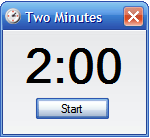
two_minute_timerWant a great time saver for your work and personal life?  Try a solution promoted in the GTD methodology: the two minute rule.

When processing your inbox any action associated with an item that will take two minutes or less to do should be done immediately.  This is because it would take more time to organize the item in your system then to resolve it straight away.

The two minute rule has some flexibility.  For example, if you have lots of time available for processing, extend it to three minutes or more per item.  If you have limited time, reduce it to a minute or ninety seconds per item.

In the end, some actions are best done when they first show up.  That is why completion of two minute items leads to less stress and more success in your work and life.