Finding Your Leadership Pathway – Roadblocks & Detours

In the first two parts of this Finding Your Leadership Pathway series, I spoke about preparing for the journey. The first step was assessing your starting point by identifying strengths, weaknesses, skills and talents. Step two was picking a destination based on personal goals, desires, and career intentions. However, once you start down the road it is inevitable that obstacles will arise. Navigating around these barriers holds the keys to success.

Obstacles on the leadership pathway come in many forms. Perhaps a promotion doesn’t materialize. Maybe funding cuts eliminate projects or strategic initiatives you were counting on for resume building. Interpersonal conflicts could inhibit committee work and strain coworker relations.

An exercise to endure these roadblocks involves preparing for them before they arrive. Start by brainstorming a list of possible roadblocks in advance. Contemplate the most likely ways that the journey could go off track. For example, imagine the goal is to become a manager at a nearby location when the current person retires. Here are possible ways this ambition could be thwarted:

  • Heavy competition results in more skilled candidates applying
  • The current manager decides to stay around longer than anticipated
  • The position is frozen due to budget cuts
  • Another candidate is appointed without any interviews
  • Family issues interfere with your ability to compete

By anticipating what might go wrong, overly optimistic thinking is challenged. When you are grounded in realism there is opportunity to consider contingencies and possible detours. In next week’s post we will cover how to strategize around them.

Finding Your Leadership Pathway – Goals

What is your leadership destination?

Leader development is an ongoing process. Last week I discussed how the beginning of leadership growth is understanding your starting point. After all, you can’t plan a journey without knowing from where it will begin. Once the starting point is set, the next action is to decide on the destination.

Let’s get something out of the way first: leadership development is not solely about rising through the ranks of an organization. For many people, moving into management or administration goes against what makes them happy at work. It is perfectly fine for someone to develop within their position and never become a supervisor. That is because leaders can and must exist at all levels of an organization. The challenge for each one of us is deciding a leadership goal that is personally and professionally fulfilling.

A useful tool for this process is the Nexus LAB: Layers of Leadership Model. Created through a partnership with the Educopia Institute, the Center for Creative Leadership, and the Institute of Museum and Library Services, it maps out the skills needed for six distinct levels of leadership.

  • Leading Self
  • Leading Others
  • Leading the Department
  • Leading Multiple Departments
  • Leading the Organization
  • Leading the Profession

The model is meant to be approached in a non-liner fashion. Successful leaders may only explore one or two of the levels over their careers. In fact, some people might lead their profession without ever having a management role.

I invite you to explore the model in depth and use it to determine your current leadership goal. For the level you desire to reach, write down the skills, challenges, and potential outcomes associated with it. This exercise will help you identify current strengths and gaps in your knowledge that can be grown on the journey ahead.

Next week, we will explore how to navigate around roadblocks and make the best of detours.

Finding Your Leadership Pathway – Assessment

What is your road to leadership?

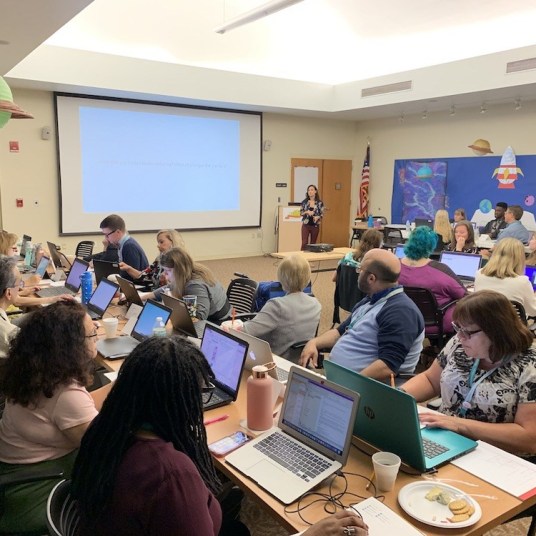
At the PLA conference in Portland, I was honored to be participate in an all-day preconference workshop called, Finding Your Leadership Pathway. Sponsored and presented by the PLA Leadership Committee, over thirty participants joined our team to craft their leadership pathway, no matter if they were a new leader or one with many years of experience under their belt.

The agenda for the day followed a five stage roadmap. Over the next five weeks I will highlight one section. Today we start at the beginning with a leadership assessment.

Photo by Dominika Roseclay on Pexels.com

In order to take any trip, you must know your point of origin. The leadership assessment starts with identifying your current position, skills, and responsibilities. Knowledge of your strengths and weaknesses is also helpful. To ensure the assessment sticks, write down the responses on a real piece of paper to make it a physical process.

While those items will orient you to the here and know, there is something even deeper to consider: values. What is a value? The Google dictionary definition states amongst several things that it is: a person’s principles or standards of behavior; one’s judgment of what is important in life.

With that in mind, what do you consider to be your five top values? List them out and see if they resonate with your life and approach to work. If they do not, you may be simply accepting the values of those around you. Instead, reexamine the list and go deeper with another round of listing values. Keep going with rounds of examination until you are satisfied with the list.

Now that you have an understanding of your starting point, next week we will provide a process to identify your leadership goal.

An Underappreciated Leadership Skill

By nature of the position, leaders are required to make decisions. While experience and training are very helpful to make good calls in challenging situations, it may not be enough. In this fast changing world, there is an important skill that will help leaders of all types succeed. It is the power of critical thinking,

In a recent article in Inc. magazine titled, Want to Improve Your Leadership Skills? Focus on Critical Thinking, executive coach Bruce Eckfelt lays out the primary reason that critical thinking is a vital skill for today’s leaders.

As a business grows in size, so does the complexity and scope of its problems and challenges. Without good critical-thinking skills, leaders will make poor decisions and fail to take advantage of strategic opportunities. Very often, what holds the business back from reaching its true potential is a lack in the leadership of foresight and effective problem-solving skills.

Photo by Julia M Cameron on Pexels.com

To enhance this skill, Eckfelt provides five ways to improve critical thinking skills. The first is something librarians loves to do: gather more and better data.

The first thing I emphasize is that most teams try to make decisions with limited and poor-quality data. Good critical thinkers start by collecting as much high-quality data as possible. They don’t take things at face value. They question summaries and dig to make sure that they really understand what’s happening on the ground and maximize the raw information they have to work with.

Learn the other four ways to improve your critical thinking skills by reading the article.

Second Brain Summit

Some very exciting happened this past week. The first ever Second Brain Summit was held online! Tiago Forte of Forte Labs brought together a series of speakers to excite and educate everyone on how to build a second brain and maximize its potential.

Here’s what Tiago had to say in a recent email:

Incredibly, we had over 12,300 live participants across 15 sessions led by 18 experts and thought leaders. Thank you to everyone who made it possible.

This week you learned:

  • How to avoid self-sabotage in your productive efforts
  • How to apply a “systems mindset” to your life
  • How to reframe productivity through the lens of ADHD
  • How to use apps like Notion, Logseq, Evernote, and OneNote
  • How to automate your notetaking using tools like Readwise and Matter
  • Insights into the future of digital notetaking
  • How to use “meta” thinking and adopt “habits of learning”
  • How to choose the perfect productivity app for you
  • How to appreciate the inherent joy of thinking
  • How to leverage your Second Brain to do your highest value work

And you know what? In case you missed anything, we’ve made every recording available on a YouTube playlist you can revisit and watch anytime.

Learn more about Building a Second Brain at the Forte Labs web site.

You Don’t Need More Content … Yet

Yesterday I finally subscribed to Netflix. Given that the streaming service already has 75 million subscribers in the US alone, it felt like I was the last one to sign on! Why did I wait so long? Quite frankly, my family has subscriptions to Disney+, Discovery+, and HBO Max. Between all three of those services I have enough movies and TV shows to keep me busy for three lifetimes of endless viewing. I resisted Netflix because I didn’t need more content.

As a trainer in productivity, leadership, and libraries, it is tempting to load up presentation with content. This is a useful approach when doing an introductory seminar or presentation. However, I have come to believe that most trainers focus too much on content delivery and not enough on integration. In short they sacrifice the cultivation of knowledge for the sake of information overload.

This insight came to me while developing a leadership clinic for TBLC, a Florida library cooperative. For weeks I struggled to decide what content to share with the students during the 2.5 hours of training. After picking and discarding many different ideas, I fell back to a training approach I learned years ago. The concept divides training into four sections:

  • Content Delivery
  • Written Component
  • Small Group Reflection
  • Large Group Share

Based on this model, delivering content is only a quarter of the learning experience. The other three components are designed to allow participants to integrate the information into their own experience. By offering students time for quiet written work, such as answering a question, they begin to wrap their mind around the material. Through communication in small groups followed by large groups, knowledge is deepened through conversation. By the end of the four sections, the student should have a strong understanding of the material and how it impacts their lives.

At the leadership clinic, the students spent a third of their time in breakout rooms. The conversations were deep and honest. In fact, the students afterward said they wanted more time in the rooms than we had available. Many stated how useful it was to talk through their issues and identify points of resolution.

Whenever you feel you need more content, it may actually be time to reflect on the information you already have. Only after you identify gaps in your knowledge is it time to seek more information.

The moral: Don’t go looking for more content, at least not yet …

Personal Productivity Stacks

We rely on a wide range of technology to get things done. However, if we don’t apply the right tool in the right way, we can end up undermining our efforts. To avoid this problem we need to spend time understanding the structure of knowledge work. This will guide us to use the right tool the right way for better results.

Tiago Forte has thought deeply about how to be more productive and creative at the same time. In a recent posting on his web site called How to Build Your Personal Productivity Stack, he discusses how technological change can both make our work easier and more frustrating.

Each wave of technology does legitimately solve a new problem from the previous wave, and – if harnessed correctly – can move us closer to our goals: the experiences and feelings that we want more of. 

But if you’re like most people, you’re probably using email for multiple purposes far beyond what it was designed for:

  • You use email to send messages
  • You use email as a to-do list
  • You use email to keep track of notes and ideas
  • You use email to manage complex projects and areas of your life

These are extremely different use cases, and using one platform for all of them ensures it fails at all of them.

To be more effective, Tiago breaks down the four key components of knowledge work.

To perform each of them effectively, you have to break apart each of the four essential activities of modern work – Email, Task Management, Notetaking, and Project Management – and use the right tool for each of those jobs.

I call these four functions a “Productivity Stack,” since each one is layered on top of and builds on the one before.

To learn more, read the rest of his post on the Forte Labs web site.

Time Hack: Choice

The old saying goes that everyone gets the same 24 hours a day. What we do within that time shapes our life. While large parts of our day are spent sleeping and working, there are hours where we get to pick our actions. In a recent article on MIT Press, author Michelle Drouin notes that the average amount of available leisure time has increased. However, there is one activity that dominates this free time.

The average American spends 22 minutes a day participating in sports, exercise, and recreation; 32 minutes per day socializing or communicating; and 26 minutes per day relaxing or thinking. In contrast, they spend 211 minutes per day watching TV. That’s 2.6 times more time watching TV than exercising, relaxing, and socializing combined.

Photo by Burak Kebapci on Pexels.com

This huge devotion to screen time limits our productivity and also makes us unhappy. In order to get out of this rut, we need a new tool.

But research also shows that by taking steps to make sure our social compromises are our own choices — not based on the way technology makes us feel — we can employ the best time hack of all. It’s called social economizing, and it means we make active decisions about how we spend our time, and we then save and invest our time where we want.

To learn more about how this hack works, I encourage you to read the rest of the article.

As well, check out Michelle Drouin’s book Out of Touch: How to Survive an Intimacy Famine.

We’re All Alone in this Together

Organizations that are able to form reliable teams tend to accomplish more goals and provide better internal and external customer service. However, there is an unspoken tension around teams. In order for them to work effectively, everyone has to know their assignment. The distribution of work needs to be clear otherwise important items fall through the cracks.

David Allen has explored the intersection of personal productivity and teamwork. In a recent blog post he notes the following:

Have you discovered yet that no matter how big the button is that says “TEAM” you’re wearing at the conference, nobody’s on yours?! That in order to get done what you have to get done, there aren’t a lot of people at your beck and call, making sure your specific actions and projects happen? Ever have the feeling that you’ve got to hold on for dear life to your own projects and outcomes, against the hurricane of events and other people trying to get their world defined and done?

Later in the post, David considers the reason why teams fail to clarify their work.

Problem is most of us never had training or experience in dealing with that syndrome efficiently and effectively. We grew up in a world where you just went to work, and the work to be done was visible and obvious.

What is the solution to this problem? It could be as simple as acknowledging our struggles.

The best teams and relationships, from my experience, are the ones in which the players all acknowledge they’re each alone in the endeavor together. That’s when we can really experience team, and function as one.

Read the entire post on the Getting Things Done web site.