
 Have you ever wondered how you make a decision? Most people believe that in any given situation they make rational, common sense choices that will maximize their success and happiness. In truth, our minds work in mysterious ways that often lead people to make decisions that run counter to their best interests. The major work on this subject was done in the 70’s and 80’s by a pair of Israeli researchers who revolutionized the field. Their names were Daniel Kahneman and Amos Tversky.
In his latest book, Micheal Lewis, author of The Blind Side and The Big Short, looks at the fascinating life and work of these two researchers in his new book, The Undoing Project. It provides a fun introduction to some of Kahneman and Tversky’s greatest discoveries, including anchoring, base rate fallacy, framing, and prospect theory. The book is an enjoyable character study of the unique partnership between these two researchers whose work has impacted fields far from academia, including medicine and sports.
After reading the book, you may become skeptical about the quality of your decisions, but at the same time you will learn ways to double check your thought process so that you can make a better decisions.
 The strength of GTD awareness and ability is knowing that the best time to do a GTD Weekly Review is when you least feel like doing it. The strange force that seems to make these simple but powerful habits so challenging is that we think we need to have the result of the behavior, before we can engage in the behavior.
 As we approach the end of the year regular work flow often slows down as colleagues take vacation for the holidays. For me, I have found this to be an ideal time to tidy up by purging my paper files.
 If you enjoyed reading Malcolm bestselling books like I did, then this is a podcast for you. As described on the web site: “He has explored how ideas spread in the
  Years ago I was a certified yoga teacher in the Kripalu tradition. I was drawn to yoga as a way to find centering, peace, and health in my life. Perhaps one of the reasons that GTD has always connected for me is that it takes the ancient wisdom from the mountaintop and brings it straight to the modern office. I recently came across this great quote from a Raja Yoga school of wisdom that clearly demonstrates the reason why it is important to get things out of your head and to bring them to completion in a timely manner.
 “People started keeping calendars a century ago. Why? Because life’s time-based commitments got more complex than they could trust their mind to manage. If you think that a Projects list is unnecessary, then throw away your calendar and trust life will just let you know what you should be doing, in the moment. Good luck. If you decide you need a calendar, then keep a list of your projects you’re committed to completing, as well as appointments to keep. Otherwise you’re intellectually dishonest.”
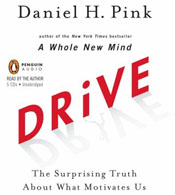 According to Pink’s study of the scientific literature, most people erroneously believe that external motivations like money and fancy benefits motivate us to do good work. The conclusion he draws is that what truly motivates us is the ability to direct our own lives, learn new things, and improve the lives of the people around us. Pink provides examples of ways to improve your own level of drive. His book also identifies different ways that organizations can use self directed motivation to inspire their workforce in ways that the old approach of carrots and sticks was never able to do.
 Efficient Librarian