
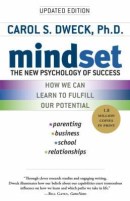
 Imagine a room of students who are working on a very tough math problem. Some of them give up quickly and say it can’t be solved while others preserve and work at it until they final succeed. What is different about these students? Believe it or not, IQ is not a factor. According to research, it is mindset.
In her groundbreaking book, Mindset, author Carol S. Dweck, Ph.D. explored the reasons why some people have greater success than others. She determined that it came down to whether a person had a fixed or growth mindset. As explained on her website:
“In a fixed mindset, people believe their basic qualities, like their intelligence or talent, are simply fixed traits. They spend their time documenting their intelligence or talent instead of developing them. They also believe that talent alone creates success—without effort. They’re wrong.
“In a growth mindset, people believe that their most basic abilities can be developed through dedication and hard work—brains and talent are just the starting point. This view creates a love of learning and a resilience that is essential for great accomplishment. Virtually all great people have had these qualities.”
Read more about this fascinating idea at mindsetonline.com
 David Allen is fond of saying that “Your mind is for having ideas, not holding them.” As a knowledge worker, your ability to generate and implement ideas is crucial to your success. The challenge is that we can never know for certain what will turn out to be a good idea and what will end up as a discarded thought. However, it is guaranteed that a forgotten idea will never be implemented. Therefore, it is important to have a method to capture ideas as they appear.
 I realized that the two things I did that caused me to procrastinate were:
 What is the value in setting a goal for yourself or your organization? Many cynics discount goals as artificial creations that don’t translate into actual results. They argue that we are going to do the work anyway, so why set up a fake expectation?
 Welcome to 2018! Let me ask you a question. Did you make a New Year’s Resolution before the ball dropped in Times Square? According to a
  It has long been proposed that one of the secrets to a happy life is finding a work/life balance. This is a magical equation where the right mix of meaningful work offset by an exact amount of normal life activity equals contentment. However, is this really as true as it seems?
 This is a question of great interest to behavioral economist Dan Ariely. So much so that he did several experiments which aimed to probe deep into how people assign value to the work they do. The results of the experiments were shared in a TED Talk. From the video description:
 The quest for greater efficiency and productivity in our work is a noble endeavor. However, in every quest there is an obstacle in the way of success. In this case, it is our own unconscious default behavior that sabotages our best efforts at change and keeps us stuck at square one.
 Chip and Dan Heath discuss this dilemma in their book,
  Efficient Librarian