4000 Weeks

It is easy to think that with enough time we will be able to accomplish anything we want. However, the truth is that our days on this earth is limited. Some of it is restricted by commitments that others put upon us, but most comes from those we place on ourselves. With limited time, most of the items on our Someday/Maybe list will never be completed. This may seem grim, but it also serves as the inspiration to do great things.

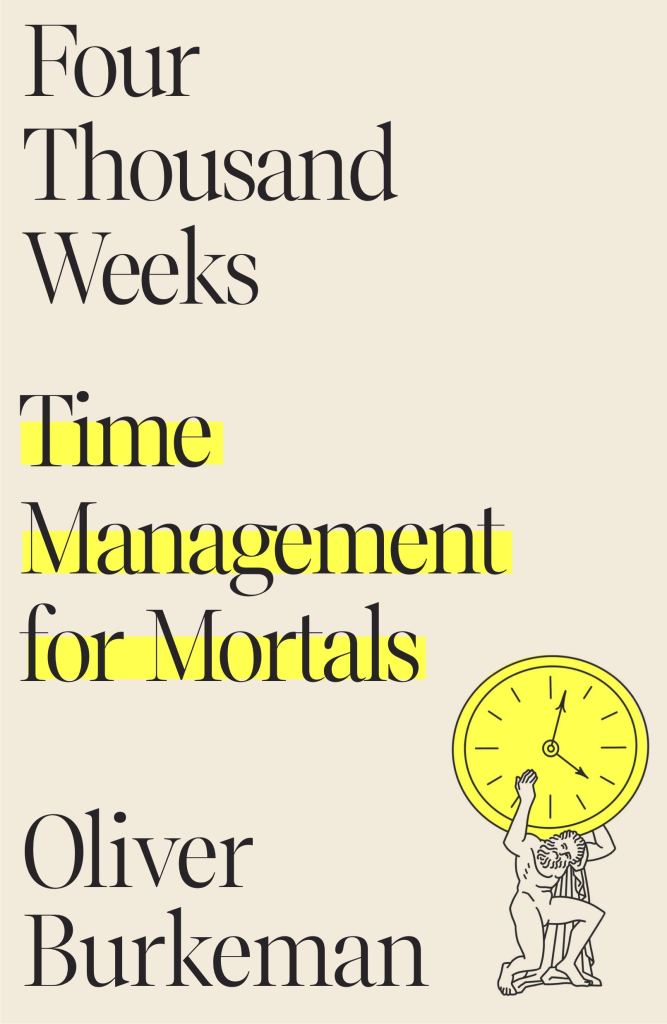
In a recent article in The Atlantic, reporter Joe Pinsker shares an interview with author Oliver Burkeman about his new book, Four Thousand Weeks: Time Management for Mortals. In the book, Burkeman states that the average life span of a person lasts around 4000 weeks, roughly to about the age of 80. With this finite perspective in place, a person can tackle the challenge of determining what is most important to them.

“The average human lifespan is absurdly, terrifyingly, insultingly short,” he writes. Given this limitation, it makes sense that the typical approach to time management is to seek ways to cram ever more into our finite number of days.

But Burkeman argues that this is the wrong way to manage time. Rather than looking outward to productivity strategies and hacks, Four Thousand Weeks encourages an inner shift in perspective. It confronts a series of comforting illusions that many of us hold onto instead of internalizing colder truths: that we will die not having done a tremendous number of things we care about; that every commitment we make to a person, place, or line of work rules out countless others that may fulfill us; that our lives are already ticking away.

Later in the article, Burkeman makes a statement that seems to sum up his philosophy.

The only way to get around to the important things is: Instead of trying to eradicate all the other stuff, [make progress] on the important stuff first. You just have to let the other chips fall where they will.

Read the full interview on The Atlantic web site.

Think Like a Scientist

The world is full of disagreement. Throughout our lives we encounter people who have different views from us on a wide range of topics. In some cases, these views may be held very intensely, leading to arguments, conflict, and at worst violence. If you have ever tried to change people’s minds, it can appear to be a futile process. Why is that so?

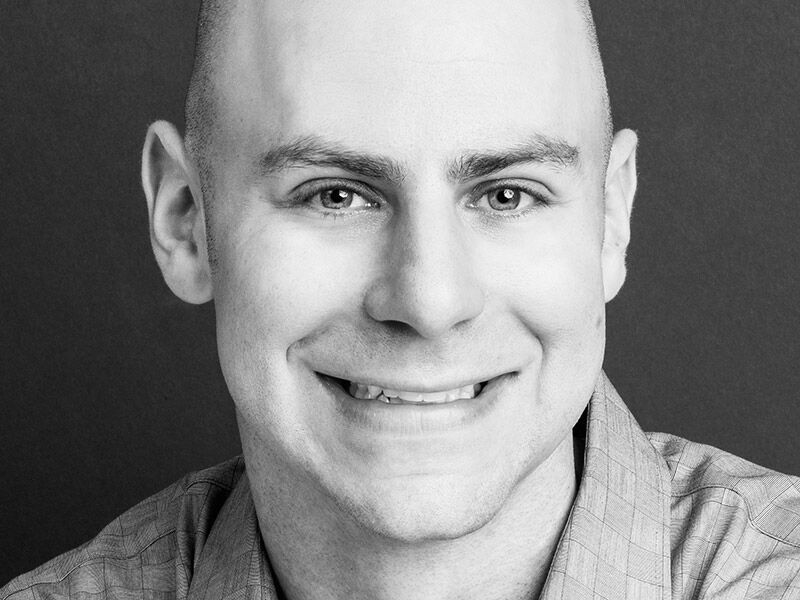
According to Adam Grant, part of the reason that disagreements are rarely resolved is because people don’t know how to engage in thoughtful debate. He argues in his new book, Think Again, that most people fall to one of three default modes of persuasion. In a recent article in Inc. magazine, contributor Jessica Stillman describes these modes this way:

Adam Grant

Preacher: “When we’re in preacher mode, we’re convinced we’re right,” explained Grant. From the salesman to the clergyman, this is the style you use when you’re trying to persuade others to your way of thinking.

Prosecutor: “When we’re in prosecutor mode, we’re trying to prove someone else wrong,” he continued.

Politician: It’s no shock that “when we’re in politician mode, we’re trying to win the approval of our audience.”

The problem with all three of these modes is that they rarely succeed in changing other person’s mind. In fact, they often create more resistance. Instead, Grant identifies a different approach to resolving disagreements.

Scientist: When you think like a scientist, “you favor humility over pride and curiosity over conviction,” Grant explained. “You look for reasons why you might be wrong; not just reasons why you must be right.”

This mode is challenging because it requires the maturity to accept that their position could be wrong. This vulnerability can become a bridge to connect people in a way that allows for understanding. To learn more, I invite you read Stillman’s article. If you want to dive deeper, please read Grant’s book, Think Again.

Think Like a Chef!

Have you ever had a day when new information, emails, and calls were flying at you in record speed? The nature of knowledge work is that we move between times of quiet and reflection to periods of rapid action. It is in those hectic times that we can easily fall behind and get flustered. So to master those busy periods it is helpful to consider another profession that works on rapid deadlines and continuous input: Chefs!

In a recent blog post, Tiago Forte examined the work environment that chefs create in their kitchens to handle the daily dinner orders. It is called mise-en-place. Tiago describes it this way.

Mise-en-place is about bringing together all the tools a chef needs in close proximity, prepped for immediate use, so that they can just execute – quickly, consistently, and sustainably.

Observing the way that chefs work to handle the flow of orders, Tiago highlights six principles that he believes can be applied to knowledge work. The first is sequence. As Tiago describes:

In a kitchen, sequence is everything.

The biochemical realities of food demand it: the meat can’t go onto the chopping block if it’s frozen; the pasta won’t absorb the sauce unless it’s been cooked; the garlic can’t be added until it’s been chopped.

In knowledge work, the importance of sequence isn’t always so clear. Does it really matter whether you send that email or write up that report first? It often feels like we should be doing everything immediately and all at once.

But consider that we can never do more than one thing at a time. The flow of time is linear, which means at some point, even our most complex thinking and planning has to get distilled down to a simple, linear to-do list: what comes first, what comes next, and what comes after that.

Once we realize the importance of sequence, it becomes apparent that not all moments are created equal: the first tasks matter much more than the later ones. In a kitchen, the few seconds it takes to start heating up a pan or start defrosting the chicken will have the biggest impact on the overall timeline, because these steps can’t be accelerated. They take as much time as they take.

Discover the other five principles by reading Tiago’s post.

Critical Thinking – The Smart Thing to Do

Have you ever known someone who was very intelligent, yet made dumb mistakes? Take the story of Jonah Lehrer. He was an up and coming New York Times journalist whose career collapsed after a plagiarism scandal. Then it was discovered he fabricated quotes he attributed to Bob Dylan then lied about the source. All around the world smart people fall for scams, conspiracies, and tricks. It seems that having a PhD, membership in Mensa, or honored credentials from prestigious organizations does not prevent foolishness.

Scientific American journalist Heather A. Butler explored the intersection of intelligence and decision making in an article titled Why Do Smart People Do Foolish Things? In it, she points out that intelligence is not about being wise.

The most widely known measure of intelligence is the intelligence quotient, more commonly known as the IQ test, which includes visuospatial puzzles, math problems, pattern recognition, vocabulary questions and visual searches.

Image from Pixabay.com

Butler contrasts it to the skill of critical thinking.

Though often confused with intelligence, critical thinking is not intelligence. Critical thinking is a collection of cognitive skills that allow us to think rationally in a goal-orientated fashion and a disposition to use those skills when appropriate. Critical thinkers are amiable skeptics. They are flexible thinkers who require evidence to support their beliefs and recognize fallacious attempts to persuade them. Critical thinking means overcoming all kinds of cognitive biases (for instance, hindsight bias or confirmation bias).

Butler goes on to share why it is important to understand the difference since it is hard to increase intelligence, but one can train to improve critical thinking skills. Read her article to learn more.

Is Productivity just is a Phase?

When did you decide to seek out personal productivity practices?

Many people do so when they feel overwhelmed by their work. Perhaps they have been given more and bigger projects or received a promotion with lots of responsibility. Others might have changes in their home life, such as a new child, that prevent them from putting in overtime. For these reasons and more they must become more efficient. Either way, personal productivity practices often make a huge impact on our work, but are they an end in themselves or a means to another end?

According to Tiago Forte of Forte Labs, learning personal productivity practices is only one step on a person’s journey. In fact it is an early stage. In a recent post on his web site he states:

I’ve begun to realize that the concept of “personal productivity” is just a season in people’s lives. It is a temporary phase that we each pass through on our way to other things.

Productivity as we know it is largely an entry-level concept. It caters to people just beginning their careers, starting their first professional jobs, or moving to new roles that demand a higher level of personal output.

Why is it attractive to people in an early stage of their professional life? Tiago believes it is due to leverage.

The reason productivity is just a phase is that it is relatively low leverage. “Leverage” refers to the ability to do more with less, such as using a lever to lift a boulder that you’d never be able to lift on your own strength.

You do need to reach a certain level of proficiency in your personal productivity. But once you do, you can go beyond it to greater sources of leverage. And you must, if you want to accomplish more while working less.

What are those other sources of leverage? There are many options.

Learn about these other sources of leverage by reading the rest of his posting.

An Interview With David Allen

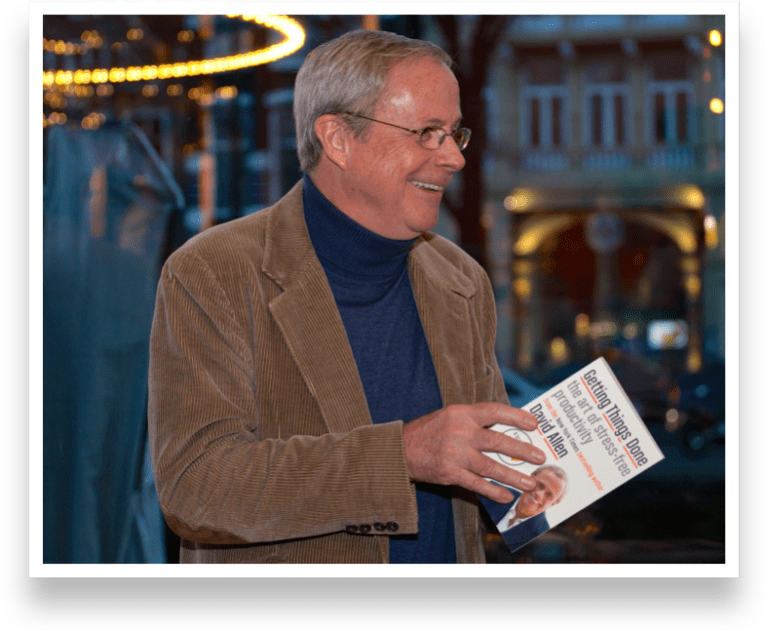
Discovering Getting Things Done by David Allen ten years ago was a huge professional turning point for me. GTD provided a way to structure work that allowed me to achieve more than I had thought possible. In fact one of the best training tools I ever purchased was a ten CD recording of a GTD Live seminar which I listened to a dozen times. Over the years I have frequently returned to David Allen’s ideas and still find a clarity of thought this is always inspiring.

If it has been a while since you read Getting Things Done, or maybe have yet to open it, I highly recommend this interview with David Allen on Medium. He covers a lot of the basics of the GTD philosophy and how to apply it. For example:

These are the 2 elements of productivity:

  1. What am I trying to accomplish?
  2. How do I allocate resources, attention, and activity to make that happen?

They’re not automatic decisions. No email will tell you outcomes or actions. No thought you wake up with tells you that. You actually have to sit down and think and use your cognitive muscle. Put yourself through this thought process.

Later on in the interview he discusses priorities and clears up misconceptions around how they are set.

You’re making priority decisions every moment. Now you are talking to me, that is your priority. And that’s the best thing you can be doing right now. Otherwise, your head would be totally somewhere else.

If you’re always thinking about priorities … I’m not saying to not set priorities, but don’t try to oversimplify that and give yourself some formula that determines your purpose, your core values, your vision in where you’re going. The goals you need to accomplish, the things you need to manage and maintain to make sure you’re healthy.

Read the full interview to learn more.

Second Brain Myths

Forte Labs signature course, Building a Second Brain is one of the best ways to get your digital life under control. Through a combination of simple practices it is possible to create a great online resource for all your notes that will enhance your creativity and improve your productivity.

However, there are many misconceptions on what it means to Build a Second Brain. In a recent post on his web site, Tiago Forte explores nine of them. For example, one of the issues he lists is a concern that doing this work will require a major overhaul of a person’s digital life.

Tiago explains:

This couldn’t be farther from the truth. A Second Brain is adaptive, like a living organism – messy, organic, and highly adaptable. Just like your first brain, a Second Brain has natural “plasticity,” with many ways of accomplishing any given task. When one part of your system is missing, another part can adapt and evolve to make up for it.

In the 4 steps of my CODE framework – Capture, Organize, Distill, Express – any incremental improvement immediately makes a difference, whether or not the other parts of the system are already in place. You don’t have to wait for each of the pieces to work in perfect harmony to start producing value.

To learn more about the power of Building a Second Brain and to clear up other misconceptions, please read the rest of the article.

Shortcuts are the Long Way Round

Let’s face it, work can be hard. Faced with the burden of putting in long hours to perfect a skill many of us search for ways to shorten the time. Some of these approaches are useful. From my own experience learning GTD was a great shortcut to being more productive and it helped clear my head to make better decisions. However, not all shortcuts are created equal. In fact, some are a waste of time.

In an article on his web site titled Focus On Your Skills—Not On Finding Hacks, Darius Foroux shares from his experience how searching for shortcuts to success can never replace building skill in a discipline.

Look, one thing I can share from personal experience is that building a business or career is HARD. It takes a lot of time and energy to learn new skills so you can provide value

And trust me, I’ve tried to look for shortcuts and hacks over the past ten years. Maybe I’m missing something those geniuses are selling, but I can’t find it. To be sure, I’ve connected with many successful entrepreneurs over time.

I’ve been very lucky with my father, who’s a successful businessman himself. Through him, I met many people who’ve done well for themselves and their communities.

And every single one of them said the same thing. There’s no way around hard work.

He goes on to share what he claims is the least exciting advice in the world.

Keep yourself to a very high standard. Ask yourself: “Am I proud of the work I’m delivering?” 

Whether that’s in your creative or professional work, don’t settle for “meh” work. It doesn’t have to be the best in the world. It just has to be your best. That will do two things for you.

It will help you to improve. And it will help you to value your own work. 

Read the full article on Foroux’s web site.

Don’t Worry about FOMO! Live the JOMO lifestyle!

Have you ever had the experience of wondering if you are missing something important? Have you ever been concerned that other people are doing something that you need to know? Have you ever had a potential heart attack when you noticed that your phone is in another room and you may have missed a call or text? Welcome to FOMO – the fear of missing out. It drives people to constantly check their messages and social media feeds to see if important things are happening around them. Most often nothing is, but the fear drives people to compulsively worry about it!

The folks who developed Basecamp understand this concern. That is why they propose living your life in a state of JOMO – the joy of missing out. As they describe in their book, It Doesn’t Have to be Crazy to Work Here, authors Jason Fried and David Hansson share the philosophy of JOMO on pages 70-71.

People should be missing out! Most people should miss out on most things most of the time. That’s what we try to encourage at Basecamp. JOMO! The joy of missing out.

Later on they clarify why it is a part of their company’s culture:

Because there’s absolutely no reason everyone needs to attempt to know everything that’s going on at our company. And especially not in real time! If it’s important, you’ll find out. And most of it isn’t. Most of the day-to-day work inside a company’s walls is mundane. And that’s a beautiful thing. It’s work, it’s not news.

I invite you to give it try. Resolve to focus only on what is truly important in your job and life. Let the Twitter feeds and gossip slide by without a second glance. Give it a week then see if you feel more relaxed and focused. If so, then you are now living the JOMO lifestyle!