
You may be familiar with the term “social capital”— the concept commonly used to measure people’s relationships and networks. It has been used for many years as a way to emphasize the importance of people in an organization or community. While this concept is important, what has often been overlooked is the public space that people need for this interaction to take place, known as the Social Infrastructure.
Social Infrastructure is featured in a recent Atlantic article titled, Worry Less About Crumbling Roads, More About Crumbling Libraries. As author Eliot Klinenberg writes:
 “Public institutions, such as libraries, schools, playgrounds, and athletic fields, are vital parts of the social infrastructure. So too are community gardens and other green spaces that invite people into the public realm. Nonprofit organizations, including churches and civic associations, act as social infrastructure when they have an established physical space where people can assemble, as do regularly scheduled markets for food, clothing, and other consumer goods.”
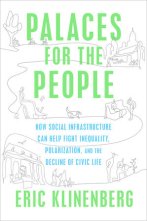
Read the rest of this fascinating article on the Atlantic’s website. If you enjoy it, look for Klinenberg’s book, Palaces of the People: how social infrastructure can help fight inequality, polarization, and the decline of civic life at your local library.
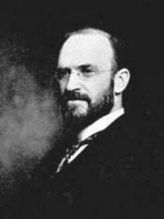 “He was a zealous librarian celebrity, famously arrogant, and completely committed to the idea that the public could only improve themselves if they understood and embodied Christian morality. Dewey could provide this education with books, which would “elevate” them through a system of ideologically coordinated public libraries. When shown the foundation of Western literature—ran the logic—readers would understand how society functioned as well as their place within it. The result would be literate but passive components of a capitalist machine. Public libraries would be its oil.”
 Why do I use the word “efficient” to describe this path of librarianship? In my article,
  Last week, my article on
  The other day I received the following email from
  The
The  Are you traveling to Philadelphia this month for the
 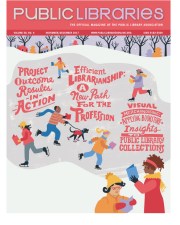 An Efficient Librarian creates clean edges to her work. It all starts with an organized desk and a clearly defined physical inbox to identify new input. One habit-changing practice is to empty the inbox regularly and use it only to place new items that have yet to be processed. An Efficient Librarian pays attention to how time is spent and looks for ways to declutter surroundings and simplify systems. For me, mastering workflow and creating systems that were tight, clean, and quick was a key to my transition. I believe that the application of these principles saves me weeks of time every year to focus on creative and exciting work that takes me along new innovative paths. This unleashing of energy is needed to revitalize our profession in the face of changing times.
 Efficient Librarian