
Over the past four years of my GTD practice, I have found that the most challenging idea to consistently apply is keeping an up-to-date project list. David Allen has often stated that this is the hardest list to maintain, but conversely one of the most important to keep. Below is an excerpt from an article he wrote a few years ago:
 “People started keeping calendars a century ago. Why? Because life’s time-based commitments got more complex than they could trust their mind to manage. If you think that a Projects list is unnecessary, then throw away your calendar and trust life will just let you know what you should be doing, in the moment. Good luck. If you decide you need a calendar, then keep a list of your projects you’re committed to completing, as well as appointments to keep. Otherwise you’re intellectually dishonest.”
Read the rest of the article on the Getting Things Done web site.
 One way to move a project forward is to pose a simple question – what is the next action? Each project on your plate requires a physical action to move it forward, such as making a phone call, writing an email, drafting a memo, walking down the hall to visit HR, cleaning a cabinet, etc. The question forces you to get real about the project by making it solid and tangible in your mind. It can create momentum that will move the project to completion.
 “I assert that it’s actually less effort to maintain your email inbox at zero than to maintain it at 300 or 3,000. Will it take effort? Of course. But there is gold to be mined there with a trusted practice that will have ripple effects across your workflow and motivation.
 “I was taking a cycling class one time and the instructor made a comment that intrigued me. Between intense bursts of climbing hills she said, ‘recovery builds confidence and strength.’ Whereas part of me wanted to keep a fast pace and just keep going, I took her advice, slowed my speed down to rest my legs and heart. I was stronger on the next hill I climbed. OK–so you knew there’d be something GTD in this: the Weekly Review is recovery. It’s my time to relax my mind and body from the frantic pace of the daily grind. It builds confidence in my system letting my mind know it’s OK to relax and be creative. It gives me mental strength to make better choices because I’m seeing a clear picture of everything instead of chasing after latest and loudest.”
 Having everything that is actionable in one place creates a simple menu of items that can be worked on whenever time allows. It creates efficiency because there is no longer a need to search around your work space for actionable items. The clarity of mind that comes from knowing where all your actions are stored is priceless.
 “Over the years many people have reported “transformational” experiences in working with the Getting Things Done® methodology. I have seen people lose pounds in just a few days, their faces brighten, their countenance and attitude swing way to the positive, and even make tremendous shifts in how they think and work for the rest of their lives.
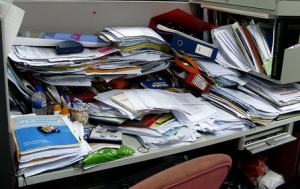 Now I understand that a clear desk leads to peace of mind, which in turn becomes an outlet for creativity and productivity. In one of his Ted Talks, David Allen uses an example of cooking. If a chef wants to make a beautiful and inventive dinner for her guests, it is very challenging to do it in a messy kitchen. Likewise, if you wish to have a creative and productive office space, a clear desk is vital. The clear surface of your desk allows you to spread out the project you are working on to find new ideas and solutions that were not evident before. Filing away anything that is not relevant to the task at hand allows your mind to focus distraction free.
 may have already discovered that your head is a crappy office space. David Allen often says that if you have something saved only in your head, you are going to give it far more attention then it deserves. Our mind can only effectively hold onto one item at a time in its conscious memory. Once something new comes to its attention, the odds are your mind will drop the previous item. This creates huge inefficiencies and potential ticking time bombs if the item that was lost has the potential to blow up later.
 Efficient Librarian