A Neuroscientist’s Advice on Productivity

There are many factors that affect our productivity. However, they all come back to the fact that knowledge works happens in our brains. Therefore, a healthy brain should enable us to get more things done. To that end, what does the field of neuroscience say about productivity?

In a recent article in Science Focus, neuroscientist Dean Burnett discusses the connection between the brain and knowledge work. Specifically, he lists five tips to be more productive. The first one highlights the beneficial effect of background music.

When we’re trying to focus on a task, our conscious attention is occupied, but can still be diverted by the unconscious system. And if we’re in complete silence, any creaks or sighs or murmurs or other random sounds stand out more, meaning our unconscious attention is more likely to be distracted, which hinders our productivity.

But, if we play music in the background, it masks obtrusive noises and occupies our unconscious attention, like giving a bored child a toy to play with while you’re trying to work. Obviously, the type of music will make a difference. Things with lyrics aren’t as good because our brains are more stimulated by linguistic information, and music that has a negative impact on mood can sap motivation.

Discover the other four tips by reading the full, and fairly short, article.

Building a Second Brain Now Released

After many years of anticipation, Tiago Forte has released his book, Building a Second Brain. It is the distillation of the ideas and exercises originating from his signature course of the same name. Here is how Tiago introduces the book on his web site:

What if you made use of the ideas, wisdom, and resources available to you online instead of stockpiling and hoarding information with no end in sight? 

What if you knew with total confidence that you could find the information you need when you need it instead of wasting time looking for notes you swore you’d saved? 

What if you could leverage technology to think better, clear your mind, and get more done instead of letting it disrupt you with constant notifications and demands? 

All this and more is possible with a Second Brain – a trusted place outside your head where you can collect and organize your most important ideas and insights and use them to do your best work.

As part of his promotional tour, the Palm Beach County Library System is honored to host Tiago for a virtual meet the author session on July 14, 2 pm EST. Preregister to receive the Zoom link.

Congratulations Tiago on this great achievement!

Tips for Better Writing

Do you like to write?

Much like public speaking, many people feel uncomfortable writing for public consumption. However, for almost any kind of professional career, being skillful at writing is an asset. Thankfully there are very simple ways to improve your writing ability without enrolling in a course.

In a recent article on his web site, Darious Foroux lists 15 brief tips that anyone can use to improve their writing. The first one is the simplest of all:

Keep It Brief – Short writing forces you to be clear. Because our thoughts are usually abstract and all over the place, our writing tends to be the same. You can avoid that by always aiming to be as brief as possible.  

That tip is especially true for business writing, since most people want to get to the point quickly to complete a task or project. Another tip that can be applied immediately is to: Be Direct.

Say what you want, mean, or feel. Avoid leaving things open to interpretation because that only annoys people. We can often be more direct in our writing than in real life. When I teach these types of writing lessons in my video course, I don’t need to be this direct because I can use my voice, facial expressions, and examples to make my point. But when we write, we only have our words. So make them count. 

Learn about the other writing tips on Foroux’s web site.

Second Brain Summit

Some very exciting happened this past week. The first ever Second Brain Summit was held online! Tiago Forte of Forte Labs brought together a series of speakers to excite and educate everyone on how to build a second brain and maximize its potential.

Here’s what Tiago had to say in a recent email:

Incredibly, we had over 12,300 live participants across 15 sessions led by 18 experts and thought leaders. Thank you to everyone who made it possible.

This week you learned:

  • How to avoid self-sabotage in your productive efforts
  • How to apply a “systems mindset” to your life
  • How to reframe productivity through the lens of ADHD
  • How to use apps like Notion, Logseq, Evernote, and OneNote
  • How to automate your notetaking using tools like Readwise and Matter
  • Insights into the future of digital notetaking
  • How to use “meta” thinking and adopt “habits of learning”
  • How to choose the perfect productivity app for you
  • How to appreciate the inherent joy of thinking
  • How to leverage your Second Brain to do your highest value work

And you know what? In case you missed anything, we’ve made every recording available on a YouTube playlist you can revisit and watch anytime.

Learn more about Building a Second Brain at the Forte Labs web site.

Personal Productivity Stacks

We rely on a wide range of technology to get things done. However, if we don’t apply the right tool in the right way, we can end up undermining our efforts. To avoid this problem we need to spend time understanding the structure of knowledge work. This will guide us to use the right tool the right way for better results.

Tiago Forte has thought deeply about how to be more productive and creative at the same time. In a recent posting on his web site called How to Build Your Personal Productivity Stack, he discusses how technological change can both make our work easier and more frustrating.

Each wave of technology does legitimately solve a new problem from the previous wave, and – if harnessed correctly – can move us closer to our goals: the experiences and feelings that we want more of. 

But if you’re like most people, you’re probably using email for multiple purposes far beyond what it was designed for:

  • You use email to send messages
  • You use email as a to-do list
  • You use email to keep track of notes and ideas
  • You use email to manage complex projects and areas of your life

These are extremely different use cases, and using one platform for all of them ensures it fails at all of them.

To be more effective, Tiago breaks down the four key components of knowledge work.

To perform each of them effectively, you have to break apart each of the four essential activities of modern work – Email, Task Management, Notetaking, and Project Management – and use the right tool for each of those jobs.

I call these four functions a “Productivity Stack,” since each one is layered on top of and builds on the one before.

To learn more, read the rest of his post on the Forte Labs web site.

Time Hack: Choice

The old saying goes that everyone gets the same 24 hours a day. What we do within that time shapes our life. While large parts of our day are spent sleeping and working, there are hours where we get to pick our actions. In a recent article on MIT Press, author Michelle Drouin notes that the average amount of available leisure time has increased. However, there is one activity that dominates this free time.

The average American spends 22 minutes a day participating in sports, exercise, and recreation; 32 minutes per day socializing or communicating; and 26 minutes per day relaxing or thinking. In contrast, they spend 211 minutes per day watching TV. That’s 2.6 times more time watching TV than exercising, relaxing, and socializing combined.

Photo by Burak Kebapci on Pexels.com

This huge devotion to screen time limits our productivity and also makes us unhappy. In order to get out of this rut, we need a new tool.

But research also shows that by taking steps to make sure our social compromises are our own choices — not based on the way technology makes us feel — we can employ the best time hack of all. It’s called social economizing, and it means we make active decisions about how we spend our time, and we then save and invest our time where we want.

To learn more about how this hack works, I encourage you to read the rest of the article.

As well, check out Michelle Drouin’s book Out of Touch: How to Survive an Intimacy Famine.

Konmari Approach to Gift Giving

It’s the holiday season and between thoughts of mistletoe and colored lights, most of us are shopping for gifts. However, gift giving can be very stressful. Will it fit them? Will it work in their home? Will they even like it? How do we make better choices when it comes to selecting gifts?

Marie Kondo has ideas on how to choose gifts that will spark joy. For starters, she suggests thinking about the recipient’s lifestyle.

Now, before I search for a gift, I imagine what would spark joy based on the recipient’s lifestyle. I recall specific details about their daily routines, living quarters, and interests: How much space do they have? What activities do they like to do? What objects do they treasure?

Once I’ve considered the details of their day-to-day lives, I can search in earnest.

She also provides an important perspective on not getting attached to the ultimate fate of the gift.

The true purpose of a gift is to be received – whether or not it’s used and loved for years to come is besides the point.

Learn more about how Marie picks gifts on her web site.

Plus, if you want to learn more about Marie’s approach to receiving gifts, please reread my blog post on the topic from 2018.

Benefits of Relaxation

This past two years have been a stressful time. We see it in our politics, our workplaces, and even in our private lives. Chronic stress is well known to be a health hazard which is very problematic with COVID-19 still circulating in the population. With Thanksgiving a few days away, right now is a good time to dedicate yourself to purposeful relaxation.

The benefits of relaxation have been widely studied. They impact us physically, mentally, and energetically. On their website, Advent Health provides a list of ten benefits of relaxation. Here is the first one, improved concentration:

If stress begins to overpower your ability to focus, it may be difficult to accomplish even simple tasks. Relaxation techniques can help give you something else to focus on, allowing your mind a chance to clear. 

Photo by Artem Beliaikin on Pexels.com

Another important reason relaxation is very important is that it lowers blood pressure.

As your body reaches a state of relaxation, your breathing becomes slower and causes your body to slow down other functions. As your heart rate slows, your overall blood pressure lowers.

Read other eight at the Advent Health web site.

If you need some tips on how to relax, Healthline provides six simple ideas such as breathing it out and writing down your thoughts.

Finally, I wish everyone a very Happy Thanksgiving.

Can you have purpose without passion?

There is a long standing idea that if you are not excited about doing something, then it is not for you. Passion for our work is said to drive us to do it better and stick with it when we are in rough times. How true is this idea?

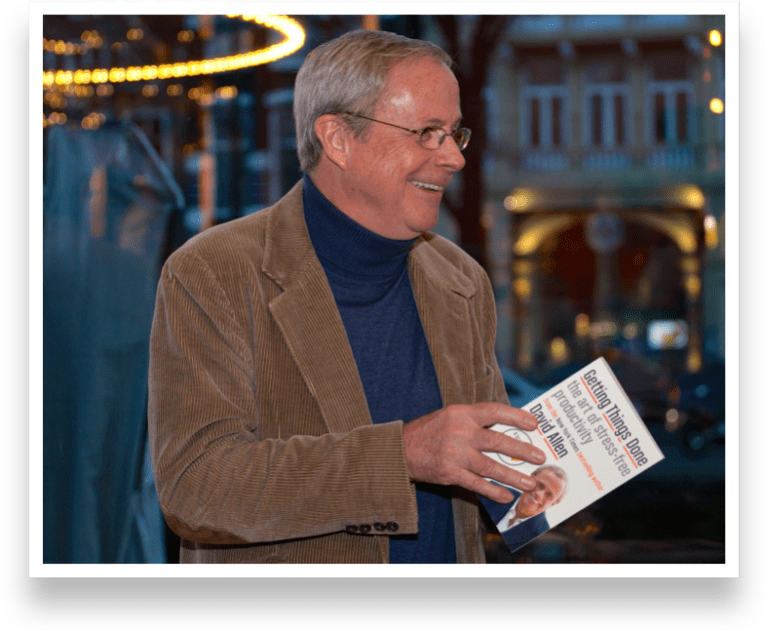
According to David Allen, passion and purpose may be misunderstood. In a recent blog post titled, Go beyond passion to peaceful purposefulness, he shares thoughts about the connection between the two. To begin, he points out his resistance to passion.

I have been attempting to understand why it bugs me to hear professional motivators talk about the necessity for “passion” to be successful. Perhaps I’m just getting too old and lazy to be interested in jacking up my emotions about anything. (Getting passionate about something usually seems to me like hard work.) Or perhaps it’s the fact that jacked-up emotional states are not something you need or even want, to be successful.

Instead of passion, Allen shifts the mindset to the concept of identification.

I think I know what the motivators are referring to. There is a quality of intensity of commitment that resides with successful people. But rather than “passion” I would suggest the word “identification.” When you really identify with something, whether it is some intended outcome or some internal standard about your reality, it creates a true motivational energy to make it happen. But that does not at all mean a hyperemotional state.

Read his full post on the Getting Things Done web site.