Keeping Your New Year’s Resolution

new year resolutionWelcome to 2018!  Let me ask you a question.  Did you make a New Year’s Resolution before the ball dropped in Times Square?  According to a Forbes article from a few years ago, more than 40% of Americans make a resolution, but only 8% achieve it.  The article provides four timeless tips for succeeding with a new resolution:

  • Keep It Simple – Make it short and easy (i.e. lose 10 pounds by May)
  • Make It Tangible – Set clear actions (i.e. attend 2 classes at the gym per week)
  • Make It Obvious – Chart your progress (i.e. count calories and minutes worked out)
  • Keep Believing You Can Do It – Don’t Give In!

When you think about it, most resolutions are about making a new habit or changing an existing habit.  Charles Duhigg, author of The Power of Habit, provides a free resource on his web site with helpful hints on keeping a New Year’s Resolution.  You can find it here.

I wish you a productive and efficient 2018!


Interview with Tiago Forte

forteThis past year I have been studying the work of Tiago Forte, a San Francisco based productivity consultant.  Tiago has been building on the work of David Allen to find ways to enhance the ability of knowledge workers to manage projects and build productive workflows.

In an interview on the podcast, This is Product Management, Tiago presents key concepts such as the development of “meta-skills”, finding focus in any environment, and forming new habits.  From the podcast web site:

“Tiago’s approach builds on Allen’s system, applying the latest tools, and accounting for the challenges modern knowledge workers face. Tiago’s approach helps busy people use their brain for thinking instead of storage, break projects into actionable next steps, implement the right tools, and build habits to get work done.”

The interview runs for 35 minutes, but the web page with the podcast provides a handy highlights section if you want to jump to a specific topic.  It is well worth a listen.

Interview with David Allen

gtdcoverReading David Allen’s book Getting Things Done was a key professional development moment for me.  It transformed my understanding of knowledge work and allowed me to bring organization to my office for the first time.  I would not have achieved my current level of success without the principles outlined in the book.

So who is this man behind the GTD® logo?  The web site, Early To Rise, recently interviewed David Allen to learn more about his background, how he developed the core GTD® concepts and his current personal goals for this work.  Here is an excerpt from the interview where David is asked about how the Getting Things Done philosophy fit into professional training programs that were around twenty years ago.

What was your specialty exactly?

It really became how to create more space in the mind and get rid of distractions. That was just an informal approach, but an HR rep showed up to one of my workshops at one point and flat out said we need more of my methods in society. Not long after, I did a presentation for Lockheed with these methods and it hit a nerve. That’s when I knew I had something unique.

You can find the full interview on the Early To Rise web site.

Are You Overdue for a Weekly Review

overtop-desk-photoWhen did you last do a complete weekly review?  Work life moves fast, so it is important to take time to reflect on what has happened and what is coming soon.  The weekly review is a valuable opportunity to tidy up loose ends, assess progress, and prepare for the upcoming week and months ahead.  It allows for a refocusing of attention onto the things that matter instead of the latest and loudest.
A few tips for a successful weekly review:

  • Schedule it for the last day of your work week in order to enter your weekend with a clear head.
  • Block out 1-2 hours.  Close the door and ask your colleagues to honor this time of solitude.
  • Get clear – Process any last minute items that have found their way into your inbox  and do a quick mind sweep to empty out anything found only in your head to get it into your system
  • Get current – Tidy up your action folders, identity outstanding waiting for items, review your calendar going two weeks back and then as far forward as necessary.
  • Get creative – Review your someday/maybe folder for new projects to trigger, peruse your read/review pile, and reflect on the higher horizons of focus to gain perspective on your work.

To modify an old saying, a weekly review today keeps workplace stress away.  Try it and experience the difference it makes.

Work/Life Balance Myth

davidallenIt has long been proposed that one of the secrets to a happy life is finding a work/life balance.  This is a magical equation where the right mix of meaningful work offset by an exact amount of normal life activity equals contentment.  However, is this really as true as it seems?
In a recent blog post, David Allen discusses this topic and comes to his own conclusions.

“There’s not really work/life balance, there’s just balance. I mean, work is anything you want to get done, right? It doesn’t have to be pejorative. Having a good vacation can be work. Just think of the affirmation: Wow, this really works! Is that a bad thing?”

Read the rest of his blog entry on the Getting Things Done web site.

Head in the Cloud

There is an amazing paradox happening right now.  Due to the massive growth of the Internet, people have access to more information at their fingerprints than can ever be consumed in a thousand lifetimes.  However, it seems as if misinformation and lack of understanding are proliferating just as quickly as new Facebook accounts are activated.  In fact, people almost seem to have a worse understanding of the world than their pre-Internet grandparents had!

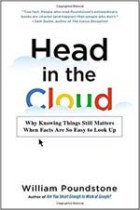
headinthecloudIn this book, Head in the Cloud, author William Poundstone explores the question of whether all this online information is only serving to make us less informed.  Online information is easier to skim, but hard to dive into deeply.  Poundstone specifically highlights a phenomenon known as the Dunning-Kruger effect which can lead people to overestimate their own level of knowledge in a subject area.

“Those most lacking in knowledge and skills are least able to appreciate that lack.  … The Dunning-Kruger effect requires a minimal degree of knowledge and experience in the area about which you are ignorant (and ignorant of your ignorance).” (p.10 & p.12)

In short, a little bit of knowledge can be a dangerous thing.

Read more by picking up a copy of the book from your local library.

The Life-Changing Magic of Tidying Up

The basic idea of organizing is to get rid of stuff you don’t need, and then place the items to keep in an appropriate spot out of the way where they can be found again when needed.  However, mental attachments to our belongings can trick us into retaining items long past their usefulness or value, which leads to clutter and confusion.

mariekondoIn her best-selling book, The Life-Changing Magic of Tidying Up, Marie Kondo created a systematic approach to organizing home and office spaces that can be quickly implemented by anyone.  While most people read the book for the nuts and bolts of how to organize a closet or drawer, the book shares a deeper Zen-like philosophy which resonates beyond the mere allocation of our stuff.  Marie calls it the KonMari Method™.  From her web site:

The KonMari Method™ is a way of life and a state of mind that encourages cherishing the things that spark joy in people’s lives.

Belongings are acknowledged for their service and thanked before being let go of, if they no longer spark joy.

People are drawn to this philosophy not only due to its effectiveness, but also because it places great importance on being mindful, introspective, and optimistic.

See more at her web site Konmari.com and check out the book from your library.

Are You Micromanaging Your Mind?

One of the greatest challenges in setting up a new organizational system is the transition to trusting it.  Yet it is hard to trust a new system until it has proven itself.  This is often a Catch 22 that tends to result in the return to old habits and systemsdavidallen.

In his most recent blog post, David Allen highlights this challenge.

“If you don’t fully trust your personal systems, you are likely to be dedicating inappropriate and unnecessary mental attention to details and content, often with a resultant negative emotional component. You’ll feel pulled, overwhelmed, and often like you’re close to losing control.

“But you can’t trust your system until it’s trust-worthy. When is that? When you know you have captured all your commitments, clarified what you’re intending to do about them, decided the actions you need to take about them, and have parked reminders of those actions in places that you know you’ll look, where and when you need to.”

Read the full blog post at GettingThingsDone.com.


What makes us feel good about our work?

Why do we go through the trouble to get up every weekday to commute to work?  Sure we need the money and it can be fun to spend the day with our coworkers.  However, are their motivational factors that make the difference when it comes to committing ourselves fully to our jobs and businesses?

danarielyThis is a question of great interest to behavioral economist Dan Ariely.  So much so that he did several experiments which aimed to probe deep into how people assign value to the work they do.  The results of the experiments were shared in a TED Talk.  From the video description:

What motivates us to work? Contrary to conventional wisdom, it isn’t just money. But it’s not exactly joy either. It seems that most of us thrive by making constant progress and feeling a sense of purpose.  Behavioral economist Dan Ariely presents two eye-opening experiments that reveal our unexpected and nuanced attitudes toward meaning in our work.

Click here to watch Dan Ariely’s TED Talk.