Second Brain Summit

Some very exciting happened this past week. The first ever Second Brain Summit was held online! Tiago Forte of Forte Labs brought together a series of speakers to excite and educate everyone on how to build a second brain and maximize its potential.

Here’s what Tiago had to say in a recent email:

Incredibly, we had over 12,300 live participants across 15 sessions led by 18 experts and thought leaders. Thank you to everyone who made it possible.

This week you learned:

  • How to avoid self-sabotage in your productive efforts
  • How to apply a “systems mindset” to your life
  • How to reframe productivity through the lens of ADHD
  • How to use apps like Notion, Logseq, Evernote, and OneNote
  • How to automate your notetaking using tools like Readwise and Matter
  • Insights into the future of digital notetaking
  • How to use “meta” thinking and adopt “habits of learning”
  • How to choose the perfect productivity app for you
  • How to appreciate the inherent joy of thinking
  • How to leverage your Second Brain to do your highest value work

And you know what? In case you missed anything, we’ve made every recording available on a YouTube playlist you can revisit and watch anytime.

Learn more about Building a Second Brain at the Forte Labs web site.
You Don’t Need More Content … Yet

Yesterday I finally subscribed to Netflix. Given that the streaming service already has 75 million subscribers in the US alone, it felt like I was the last one to sign on! Why did I wait so long? Quite frankly, my family has subscriptions to Disney+, Discovery+, and HBO Max. Between all three of those services I have enough movies and TV shows to keep me busy for three lifetimes of endless viewing. I resisted Netflix because I didn’t need more content.

As a trainer in productivity, leadership, and libraries, it is tempting to load up presentation with content. This is a useful approach when doing an introductory seminar or presentation. However, I have come to believe that most trainers focus too much on content delivery and not enough on integration. In short they sacrifice the cultivation of knowledge for the sake of information overload.

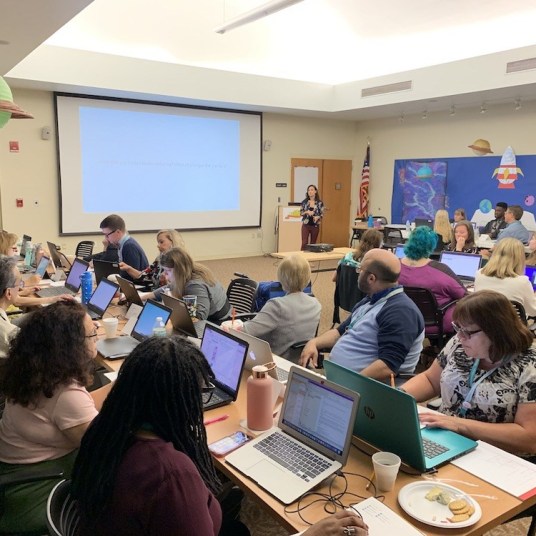
This insight came to me while developing a leadership clinic for TBLC, a Florida library cooperative. For weeks I struggled to decide what content to share with the students during the 2.5 hours of training. After picking and discarding many different ideas, I fell back to a training approach I learned years ago. The concept divides training into four sections:

  • Content Delivery
  • Written Component
  • Small Group Reflection
  • Large Group Share

Based on this model, delivering content is only a quarter of the learning experience. The other three components are designed to allow participants to integrate the information into their own experience. By offering students time for quiet written work, such as answering a question, they begin to wrap their mind around the material. Through communication in small groups followed by large groups, knowledge is deepened through conversation. By the end of the four sections, the student should have a strong understanding of the material and how it impacts their lives.

At the leadership clinic, the students spent a third of their time in breakout rooms. The conversations were deep and honest. In fact, the students afterward said they wanted more time in the rooms than we had available. Many stated how useful it was to talk through their issues and identify points of resolution.

Whenever you feel you need more content, it may actually be time to reflect on the information you already have. Only after you identify gaps in your knowledge is it time to seek more information.

The moral: Don’t go looking for more content, at least not yet …

Finding Your Leadership Pathway – a PLA PreConference

Are you planning to attend the Public Library Association Conference in Portland OR or live in the vicinity? If so, why not brush up on your leadership skills by joining me and a team of great leaders for a full day pre-conference session, Finding Your Leadership Pathway.

Our presenters include:

  • Lynn Hoffman, Director of Operations, Somerset County Library System of New Jersey
  • Isaiah West, Teen Services Specialist, Prince George’s County Memorial Library System
  • Derek Wolfgram, Library Director, Redwood City Public Library
  • Douglas Crane, Director, Palm Beach County Library System

This full day event is happening on Tues. March 22, 9 am to 5 pm, at the convention center.

What to know what is in store? Read on!

Public libraries offer multiple pathways to leadership. From team supervision to directorship, and from small municipal and rural libraries to large multi-site systems, the array of options create a rich leadership landscape for public library careers. Join current and prospective leaders at all levels to share in a day of exploration, self-reflection, and networking, all focused on helping you map out your own career development journey. In addition to having ample opportunities for interaction with other participants, you’ll also hear from over a dozen diverse leaders as they talk about their own varied experiences throughout the day.

Outcome OneState their leadership value and identify the strengths they can put to the most effective use now and in the future;
Outcome TwoCommunicate with stakeholders and powerfully advocate for change within their organizations, employing strategies to make their voice heard at all levels of leadership; and
Outcome ThreeCreate a plan for sustained action that exemplifies their commitment to maintaining and building on their leadership practice

Register for the PLA Conference and add on this event for an additional charge. Lunch is included.

I hope to see you there!

Empty Inbox – Less Stress

With the high volumes of incoming email we all receive, it can be very tempting to let them pile up. In fact, most people use their inbox as a workflow management and archival system. This approach is highly inefficient and creates unnecessary stress. Thankfully, there is a simple way to resolve this problem: empty your inbox regularly.

For the past ten years I have enjoyed the clarity of an empty inbox. I was inspired to do this after reading Getting Things Done by David Allen. In the book he provides a simple approach to clearing out the inbox no matter the volume. At the core of his technique is the workflow diagram. In a way, the GTD approach is similar to a plumber who ensures that water remains flowing through pipes.

Photo by Solen Feyissa on Pexels.com

To clear any inbox, there are three important things to understand:

1 – An inbox is only for in: The best use of an inbox is to identify new messages. Once they have been read, they must leave the inbox. No skipping over items. Go through every message from newest to oldest until complete.

2 – Empty it regularly: To cope with the high volumes, it is important to clear the inbox every day. Not only does this prevent serious backlog that can impact your efficiency, it can eliminates the stress which comes when important messages are buried under junk.

3 – Create functional folders to store messages: An “action” folder will hold items you need to respond to as soon as possible. A “waiting for” folder will hold reminders of actions you are waiting for others to do. An “archive” folder will hold all non-actionable messages you need to retain. Finally, be sure to trash as much as you can early to reduce clutter.

If you want to enjoy a less stressful work life, be sure to clear out your inbox every day. I speak from a decade of experience on this point. An empty inbox is an awesome sight to behold.

Personal Productivity Stacks

We rely on a wide range of technology to get things done. However, if we don’t apply the right tool in the right way, we can end up undermining our efforts. To avoid this problem we need to spend time understanding the structure of knowledge work. This will guide us to use the right tool the right way for better results.

Tiago Forte has thought deeply about how to be more productive and creative at the same time. In a recent posting on his web site called How to Build Your Personal Productivity Stack, he discusses how technological change can both make our work easier and more frustrating.

Each wave of technology does legitimately solve a new problem from the previous wave, and – if harnessed correctly – can move us closer to our goals: the experiences and feelings that we want more of. 

But if you’re like most people, you’re probably using email for multiple purposes far beyond what it was designed for:

  • You use email to send messages
  • You use email as a to-do list
  • You use email to keep track of notes and ideas
  • You use email to manage complex projects and areas of your life

These are extremely different use cases, and using one platform for all of them ensures it fails at all of them.

To be more effective, Tiago breaks down the four key components of knowledge work.

To perform each of them effectively, you have to break apart each of the four essential activities of modern work – Email, Task Management, Notetaking, and Project Management – and use the right tool for each of those jobs.

I call these four functions a “Productivity Stack,” since each one is layered on top of and builds on the one before.

To learn more, read the rest of his post on the Forte Labs web site.

Book Bans on the Rise

In the past year, book challenges have been on the rise. It is not unusual for school and public libraries to have people contest items in the collection. In fact every year the American Library Association shares a list of the top ten most challenged books. Librarians have established procedures in place to address complaints along with collection policies to support them.

However, the recent wave of book challenges in schools and public libraries is a new breed of challenge. In a recent article by Valerie Strauss in the Washington Post titled This wave of book bans is different from earlier ones, she points out there is a particular subject matter in contention.

Now we are seeing a new wave of book bans, marked by an unprecedented number of challenges and intense polarization. Its focus: narrowing the universe of information in schools and public libraries that might challenge young people on race and gender — the same issues at the center of the political and cultural wars ripping through the country.

Photo by Pixabay on Pexels.com

What makes this round also different is that there appears to be a greater national coordination on messaging and the books being challenged.

Advocacy groups are working to nationalize book challenges, this time with the help of conservative TV and talk shows, that for the past few decades have been mostly local events. Some state legislators are threatening punitive action against anyone in schools or libraries who spreads material deemed obscene or harmful to minors. And now students, parents, librarians and school boards are fighting back, calling the push censorship.

Read the full article on the Washington Post web site.

Time Hack: Choice

The old saying goes that everyone gets the same 24 hours a day. What we do within that time shapes our life. While large parts of our day are spent sleeping and working, there are hours where we get to pick our actions. In a recent article on MIT Press, author Michelle Drouin notes that the average amount of available leisure time has increased. However, there is one activity that dominates this free time.

The average American spends 22 minutes a day participating in sports, exercise, and recreation; 32 minutes per day socializing or communicating; and 26 minutes per day relaxing or thinking. In contrast, they spend 211 minutes per day watching TV. That’s 2.6 times more time watching TV than exercising, relaxing, and socializing combined.

Photo by Burak Kebapci on Pexels.com

This huge devotion to screen time limits our productivity and also makes us unhappy. In order to get out of this rut, we need a new tool.

But research also shows that by taking steps to make sure our social compromises are our own choices — not based on the way technology makes us feel — we can employ the best time hack of all. It’s called social economizing, and it means we make active decisions about how we spend our time, and we then save and invest our time where we want.

To learn more about how this hack works, I encourage you to read the rest of the article.

As well, check out Michelle Drouin’s book Out of Touch: How to Survive an Intimacy Famine.

We’re All Alone in this Together

Organizations that are able to form reliable teams tend to accomplish more goals and provide better internal and external customer service. However, there is an unspoken tension around teams. In order for them to work effectively, everyone has to know their assignment. The distribution of work needs to be clear otherwise important items fall through the cracks.

David Allen has explored the intersection of personal productivity and teamwork. In a recent blog post he notes the following:

Have you discovered yet that no matter how big the button is that says “TEAM” you’re wearing at the conference, nobody’s on yours?! That in order to get done what you have to get done, there aren’t a lot of people at your beck and call, making sure your specific actions and projects happen? Ever have the feeling that you’ve got to hold on for dear life to your own projects and outcomes, against the hurricane of events and other people trying to get their world defined and done?

Later in the post, David considers the reason why teams fail to clarify their work.

Problem is most of us never had training or experience in dealing with that syndrome efficiently and effectively. We grew up in a world where you just went to work, and the work to be done was visible and obvious.

What is the solution to this problem? It could be as simple as acknowledging our struggles.

The best teams and relationships, from my experience, are the ones in which the players all acknowledge they’re each alone in the endeavor together. That’s when we can really experience team, and function as one.

Read the entire post on the Getting Things Done web site.

Do the Easy Stuff First?

Everyone likes to get a quick win. It would seem that disposing of small items would generate momentum to tackle larger work. However, does this tactic lead to lower productivity?

In an article on getpocket called Why Doing the Easy Parts of Your To-Do List First Can Be a Bad Idea, Stephanie Vozza argues that studies show that tackling the low hanging fruit first may dissuade you from attempting more meaningful work.

“In the short-term, the person could actually feel satisfied and less anxious,” says Maryam Kouchaki, associate professor of management and organizations at Kellogg School of Management at Northwestern University. “But avoiding hard tasks indefinitely also cuts off opportunities to learn and improve one’s skills.“

Photo by Andrea Piacquadio on Pexels.com

Part of the problem with working on easy tasks is that they are often low value and procedural, making little impact on a person or organization’s larger goals.

Finishing tasks provides a sense of progress and makes us feel good. “We all have limited time and attention,” says Kouchaki. “In any moment, if you have a choice of doing an easy or difficult task, most of us tend to pick the easy task. Easier tasks are often quicker to complete, and they are more likely to be chosen first when people are busier. We call this ‘task completion preference.’”

The problem is that when you create a habit of choosing easier tasks over hard, you can impact your long-term productivity.

Read the full article on the getpocket web site.