
Why is it that some people love their jobs and dive into their work with great energy and enthusiasm, while others slog through their work days living a life of boring desperation? Daniel Pink looked at this question in his book, Drive: The Surprising Truth About What Motivates Us.
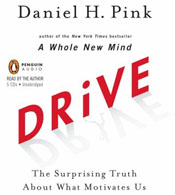 According to Pink’s study of the scientific literature, most people erroneously believe that external motivations like money and fancy benefits motivate us to do good work. The conclusion he draws is that what truly motivates us is the ability to direct our own lives, learn new things, and improve the lives of the people around us. Pink provides examples of ways to improve your own level of drive. His book also identifies different ways that organizations can use self directed motivation to inspire their workforce in ways that the old approach of carrots and sticks was never able to do.
For more information, check out his book from your local library. Also, visit Dan’s web site to watch videos, subscribe to his newsletter, and learn more about his research.
 One way to move a project forward is to pose a simple question – what is the next action? Each project on your plate requires a physical action to move it forward, such as making a phone call, writing an email, drafting a memo, walking down the hall to visit HR, cleaning a cabinet, etc. The question forces you to get real about the project by making it solid and tangible in your mind. It can create momentum that will move the project to completion.
 “I assert that it’s actually less effort to maintain your email inbox at zero than to maintain it at 300 or 3,000. Will it take effort? Of course. But there is gold to be mined there with a trusted practice that will have ripple effects across your workflow and motivation.
 For example, if inbox zero is your goal then keep track of the number of messages in your inbox at the end of the day when you leave work. If you want to be faster at the computer, track and record the number of words you can type per minute. To keep your commitments under control, maintain an accurate project list, count the projects on it, and discover the maximum number of projects that your stress management can handle at one time. In short, if you have meaningful productivity goals ask yourself how to measure progress because, “If you don’t measure it, it must not be important.”
 very system has one bottleneck tighter than all the others, in the same way a chain has only one weakest link.
 “I was taking a cycling class one time and the instructor made a comment that intrigued me. Between intense bursts of climbing hills she said, ‘recovery builds confidence and strength.’ Whereas part of me wanted to keep a fast pace and just keep going, I took her advice, slowed my speed down to rest my legs and heart. I was stronger on the next hill I climbed. OK–so you knew there’d be something GTD in this: the Weekly Review is recovery. It’s my time to relax my mind and body from the frantic pace of the daily grind. It builds confidence in my system letting my mind know it’s OK to relax and be creative. It gives me mental strength to make better choices because I’m seeing a clear picture of everything instead of chasing after latest and loudest.”
 Having everything that is actionable in one place creates a simple menu of items that can be worked on whenever time allows. It creates efficiency because there is no longer a need to search around your work space for actionable items. The clarity of mind that comes from knowing where all your actions are stored is priceless.
 For most people, the default way to take notes and plan events is very linear. On a clean page in the top left corner they start to write things down in sentences one line after the other. The drawback to this linear approach is that it is challenging to connect thoughts and ideas quickly, especially when they are separated on the page. A great alternative approach for note taking and planning is a mind map.
 reveals insights into the link between creativity and procrastination in Chapter 4, Fools Rush In. While procrastination is mostly associated with laziness, it can also be defined as “waiting for the right time.” Adam writes that “Procrastination turns out to be a common habit of creative thinkers and great problem solvers.” The trick to meaningful procrastination is that one must start working on the project or problem in question first before setting it aside. Studies seem to show that leaving open loops active can spur original thinking as the mind slowly churns away on the project or problem in the background. This process may open up creative options that might not have been found if the situation was rushed. So the next time you feel procrastination setting in, it may be a sign that you are waiting for creative options to appear, in which case, procrastinate on!
