
What is the primary purpose of an inbox?
People use their inboxes for a wide variety of things. Some use it to track their actionable items. Others use it to store important messages. Yet others, especially with email, don’t even bother moving items out of their inbox altogether! Unfortunately, these practices obscure the most valuable function of an inbox, which is to identity new content.
 Think of the light on a telephone answering machine which turns on when a new message arrives. Failure to clear the message leaves the light on which means one will never know if another message has arrived after that one. The light ceases to have a function and becomes background illumination.
The inbox is best used as a processing station to identify new content, decide what it means, and then move it along to the appropriate part of the system. When an inbox is used to store actions or reference, then every time it is checked a part of the mind has to examine all the content and reevaluate it. This is exhausting and unproductive.
An empty inbox removes intellectual clutter by forcing the separation of actionable and reference from new content. Plus, getting to an empty inbox every day is an easy win that serves to energize the workday.
Try it out – keep you inbox for “in” and notice how that changes your world.
 In fact, I highly recommend listing to one podcast in particular:
  To be clear, this curse has nothing to do with magic or ancient mystical tombs. The Curse of Knowledge is a cognitive bias that occurs when individuals are unable to ignore the knowledge they have which others do not, or when they are unable to disregard information already processed. This is the reason why an expert musician can make a lousy teacher of novices, because the expert forgets what it is like to know so little.
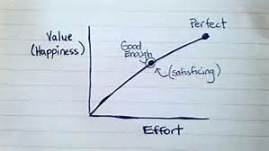 entails searching through the available alternatives until an acceptability threshold is met. (Satisficing = Satisfy + Suffice) Often this is a viable strategy since searching for the perfect product or solution would run into the law of diminishing returns where additional effort leads to fewer results. So a natural tendency is to find the first good choice and stop there. While satisficing can be a good short term option, it may result in long term inefficiencies. The quick purchase of running shoes now could produce regret over the colors and painful blisters a few days later.
 “Over the years many people have reported “transformational” experiences in working with the Getting Things Done® methodology. I have seen people lose pounds in just a few days, their faces brighten, their countenance and attitude swing way to the positive, and even make tremendous shifts in how they think and work for the rest of their lives.
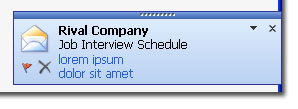 desktop email alert was a subtle yet significant distraction to my workflow. So I shut it off and found it made a world of difference to my efficiency. So go ahead, shut yours off too. Visit this Office support page to learn how:
  may have already discovered that your head is a crappy office space. David Allen often says that if you have something saved only in your head, you are going to give it far more attention then it deserves. Our mind can only effectively hold onto one item at a time in its conscious memory. Once something new comes to its attention, the odds are your mind will drop the previous item. This creates huge inefficiencies and potential ticking time bombs if the item that was lost has the potential to blow up later.
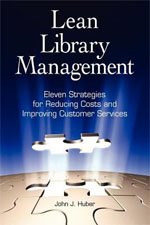 Lean Management, which began as the Toyota Production System, is a set of techniques that aims to improve any system into a quicker and more accurate one with less waste. Simply put, lean means creating more value for customers with fewer resources. It does so by empowering those who work at the front lines with decision making power while coordinating improvement opportunities across a department. While reading the book, I made many connections between this technique and GTD.
