Step One in Foroux’s method was to pick the book wisely. I choose Joy at Work. It is a follow-up to Marie Kondo’s best selling The Life Changing Magic of Tidying Up which focused on the home. My family had fun applying the Konmari principles to our house last summer, so I was curious to see how the philosophy could be transferred to the workplace. Given that I am a firm believer in GTD, I was also interested in learning how her techniques complimented and contrasted David Allen’s classic approach to getting things done.
Let’s be honest, if you search for productivity books in Amazon, the majority of titles shown in the results are written by men. Why is this so? It can’t be that men are the only ones worried about getting things done quickly and efficient. Also, what does this mean for our understanding of productivity itself? Is there something missing if only men are writing about it?
In a recent article at Forte Labs, Lauren Valdez explores this question. She believes one reason for this result is that books written by women are placed into the “organization” category. For example a search for decluttering books in Amazon produces almost the exact opposite result with women being the predominant authors. However, Lauren believes the truth runs deeper than just a matter of odd cataloging.
Productivity is not about optimizing every aspect of your life or being well-versed on the latest and most flashy new app. The point of productivity is to do what brings you pleasure and to have more freedom. We aren’t machines. We are humans.
To be productive, we all need to balance the logical, technical side with the emotional, intuitive side. These can be understood as masculine and feminine energies. I define masculine-energy as associated with logic, order, and the technical, whereas feminine energy is associated with intuition, self-awareness, and creativity.
Another way we can think about this is using the left-side and right-side of thebrain. Most productivity advice lies on the masculine side, but you need the yin and yang balance between both these energies. No matter where on the gender spectrum you fall, we all can tap into our masculine and feminine energies.
We are often our own worst enemy, as it is very easy to be enthralled by the next shiny bauble. However, sometimes it is other who distract us. The ability to focus is key to getting anything done well. There are many possible reasons for our inability to focus. In his recent article The Two Things Killing Your Ability to Focus published in the Harvard Business Review, writer William Treseder narrows down the culprits to two specific causes, our electronic devices and meetings.
First, we increasingly are overwhelmed with distractions flying at us from various connected devices. Smartphone and tablet use is spiking, and we now use digital media for an average of over 12 hours per day. This hyper-connected state does not allow us to process, recharge, and refocus.
Second, we rely excessively on meetings as the default form of interaction with other people at work. Studies indicate that we spend anywhere from 35–55 percent of our time, and sometimes much more, in meetings. If we want to stay focused on truly meaningful activity, something has to change.
How do we get around these obstacles in order to better focus? Treseder suggests several approaches. For example, to make meetings more useful he suggests we shrink the number of people in attendance.
Countless studies, starting with this 2015 HBR research, have shown the benefits of smaller teams. Focus and responsibility are more challenging with too many people — which is how you end up with folks staring down silently at their laptops for an entire meeting. To stay focused, keep your team focused. Limit the number of people in any meeting to eight or fewer unless it is a meeting that is purely informational.
Even though I am a librarian, it has been a struggle lately to read books cover to cover. Perhaps it is due to age, or the pandemic stress, or simply competing demands on my time, but sitting down with a book is not simple anymore. Yet there are still many titles I want to read for self development. What can I do?
The answer might be to follow the advice in the article How To Read A Self-Help Book In 90 Minutes by Darius Foroux. He outlines a simple four step plan to quickly identify and deploy the most useful pieces of advice from any book. For example the first step is to choose wisely:
Why do you read a book? Is it because someone recommends it? Or because it’s an NYT bestseller? Those are lousy reasons to pick up a book and invest your time in reading it.I have only 1 question that helps me to decide reading a book: Is this book currently relevant to me? In other words: Will this book help me now? If the answer is no, I don’t read it. … You can’t expect to retain the information you read forever. That’s why you want to read books that are relevant to you.
Darius Foroux
I am going to use his approach to tackle Joy at Work by Marie Kondo and Scott Sonenshein. In a future article I’ll share my summary of the key points and my experience using Foroux’s system.
Today I want to share a classic David Allen video.
When I first discovered GTD back in 2011 I searched for anything related to David Allen and his teachings. One of the most impactful pieces was a video of his first TEDx talk from Claremont College. I have lost track of the number of times I have watched it, but it always yields something new on repeat viewings.
Right off the top, David shares a central theme of GTD. It is the idea of appropriate engagement:
“Getting things done is not about getting things done. It’s really about being appropriately engaged with what’s going on. Appropriate engagement is the real key here. Many times not getting something done is the way to appropriately engage with it. … There is some key, something unique about being appropriately engaged. Why does a crisis get us there? Because it forces us to do the behaviors that get us there.”
The video is twenty two minutes, but it is time well spent. Share in the comments your biggest insight from watching it.
Just a quick post to share news about a new podcast from a thinker who has been featured on the Efficient Librarian. Tiago Forte has created a podcast series based on his signature work, Building a Second Brain. In the podcast, Tiago summarizes and explains important aspects of his work. Even better, the episodes are purposefully kept short for easy listening.
Here’s the official description:
Overwhelmed by consumption? The Building a Second Brain Podcast gives you the tools to thrive in the Information Age. Tiago Forte teaches you how to turn your notes, bookmarks and unread articles into completed creative works. Learn how to build your own “Second Brain” – a trusted place outside your head where you can collect your most important ideas and insights, and use them to do your best work. You’ll discover why many myths about the creative process hold us back, and how replacing them with a modern approach can unlock our true creative potential. You’ll be amazed at what you can create with the right frame of mind.
I have come to realize that this is a pandemic is a strange time to evaluate productivity. Our society is in a weird space were many people are over worked due to the essential nature of their jobs. Conversely, many people are now under worked due to being laid off or furloughed. It is the very few whose work continues unaffected by the disaster.
No matter where your work lies on this continuum, the changes in the world around us have an impact on our mental state. With so much of the future unknown a new definition of productive is needed. With this in mind I came across an article by Scott Young titled, “What is Productivity Guilt? (And How Can You Prevent It?)” In the piece he provides advice on how to be easier on yourself to avoid productivity guilt. For example:
Accept that you’ll always be imperfect. That’s okay. Everyone is. Nobody, including me, does everything perfectly all the time. … I go through phases where my habits evolve. Old ideas I wrote about get replaced with new ones. Not always because the new is better than the old, but because I’m always changing (as will you). If you see, instead, that everything I’ve written about is a static and permanent part of who I am, when you sum it all up, you’ll get to something that’s probably unmanageable as a whole.
Young goes on to provide the following advice when facing the specter of productivity guilt:
The real source of the guilt, however, isn’t because the standards imposed are too unrealistic or even undesirable, but because there’s always a gap between how we see ourselves and how we would like to be. The right move to make is always one that pushes you a little, but takes where you are as a starting point. That also includes your psychological strengths and weaknesses.
For people who are staying or working from home, this strange time presents an opportunity to start a new habit or finally read a productivity book like Getting Things Done. However, like any new project it can seem overwhelming at first. This can in turn lead to inertia and the old habits remaining in play.
Yet, it may not be as hard to change as it first seems. In a recent blog post, David Allen answered one of the most popular questions he receives about GTD: “Where do I start?”
I have a very strict and specific procedure that must be followed, without exception. If followed, it’s a guarantee of success. If not, well…good luck. Where, exactly, should you start? (Hang on, this is going to be tough…)
Anywhere.
Yes, anywhere. Any portion or component of the GTD approach, applied, will bring at least a bit more clarity, focus, and control for you—without exception. And very likely when any one thing is executed, it will create a reverberation effect and spread to other parts. It’s a holistic model—i.e., any piece can be worked, and it will add to the whole gestalt.
Are your ready for the next surprise? Did you know there is a surprise coming? It is inevitable that something will occur in the next week or so that you were not expecting to happen. It could be a pleasant surprise, or a shocking and jarring one, but it will happen. So, how will you handle it?
David Allen built his GTD system with the understanding that life moves quickly and we can not possibly anticipate everything that is going to happen. In a recent blog post called “Is Your World Outrunning You?” he considers how we came to this point and why systems like GTD help us navigate these fast-changing times:
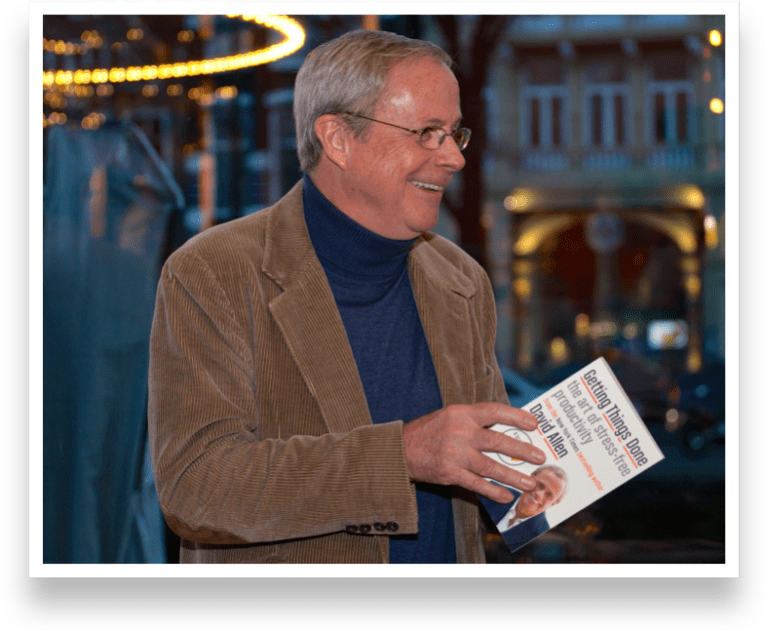
David Allen – Founder of GTD
There is nothing new in the world, except how frequently things are new, and the number of people having to accept and adapt consistently to that reality. The difference between your world and that of your parents is in how much less you can count on anything providing stability in your life and work, for any significant length of time. Perhaps your father and mother had to totally reconfigure their worlds two or three times in their adult life, if that. You might have to do that two or three times this year.
(Why is GTD successful?) Quite simply, the need people have to create more room in their heads, less stress in their lives, and more control over all the facets of life and work that now impinge on most all of us.







 Efficient Librarian