Can you have purpose without passion?

There is a long standing idea that if you are not excited about doing something, then it is not for you. Passion for our work is said to drive us to do it better and stick with it when we are in rough times. How true is this idea?

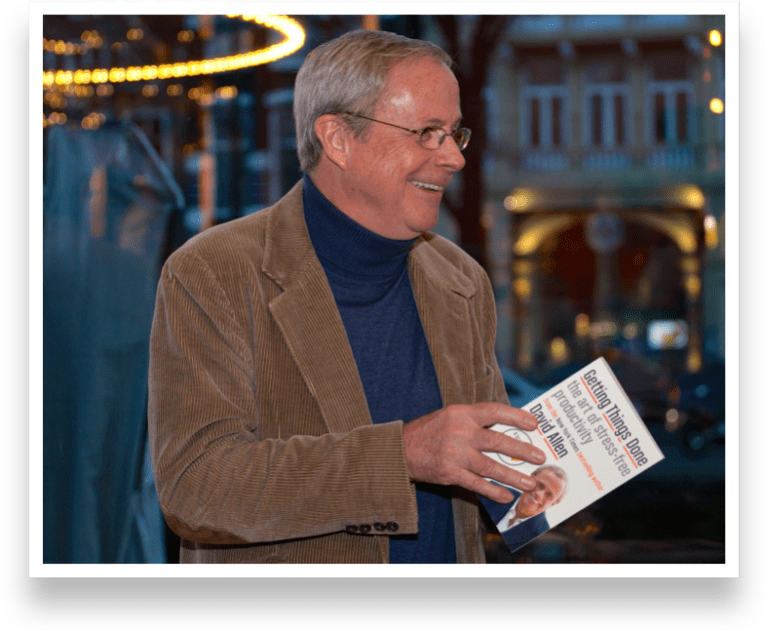
According to David Allen, passion and purpose may be misunderstood. In a recent blog post titled, Go beyond passion to peaceful purposefulness, he shares thoughts about the connection between the two. To begin, he points out his resistance to passion.

I have been attempting to understand why it bugs me to hear professional motivators talk about the necessity for “passion” to be successful. Perhaps I’m just getting too old and lazy to be interested in jacking up my emotions about anything. (Getting passionate about something usually seems to me like hard work.) Or perhaps it’s the fact that jacked-up emotional states are not something you need or even want, to be successful.

Instead of passion, Allen shifts the mindset to the concept of identification.

I think I know what the motivators are referring to. There is a quality of intensity of commitment that resides with successful people. But rather than “passion” I would suggest the word “identification.” When you really identify with something, whether it is some intended outcome or some internal standard about your reality, it creates a true motivational energy to make it happen. But that does not at all mean a hyperemotional state.

Read his full post on the Getting Things Done web site.

4000 Weeks

It is easy to think that with enough time we will be able to accomplish anything we want. However, the truth is that our days on this earth is limited. Some of it is restricted by commitments that others put upon us, but most comes from those we place on ourselves. With limited time, most of the items on our Someday/Maybe list will never be completed. This may seem grim, but it also serves as the inspiration to do great things.

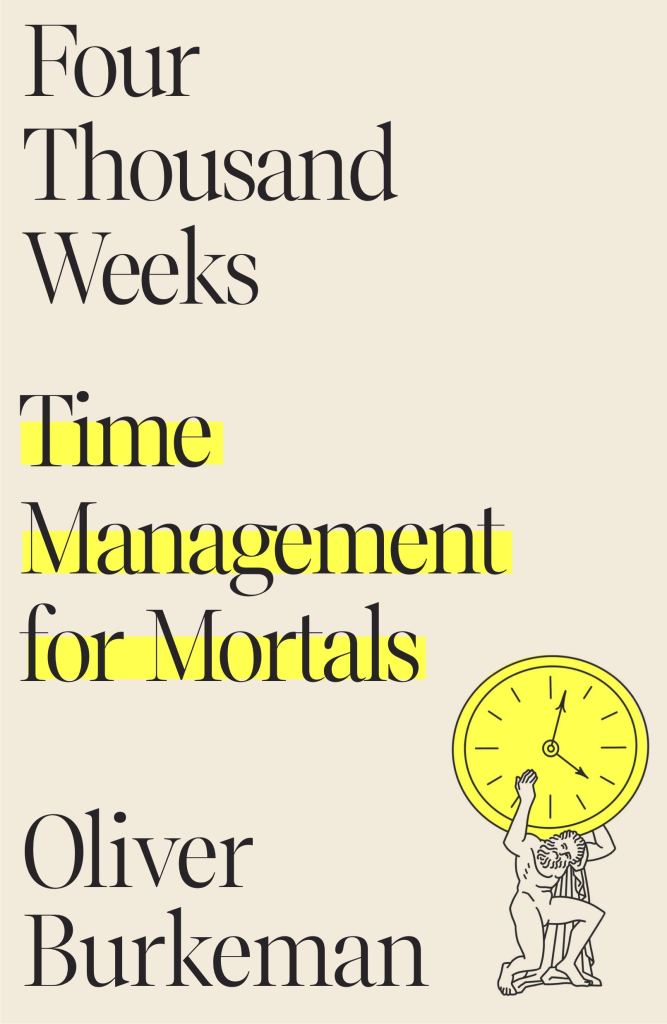
In a recent article in The Atlantic, reporter Joe Pinsker shares an interview with author Oliver Burkeman about his new book, Four Thousand Weeks: Time Management for Mortals. In the book, Burkeman states that the average life span of a person lasts around 4000 weeks, roughly to about the age of 80. With this finite perspective in place, a person can tackle the challenge of determining what is most important to them.

“The average human lifespan is absurdly, terrifyingly, insultingly short,” he writes. Given this limitation, it makes sense that the typical approach to time management is to seek ways to cram ever more into our finite number of days.

But Burkeman argues that this is the wrong way to manage time. Rather than looking outward to productivity strategies and hacks, Four Thousand Weeks encourages an inner shift in perspective. It confronts a series of comforting illusions that many of us hold onto instead of internalizing colder truths: that we will die not having done a tremendous number of things we care about; that every commitment we make to a person, place, or line of work rules out countless others that may fulfill us; that our lives are already ticking away.

Later in the article, Burkeman makes a statement that seems to sum up his philosophy.

The only way to get around to the important things is: Instead of trying to eradicate all the other stuff, [make progress] on the important stuff first. You just have to let the other chips fall where they will.

Read the full interview on The Atlantic web site.

Three Random Words

How many passwords do you have for all of your online accounts? 10, 100, 1000?

I calculated my own situation and found over 200 passwords on my list. Nowadays it seems that every web site you visit or service you use requires setting up an account with a password. On top of it, many sites have complex protocols, such as requiring numbers, capital letters, or special characters, which make those passwords hard to remember. Is it possible to find a simpler way to create passwords that are easy to remember, but hard to hack?

According to a recent article in The Guardian, science editor Robin McKie pointed to a recent study that claimed the best passwords are phrases composed of three random words. Her article begins:

It is much better to concoct passwords for online accounts that are made up of three random words as opposed to creating complex variations of letters, numbers and symbols, government experts have said.

In a blogpost, the National Cyber Security Centre (NCSC) – which is part of Government Communications Headquarters – said a three-word system creates passwords that are easy to remember. In addition, it creates unusual combinations of letters, which means the system is strong enough to keep online accounts secure from cyber criminals. By contrast, more complex passwords can be ineffective as their makeup can often be guessed by criminals using specialist software.

Photo by Pixabay on Pexels.com

Of course, many sites still have strict character requirements, but if this idea is true, we can all move away from odd rambling passwords composed of letters or numbers that are impossible to remember. Instead you can go with such combinations as: Tree-Car-Garlic; Rose-Titanic-Algae; River-Doughnut-Tornado; or Sewer-Stop-Gloat. (A random number could be added at the end if needed.)

To learn more, read the rest of the article on the Guardian’s web site.

Libraries are an “investment that’s well worth it”

Those who work and frequent public libraries are well aware of the value they provide to their local communities. However, one challenge public libraries face is getting awareness of their value out beyond their core customers. So it is always great to see a national publication or program talk about the positive role that public libraries play in their community.

On a recent episode of NPR’s Marketplace, host David Brancaccio interviewed reporter Chris Farrell about the return on investment that libraries provide to their local residents.

Photo by Pixabay on Pexels.com

Brancaccio: Well, do we know that? It’s a decent return on investment?

Farrell: Well, there’s this recent study — this one grabbed my attention — [by] three economists [from] Montana State University, Federal Reserve Bank of Chicago and Miami University. And they calculate by some measures a healthy return on investment. So among their findings, library capital investment increases children’s attendance at library events by 18%, children’s checkout of items by 21% and total library visits by 21%. Now, OK, that’s interesting, but increases in library use translate into improved children’s test scores in nearby school districts.

Read or listen to the rest of the interview online at the Marketplace web site.

Leadership Perspectives – Organizational Health

Who is responsible for the health of the organization you work for? Most people assume it is the top leader and there is lots of truth to that belief. However in reality everyone in the organization has a role to play in building a strong culture.

The ALA Learning Exchange newsletter recently published a short article I wrote about this topic. It starts out with this question.

So how does one determine organizational health? Many people think it is through the measurable outputs and outcomes laid out in the strategic plan. These can be such factors as visitor counts, circulation numbers, program attendance and more. Other factors such as employee turnover may point to job satisfaction. However, all these pieces are just a part of the equation. After all, you can have an organization that achieves its goals yet is stressed out and hostile. In the end, an organization’s health is determined by the strength of its culture. Strong cultures thrive no matter what the situation, while weak cultures disintegrate at the slightest sign of stress.

To learn more about how culture directly affects an organization, please read the rest of the article which has been posted here for your review.

Think Like a Scientist

The world is full of disagreement. Throughout our lives we encounter people who have different views from us on a wide range of topics. In some cases, these views may be held very intensely, leading to arguments, conflict, and at worst violence. If you have ever tried to change people’s minds, it can appear to be a futile process. Why is that so?

According to Adam Grant, part of the reason that disagreements are rarely resolved is because people don’t know how to engage in thoughtful debate. He argues in his new book, Think Again, that most people fall to one of three default modes of persuasion. In a recent article in Inc. magazine, contributor Jessica Stillman describes these modes this way:

Adam Grant

Preacher: “When we’re in preacher mode, we’re convinced we’re right,” explained Grant. From the salesman to the clergyman, this is the style you use when you’re trying to persuade others to your way of thinking.

Prosecutor: “When we’re in prosecutor mode, we’re trying to prove someone else wrong,” he continued.

Politician: It’s no shock that “when we’re in politician mode, we’re trying to win the approval of our audience.”

The problem with all three of these modes is that they rarely succeed in changing other person’s mind. In fact, they often create more resistance. Instead, Grant identifies a different approach to resolving disagreements.

Scientist: When you think like a scientist, “you favor humility over pride and curiosity over conviction,” Grant explained. “You look for reasons why you might be wrong; not just reasons why you must be right.”

This mode is challenging because it requires the maturity to accept that their position could be wrong. This vulnerability can become a bridge to connect people in a way that allows for understanding. To learn more, I invite you read Stillman’s article. If you want to dive deeper, please read Grant’s book, Think Again.

Think Like a Chef!

Have you ever had a day when new information, emails, and calls were flying at you in record speed? The nature of knowledge work is that we move between times of quiet and reflection to periods of rapid action. It is in those hectic times that we can easily fall behind and get flustered. So to master those busy periods it is helpful to consider another profession that works on rapid deadlines and continuous input: Chefs!

In a recent blog post, Tiago Forte examined the work environment that chefs create in their kitchens to handle the daily dinner orders. It is called mise-en-place. Tiago describes it this way.

Mise-en-place is about bringing together all the tools a chef needs in close proximity, prepped for immediate use, so that they can just execute – quickly, consistently, and sustainably.

Observing the way that chefs work to handle the flow of orders, Tiago highlights six principles that he believes can be applied to knowledge work. The first is sequence. As Tiago describes:

In a kitchen, sequence is everything.

The biochemical realities of food demand it: the meat can’t go onto the chopping block if it’s frozen; the pasta won’t absorb the sauce unless it’s been cooked; the garlic can’t be added until it’s been chopped.

In knowledge work, the importance of sequence isn’t always so clear. Does it really matter whether you send that email or write up that report first? It often feels like we should be doing everything immediately and all at once.

But consider that we can never do more than one thing at a time. The flow of time is linear, which means at some point, even our most complex thinking and planning has to get distilled down to a simple, linear to-do list: what comes first, what comes next, and what comes after that.

Once we realize the importance of sequence, it becomes apparent that not all moments are created equal: the first tasks matter much more than the later ones. In a kitchen, the few seconds it takes to start heating up a pan or start defrosting the chicken will have the biggest impact on the overall timeline, because these steps can’t be accelerated. They take as much time as they take.

Discover the other five principles by reading Tiago’s post.

Are We Reaching the End of Library DVD Collections?

DVDs have been a mainstay of library collections for the past twenty years. These little plastic discs are often the most borrowed items every year. However, as with all technology, times change to potentially render them obsolete. In this case the rise of online streaming services threatens to push DVD collections to the trash bin alongside the VHS cassette and music CD.

Last month I surveyed members of the Urban Library Council to gain insight into the future of DVD collections. The results of my findings were posted in a new article on the Public Libraries Online web site, a publication of PLA. Below is an except from the article.

An informal survey of over a dozen Urban Library Council member libraries conducted for this article shows a more complicated picture. Based on checkouts, demand for DVDs across North American libraries has dropped. For example Migell Acosta, Director of San Diego County Library (CA) reported that they “Have seen a gradual decline in DVD/Blu-Ray circulation over the past 5 years or so, but not as steep as physical music and audiobooks.” 

This drop in borrowing has local variation. In Pima County Public Library (AZ), Director Amber Mathewson noted that demand remains strong. “In one of our more affluent neighborhoods the children’s DVDs were overflowing …. Our hypothesis was that neighborhood has switched to Disney+, but other locations in our county are still circing DVDs pretty heavily.”

The situation is different in Johnson County Public Library (IN). Kelley Gilbert, Collection Services Manager reported they may need more DVDs. “DVD circulation has been really steady throughout the pandemic, and our patrons are always requesting titles that we’ve managed to miss.”

To find out more, including the perceived diversity benefits of maintaining DVD collections, please read the rest of the article.

Critical Thinking – The Smart Thing to Do

Have you ever known someone who was very intelligent, yet made dumb mistakes? Take the story of Jonah Lehrer. He was an up and coming New York Times journalist whose career collapsed after a plagiarism scandal. Then it was discovered he fabricated quotes he attributed to Bob Dylan then lied about the source. All around the world smart people fall for scams, conspiracies, and tricks. It seems that having a PhD, membership in Mensa, or honored credentials from prestigious organizations does not prevent foolishness.

Scientific American journalist Heather A. Butler explored the intersection of intelligence and decision making in an article titled Why Do Smart People Do Foolish Things? In it, she points out that intelligence is not about being wise.

The most widely known measure of intelligence is the intelligence quotient, more commonly known as the IQ test, which includes visuospatial puzzles, math problems, pattern recognition, vocabulary questions and visual searches.

Image from Pixabay.com

Butler contrasts it to the skill of critical thinking.

Though often confused with intelligence, critical thinking is not intelligence. Critical thinking is a collection of cognitive skills that allow us to think rationally in a goal-orientated fashion and a disposition to use those skills when appropriate. Critical thinkers are amiable skeptics. They are flexible thinkers who require evidence to support their beliefs and recognize fallacious attempts to persuade them. Critical thinking means overcoming all kinds of cognitive biases (for instance, hindsight bias or confirmation bias).

Butler goes on to share why it is important to understand the difference since it is hard to increase intelligence, but one can train to improve critical thinking skills. Read her article to learn more.