Why it is Hard to Get Things Done (and we don’t mean GTD)

Even though we now have far more tools at our disposal to be productive in the office, more and more people are finding it hard to actually get work done. This may seem like a paradox, but there is an important reason why this is so.

The Wall Street Journal recently published an article by Ray Smith titled, Workers Now Spend Two Full Days a Week on Email and in Meetings. In it, Smith points to a survey done my Microsoft that outlines worker’s concerns.

Researchers found that the 25% most active users of its apps—in other words, people who use Microsoft’s business software for much of their online work activity—spent an average of 8.8 hours a week reading and writing emails and 7.5 hours logging meetings.

Those figures don’t include time spent instant messaging, on the phone or in other, impromptu conversations with co-workers. In all, the average employee spent 57% of their time using office software for communication—in meetings, email, chat. The remainder of time, 43%, they used for creating things, such as building spreadsheets or writing presentations.

Photo by Andrea Piacquadio on Pexels.com

Smith shares how this workload affects a worker’s ability to think big.

In a separate Microsoft survey of 31,000 people worldwide, nearly two out of three said they struggled to find time and energy to do their actual job. Those people were more than three times as likely as others polled to say innovation and strategic thinking were a challenge for them.

The study found that despite our assumption that more communication and collaboration lead to a better outcome, it seems this is not the case. Smith points out that one of the biggest hinderances to a productive workplace comes from not setting priorities for meetings and clearly considering who should attend.

Too often, meetings are scheduled without clarity on what they are supposed to achieve, said Rita J. King, executive vice president of workplace-consulting firm Science House. “The key is to not invite someone to a meeting unless you are absolutely certain that they belong there, and you can tell them why,” she said.

Learn more about the concerns expressed in the Microsoft survey and some strategies to solve them by reading the full article.

The Best Time to Get Feedback

There is a funny paradox at the heart of creativity. Most people would prefer not to receive criticism of their work; however, the only way to know if the work is effective is to get feedback. Therefore, the question is when is the best time to solicit evaluations of your work?

According to Tiago Forte, the best time to get feedback is early in the creative process. As he wrote in a recent newsletter:

The fundamental difficulty of creative work is that we lack objectivity when it comes to our creations.

That’s where feedback becomes invaluable—a borrowed pair of eyes from a novice’s perspective. It allows us to step outside our subjective viewpoint and identify what may be missing in our work.

However, there’s a common mistake I see people make when seeking feedback: they wait too long, often investing months of effort before unveiling their work.

The trap in waiting for feedback is that you could be well down a road that leads to a dead-end, which wastes time and energy. I know from personal experience the pain of this mistake on a writing project from a few years back. As Tiago writes:

Receiving feedback on a small aspect of your work at an early stage is less confronting, allowing you ample time to make corrections.

Each bit of intermediate feedback becomes a valuable tool for refining your creation—making it more focused, appealing, succinct, or easier to grasp.

Therefore, don’t be afraid to share your work as early and often as possible.

Learn more about Tiago by visiting Fortelabs.com.

You Deserve a Break

Are you the type of person to work non-stop throughout the day? In many American offices, and some other countries too, there is a culture the emphasizes continuous work. This means employees don’t stop for breaks, lunch, or even at normal quitting time. This happens due to a belief that this non-stop work ethic makes for a more productive workplace. However, is that true?

According to recent studies, taking breaks not only leads to greater productivity, but also better mental and physical wellbeing. An article in the Harvard Business Review by Zhanna Lyubykh and Duygu Biricik Gulseren titled, How to Take Better Breaks at Work, According to Research, highlights reasons why breaks are important.

Like batteries that need to be recharged, we all have a limited pool of physical and psychological resources. When our batteries run low, we feel depleted, exhausted, and stressed out.

Pushing through work when very little energy is left in the tank puts a strain on well-being and work performance. In extreme cases, nonstop work can lead to a negative spiral: A worker tries to finish tasks despite their depleted state, is unable to do them well and even makes mistakes, resulting in more work and even fewer resources left to tackle those same tasks. This means that the more we work, the less productive and more exhausted we can become. Think about reading the same line for the fifth time, for example, and still not absorbing it.

The good news is that taking breaks can help employees to recharge and short-circuit the negative spiral of exhaustion and decreasing productivity. 

Photo by Andrea Piacquadio on Pexels.com

Since breaks are valuable, what is the best way to take one? The authors provide a few suggestions, starting with break length:

A longer break does not necessarily equate to a better break. Disengaging from work only for a few minutes but on a regular basis (micro-breaks) can be sufficient for preventing exhaustion and boosting performance. For example, workers can take short breaks for snacking, stretching, or simply gazing out of the window. Further, timing of the break matters — shorter breaks are more effective in the morning, while longer breaks are more beneficial in the late afternoon. This is because fatigue worsens over the workday, and we need more break time in the afternoon to recharge.

Read the rest of ways to optimize your break time by reading the rest of the article.

Handling Meeting Distractions

As much as people object to them, meetings are still an important part of the workplace. Meetings have the ability to disseminate information quickly and simultaneously to all participants. They also offer opportunities to discuss and elaborate on policy, process, or changes within an organization. However, meetings can also be derailed very quickly. Addressing these dead ends and distractions is vital to a productive workplace.

Luis Velasquez writing in the Harvard Business Review, recently shared 4 Distractions that Derail Meetings — and How to Handle Them. The first type of distraction are items he terms as “gravity problems.”

These occur when team members get sucked into discussing a challenge or issue that’s fundamentally unsolvable at the team level, much like the force of gravity. Trying to solve a gravity problem diverts time, mental capacity, and motivation away from solvable issues, leading to team frustration. In the previous example, company culture and leadership support are gravity problems that are distracting from the solvable issue: the product launch.

Photo by fauxels on Pexels.com

After listing three more, Valasquez provides strategies to keep meetings on task. The first one is to always determine the primary objective of the meeting.

Is the goal to make a decision, brainstorm, get people aligned, or something else? Keeping your eye on the overarching goal will help you develop a focused and clear agenda. For instance, in a decision-making meeting, the objective is to make a choice among different options. Thus, organizers must clearly understand the options, supporting data, decision-makers, and decision-making processes.

Learn about the other three distractions and more strategies on how to avoid them by reading the full article.

Florida Libraries are Fundamental to Freedom

On May 19, 2023, I became President of the Florida Library Association. At the conference in Dayton Beach, I unveiled the Presidential theme: Florida Libraries are Fundamental to Freedom. Below is the opening portion of the speech explaining the theme and how it is important to the work that libraries are doing today.

Florida libraries are fundamental to freedom.

The drafters of the Declaration of Independence believed in the essential rights to life, liberty, and the pursuit of happiness. Since 1776, our nation has struggled to apply these principles equally across all its residents in order to create that elusive more perfect union. At its core, the freedoms that Americans seek are the same freedoms supported by our libraries. Of these aspects of liberty, three specific freedoms stand out for me.

Florida libraries support the freedom to participate. In an increasingly fractious society, our buildings remain the one space where everyone is welcome. Through our libraries, residents can find all the tools and resources needed to live their lives. Whether it is using public computers to apply for benefits, meeting neighbors at a children’s story hour, or to register to vote and actually vote, libraries remain central to our communities. Eric Klinenberg in his book, Palaces for the People, states that a founding principle of libraries is, “that all people deserve free, open access to our shared culture and heritage, which they can use to any end they see fit.”

Read the full speech found on the Efficient Librarian website.

An AI Answers Second Brain Questions

Every day we heard of a new use for AI. Whether it is to assist with travel planning, exercise routines, or writing resumes, the applications seem without end. In prior postings I shared experiments with the most famous AI on the block right now, ChatGPT. However, it is not the only one out there. In fact, people are feeding content into other AIs as a way to help the system learn and grow.

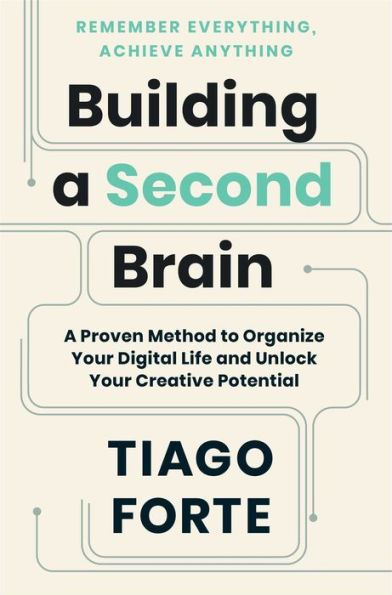
An example I came across recently was from Tiago Forte. He took an AI and feed it the contents of his book, Building a Second Brain. Next, he set up a simple interface to allow users to ask the AI questions about the book.

Here’s what happened when the AI is asked the sample question, What is Building a Second Brain about?

Answer: Building a Second Brain is about how to use technology to revolutionize personal effectiveness. It provides a system for organizing information holistically, for any project or goal, and for easily and generously sharing it with others.

To test it further, I asked it to define PARA.

Answer: PARA is a productivity system developed by Tiago Forte that helps knowledge workers organize their work and resources into four categories: Projects, Areas, Resources, and Archives. It is designed to help users quickly access the information they need and keep their workspace uncluttered.

Finally, I decided to ask it a more challenging question: What is the best way to save video content in a Second Brain?

Answer: The best way to save video content in a Second Brain is to take notes while watching the video, distilling the key points and ideas into concise summaries. This will make it easier to quickly rediscover the information in the future. Additionally, it is important to store the video in an easily accessible format, such as a bookmark or link.

Overall, I found these responses to be on point. However, maybe you can ask it a question about Building a Second Brain that will stump it. To try for yourself by jumping over to the AI website.

Art of Failure

Have you ever failed?

For most of us, failure is something we avoid at all costs. There is a stigma that those who fail seen as bad or incompetent. Yet the truth is that failure is a natural part of any learning process. To improve in an endeavor, we have to be willing to be wrong and learn from it.

The Big Think recently reposted an updated article that showed the paradox of failure through the lens of video games. Columnist Kevin Dickinson believes that video game players enter their games knowing they are going to lose, but that’s part of the fun. Why is this so? According to the article:

Failure feels awful, so people avoid it as often as they can. Even when we fail out of sight of others, our minds try to maintain our self-image by elaborating excuses for why the failure either wasn’t our fault or was completely unavoidable (i.e., motivated reasoning).

It’s interesting then that players seek out a pastime in which they are guaranteed to fail and willingly pay the price for that failure—whether it’s another quarter, lost time, or being forced to reassess one’s skills. In his short book The Art of Failure, Juul labels this phenomenon as the paradox of failure, the clash between a player’s desire to avoid failure and their drive to seek it out.

When failing a game’s challenge, Juul notes, a player discovers a deficiency in their ability or approach. Although having little importance outside the game, these deficiencies, like all inadequacies, are unpleasant to discover. Ironically, a player is never required to explore these personal inadequacies as they relate to a skill set they would never need had they not pressed start:

Before playing a game in the Portal series, we probably did not consider the possibility that we would have problems solving the warp-based spatial puzzles that the game is based on—we had never seen such puzzles before! This is what games do: they promise us that we can repair a personal inadequacy that they produce in us in the first place.

Photo by Julia M Cameron on Pexels.com

What drives players to keep playing even when they struggle? The trick may be in the thrill of discovery and the challenge needed to appreciate the victory.

One reason players crave failure is that success without that possibility is tasteless. “Failure,” states Julie Muncy at Wired, “offers texture, complexity, and a chance for growth on the part of the player and character alike.” Games that can beat you are worth engaging with.

Read the full article at the Big Think website.

Tidying Odd Spaces

This weekend I got into the tidying zone. The target was my home and office work desks. Paperwork and other items had gotten out of control and required dedicated attention to resolve. The cleanup also included the desk drawers, which contained all sorts of strange items.

Marie Kondo has through a lot about how to tidy up odd spaces in the house. On her website, she shares tips on how to get those spaces under control. One of the most important steps to clean a drawer or closet is to take everything out.

Taking everything out of junk drawers and other komono hot spots and laying it out provides a fresh view of all the contents. You may find something that was once missing or something you forgot you owned. It is an opportunity for re-acquainting yourself with the objects that live with you and recognizing those that spark joy and those that don’t.

The rationale for this is simple; it takes just as much energy to put the item back in the original spot as it would to simply toss it or place it in a more appropriate location. However, that leads to the question of how to organize these miscellaneous items so that they remain functional and not lost in an out of the way space. Marie’s approach is to compartmentalize.

Komono is hard to contain when not carefully thought through. Organize the contents of a komono drawer by category. When you open it to reach for your scissors or letter opener, have those sharp items live together. Matches and lighters can live together as fire-starters. Grocery list paper and your favorite pencil should be neighbors.

Small items that live in these kinds of komono drawers tend to jostle around every time the drawer is open and closed. Junk drawer organizers and small compartments within help keep like-with-like and protect the drawer from becoming jumbled again.

Review all the steps to tidying odd spaces on the Konmari website.

Right to Read Day

It is a sad but true fact that some people consider reading to be a dangerous activity. Of course, history is full of examples where repressive regimes have sought to prevent their citizens from reading certain books, even going as far as burning them! (The books usually, but sometimes the reader as well.) When this takes place, it is essential that all who value learning and literature fight for the freedom to read.

The American Library Association has been America’s leading champion in the fight against censorship. This year for National Library Week, they have declared today to be the Right to Read Day. As they explain on their website:

The Monday of National Library Week – April 24, 2023 – will mark one year since the launch of the Unite Against Book Bans campaign. To honor the occasion, we’re calling on readers, advocates, and library lovers to fight back against censorship in a national day of action to defend, protect, and celebrate your right to read freely. We’re calling it Right to Read Day.

On the same day, the American Library Association will release its list of the Top 10 Most Challenged Books of 2022. The list follows ALA’s recent unveiling of data showing record-shattering attempts to remove books from school and public libraries, and it shows us what types of books are being challenged the most and why.

It’s also a call to action.

Join us on #RightToReadDay and beyond by participating in the actions below to support your library and defend the freedom to read in your community.

Do you want to help protect the freedom to read as an essential human right? Learn the five steps that you can do today or any day to fight for the right to read.