Being Thankful at Thanksgiving

Of all the holidays celebrated in the United States, Thanksgiving may be the most universal. After all, not everyone enjoys the gift giving bonanza at Christmas. If you are not in love Valentine’s Day is painful and many people sleep through New Year’s Eve. Thanksgiving offers everyone a chance to share a meal with friends and loved ones for one quiet day.

As you gather around the table this week, I suggest you take time to share something that you are thankful for from this past year. Think of it as a preventive measure. After all, it is too easily to fall into the negative, whether around politics or personal preferences, and no one enjoys arguments over mashed potatoes and stuffing. Keeping the discussion focused to the items we are thankful for may offer a great boost of joy at the table and beyond. This is because gratitude has many positive benefits.

According to an article on Healthline, written by Bethany Fulton, gratitude offers many scientifically proven benefits. One of them is improved relationships.

Gratitude not only improves your physical and mental well-being; it may also improve your relationships.

Gratitude plays a key role in forming relationships, as well as in strengthening existing ones.

When it comes to romantic relationships, gratitude can help partners feel more satisfied with each other. One 2010 study showed that partners who demonstrated gratitude toward one another reported increased relationship satisfaction and improved happiness the following day.

Photo by RODNAE Productions on Pexels.com

Additionally, being grateful also increases your optimism.

Being an optimistic person can have plenty of health benefits, including healthy aging, according to a 2019 studyTrusted Source. If you’re not naturally optimistic, gratitude practice can help you cultivate an optimistic outlook, as suggested by a 2018 study.

In an older 2003 study, it took just 10 weeks of regular gratitude practice for participants to feel more optimistic and positive about their present lives and the future.

Learn more benefits by reading the whole article. And to everyone celebrating this week, have a very happy Thanksgiving.

The Key to Mastery Is Not What You Expect

Many coaches instruct their clients that the best way to be good at something is to practice it over and over again. It is thought that narrow repetition of a specific move, skill, or technique will lead to mastery. However, it seems there is a better approach that will generate lasting benefit.

In an article on Scott H, Young’s web site, he points to recent research that supports the idea that variability is even more important than straight repetition. This is due to the idea of contextual interference. Young explains:

Contextual interference occurs when you practice the same skill, but vary the situations in which it is called for.

For instance, you could practice your tennis backhand by being served backhand shots repeatedly. Alternatively, your coach could mix things up: serve you backhand shots interspersed with balls that require a forehand shot.

Or imagine preparing for a calculus exam: you could study all the questions that require the chain rule, then all the questions that use the quotient rule. Instead, you might shuffle these questions together so you can’t be sure which technique is needed.

Young goes on to point out why contextual interference improves mastery. One of the reasons is:

Identifying problems correctly and ensuring the correct technique is associated with the problem. A major difficulty in learning isn’t getting knowledge into your head—but getting it out at the right time. Practice that repeats the same technique in narrow situations may result in skills that aren’t accessible when you need them.

Learn more about the advantages of variability in your training by reading the rest of the article.

12 Grand Challenges

What is the future of Local Government?

This past weekend fifty-one delegates from across the country came together in Omaha to shape that future. The event was the Local Government 2030 National Convening. With a purpose to discern the lessons from the future, the group worked over two days to find ways to break down silos and create the groundwork for change. I was honored to serve as a Super Delegate to help guide the work and keep everyone thinking big and bold.

A starting point for the Convening was provided by the National Academy of Public Administration. As a way to set out the problems facing government and inspire answers, they devised the Twelve Grand Challenges in Public Administration. These challenges are part of an agenda for change. As the Academy states on its website:

As the world moves quickly from the industrial age into the information age, new challenges have arisen and demands on government have increased. But the public sector has often been in a reactive mode—struggling to adapt to a rapidly evolving international, economic, social, technological, and cultural environment. Over the next decade, all sectors of society must work together to address the critical issues of protecting and advancing democracy, strengthening social and economic development, ensuring environmental sustainability, and managing technological changes. And governments at all levels must improve their operations so that they can tackle problems in new ways and earn the public’s trust.

Each of the twelve challenges focuses on a specific goal. For example, one of challenges is to “Modernize and Reinvigorate the Public Service.”

Federal, state, and local governments deliver vitally important services to the American people each and every day. If it is an important need, public agencies at one or more levels of government are likely to have an important role in meeting it.

Learn about all the Twelve Grand Challenges in Public Administration and more about the Local Government 2030 National Convening through the links provided.

The Fear That Should Scare You the Most

It is the day before Halloween (All Hallow’s Eve Eve?) and most people’s thoughts turn to frights! This is the season when we enjoy being scared. Of course, fears stay with us the entire year, but in the spirit of the spooky season, now is an ideal time to consider the fear that scares you the most.

Shola Richards has looked fear in the eye and blogged about it. In a post titled, Never Too Late, he shared the one thing that he fears the most. It is not snakes, vampires, the dark, or taxes, but something much simpler and profound.

I have always found it so strange when people say that they’re fearless. Let me tell you upfront that I’m not one of those people.

Just like most rationally thinking human beings, I have fears (quite a few, to be honest). And without question, this is the fear that scares me the most:

Looking back on my life and realizing that I haven’t lived fully.

How is that his greatest fear? Shola proceeds to tell us exactly why over the next few sentences.

If you are going to be afraid of something, don’t be afraid of what may happen if you decide to fully live your life and chase your dreams.

Instead, be afraid of what will happen if you decide not to fully live your life and allow the ghosts of “what might have been” to haunt you relentlessly for the rest of your days until you finally die with a pitiful whimper.

That’s freaking terrifying to me. It should be for you too.

Through this post, Shola is issuing a challenge. What plan or dream for your life is being left to gather dust on the shelf due to fear of failure or ridicule? Just as on Halloween we face illusionary frights then laugh about it afterwards, why not do the same with the fears around your goals?

Face the fear and see what happens next.

It may not be as scary as you fear.

Five Meeting Rules from Ray Dalio

Bad meetings are inevitable. Good meetings are fortunate. Great meetings are designed.

Meetings are a core component of knowledge work. However, very few people are trained on how to run them effectively. A focused, structured meeting benefits all the participants and moves everyone closer to their goals. Therefore, it is important to understand how to run a successful meeting.

Ray Dalio, founder of Bridgewater Associates, has thought very deeply about the workplace. In addition to the unique methods that comprise the Bridgewater culture, Dalio has set out specific rules for productive meetings. A recent article in INC magazine focused on five of them. The first is very simple yet often overlooked: clarify the meeting’s purpose.

Dalio says that you should emphasize a meeting’s purpose well before it begins. That way, everyone can walk into the meeting prepared and the group can be intentional with their time. He also adds that “Meetings without someone clearly responsible run a high risk of being directionless and unproductive.”

Another rule of successful meetings is to avoid “topic slip”:

Topic slip, as defined by Dalio, is the “random drifting from topic to topic without achieving completion on any of them.” If you’ve ever left a meeting feeling more confused than when you walked in, topic slip is a likely culprit.

To dive deeper into these two rules and then learn the other three, visit the article on the Inc website.

From Hope to Trust

How confident are you that all your priorities have been captured outside your head?

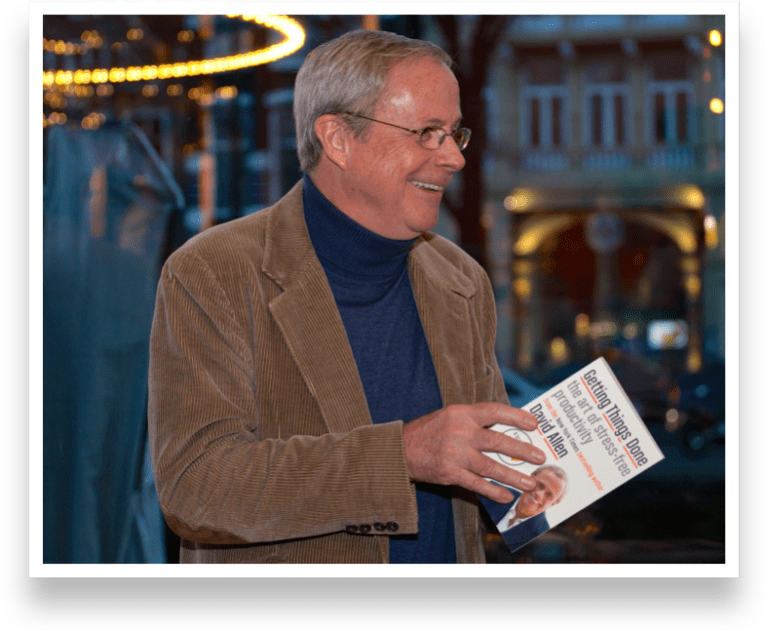
For most people, their regular practice is to keep their responsibilities and duties saved only in brain cells. Storing these things in our fallible minds makes it hard to be confident about our next actions. Once people discover this problem, they often try to create elaborate systems to remember. However, this may prove just as problematic. GTD founder David Allen explored this problem in a recent blog post:

It’s natural to want to create a system for priority coding (like “A, B, C” or the flagging feature in many apps) to tell you the most important things to do. But it’s a short-term insurance policy that won’t give you the trust you need when the time comes to take action.

If these complex approaches don’t work, is there a better way? David certainly believes so as he adds:

People would often love to be able to give up the non-stop accountability for their intuitive judgment calls about the moment-to-moment allocation of their resources. That’s why the ABC-priority and daily-to-do-list structures have often seemed so attractive as a way to “get a grip.” But reality has a way of requiring us to be more on our toes than that.

So how can we really know for sure what action to take? Prepare for the worst, imagine the best, and shoot down the middle.

Dive deeper into this philosophy by reading the rest of the post.

Should You Trust Your Gut?

Have you ever faced a tough decision and been given the advice to trust your gut? We tend to assume there is an unconscious but highly aware part of ourselves that intuitively knows the right answer. All we have to do is trust it. However, is that true?

According to a new book by Seth Stephens-Davidowitz, called Don’t Trust Your Gut, the answer is no, especially if we want to be happy. In a recent interview article on Vox, journalist Sean Illing shares that “it’s wrong because our intuitions are often influenced by false impressions or dubious conventional wisdom.”

In a conversation with Stephens-Davidowitz, Illing asked him about which conditions are conducive to trusting your gut:

There have been these studies that show if you do something in a controlled environment, many times, then your intuition is able to sense things that it would be impossible to otherwise sense, such as a firefighter who can sense that there’s a fire even before it reaches conscious awareness or is visible.

So I think there are times where our gut can be useful. But I think our gut is massively overrated.

Photo by Liza Summer on Pexels.com

Later on in the interview, the discussion turns to the connection between our gut reactions and happiness. Stephens-Davidowitz says about recent studies on the topic:

And they found all these things like, socializing, being with friends: really, really important. Being with your romantic partner: really, really important. Many of us think that we’re gonna have a good time if we just lie on our couch and browse the internet, or go on social media or play an iPhone game. And the data, when you actually ask people doing that, they tend to say they’re not particularly happy doing that.

Read the rest of the article on Vox.

The High Cost of Delaying Decisions

Have you ever had a tough time making a decision? If so, were you tempted to delay making that choice? If so, did it make the situation better or worse?

Most of the time we think that delaying making a decision will give us more useful time to deliberate which should ultimately lead to a better decision. However, is that true?

In an article by Hollie Richardson called, Decision-Making: Research Shows What Happens When We Wait for “Something Better”, it becomes clear that there is a cost to delaying decisions. As she points out:

Christiane Baumann, a doctoral candidate in the Department of Psychology, explained the way people think as being like: “The price that I am prepared to pay increases every day by the same amount. That is, the further along I am in the process, the higher the price I will accept.”

This principle can be applied not only to purchases, but also situations such as choice of an employer or a romantic partner: “At the beginning perhaps my standards are high. But over time they may lower so that in the end I may settle for someone I would have rejected in the beginning.”

Basically, the longer we leave it to make a decision, the more we’re prepared to gamble, and our standards can drop.

With this in mind, what decision are you putting off making? What if you made that decision right now?

Read the rest of the article to learn more.

What are your Core Values?

Everything we do is driven by are core values. The type of job we take, the person we choose to be in relationship with, and the friends we make are products of our inner values. However, many people have never taken the time to contemplate exactly what their values are, much less write them down.

Recently I discovered a simple exercise to bringing core values to light. It comes from the website of Scott Jeffrey, “the founder of CEOsage, a transformational leadership agency and resource for self-actualizing individuals.” Why is Jeffrey so interested in helping people identify their values? On his web site he offers the following explanation:

As a business coach, I appreciate the power of values.

I’ve noticed that individuals experience greater fulfillment when they live by their values.

And when we don’t honor our values, our mental, emotional, and physical state suffers. I’ve seen this to be true in my life too.

Scott Jeffrey

Jeffrey presents a seven-step method to articulate any person’s values. An early part of the process is to list possible values. However, this is not done so that one can pick or choose favorites. As Jeffrey explains:

Values aren’t selected; we discover and reveal them. If you start with a list, your conscious mind will test which values appear “better” than others.

That said, if you’re not familiar with working with values, you can scan a list of values to get a sense of your range of options.

Learn the entire process by visiting Scott Jeffrey’s web site.