Is AI Overrated?

Are you concerned about AI taking over the world?

Once ChatGPT hit the scene, along with hyper-realistic image generators, it seemed to the world that there was no limit to AI. Does this mean computers will take over most jobs or render thinking itself obsolete?

In a fascinating counter-point exercise, Greg Rosalsky from Planet Money on NPR listed several reasons why AI may be overrated. He starts off with a number of quick hits:

There are just so many reasons to believe AI is overrated. I could talk about the fact that productivity growth remains super disappointing. If AI were revolutionizing the economy, we would see it in the data. We’re not seeing it. I could talk about the fact that AI companies have yet to find a killer app and that perhaps the biggest application of AI could be, like, scams, misinformation and threatening democracy. I could talk about the ungodly amount of electricity it takes to power AI and how it’s raising serious concerns about its contribution to climate change. 

Photo by ThisIsEngineering on Pexels.com

Rosalsky goes on to flush out three specific reasons to doubt that AI is all it’s cracked up to be. One reason is that despite its name artificial intelligence is not really that intelligent.

When you first use something like ChatGPT, it might seem like magic. Wow, a thinking machine able to answer questions or write or generate anything in an instant. But when you look under the hood, it’s more like a magic trick. These chatbots are a fancy way of aggregating the internet and then spitting out a mishmash of what it finds.

Later, Rosalsky points out a serious legal issue with AI that needs to be resolved before it can grow further.

It’s a copycat. And perhaps the worst part of it is a good chunk of the stuff AI is copying is copyrighted, which is why there are at least 15 high-profile lawsuits against AI companies asserting copyright infringement.

To learn the other reasons by AI may be overrated, please read the rest of the article on the Planet Money website.
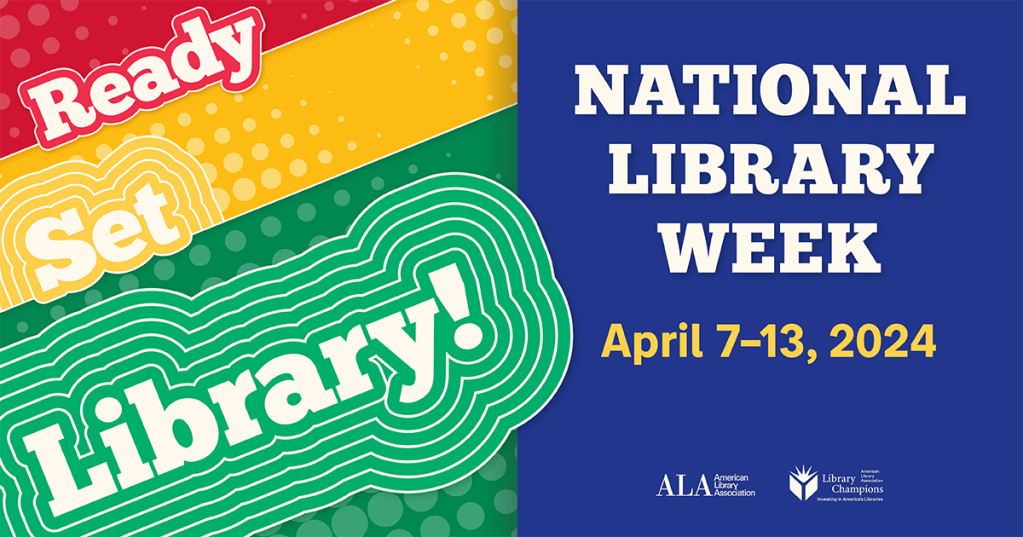

Celebrate National Library Week

Do you love libraries? Do you believe they are vital institutions in our communities? Do you value their role in our educational system? If so, please join me in celebrating National Library Week!

Every year in April is the annual celebration of the impact that libraries have on our nation. The American Library Association leads the way by setting the theme for the week. According to the ALA web site:

The theme for National Library Week 2024 (April 7-13) is Ready, Set, Library! National Ambassador for Young People’s Literature and Newbery and Pura Belpré-award winning author Meg Medina will serve as 2024 Honorary Chair.

What are some of the ways to celebrate National Library Week? For starters, the easiest first step is to visit a library. According to the ALA:

National Library Week is the perfect time to visit your library. Many libraries have special events planned for the week. Bring the kids or invite your friends. Meet the librarians. Check out books or other great items in your library’s collection or attend a program. Take time to learn all your library has to offer!

Learn more about National Library Week, including special Celebration Days such as The Right to Read Day, by visiting the ALA’s site.

7 Surprising Ways Your Library Card Can Save You Money

Do you know which card in your wallet might save you the most money? It’s not your fancy points credit card, or your AAA membership. It is mostly likely your library card!

While it is common knowledge that people can check out books for free at the library, and in fact, many libraries have even dropped overdue fines! However, there are multiple ways to get value out of your local library than simply borrowing books. This past week NPR reports Marielle Segarra and Audrey Nguyen published an article called 7 surprising ways the public library can help you save money. For the first way they highlight unusual items that some libraries lend out.

Libraries offer all kinds of items on loan. “Video gamesmusical instrumentsboard games. Some libraries have bakeware collections where you can get baking pans,” says Threets.

Akhila Bhat, branch manager at Harris County Public Library in Katy, Texas, says her library system has a seed library. “Patrons can pick up seeds to start a garden and drop off seeds for others to take home and plant.”

Meanwhile, libraries like the Providence Public Library in Rhode Island have tools you can check out. That includes a cordless drill, safety goggles and a laser level.

Photo by Kampus Production on Pexels.com

Another way that the authors highlight the value of the library card is through the free activities and events happening monthly at your neighborhood library.

Save money on live music by checking out what your local branch has to offer. The New York Public Library’s performance art space, for example, has upcoming concerts featuring a choir and a quartet. And people can watch a classical guitarist or a harpist perform at different libraries in Los Angeles County.

Learn about the other five ways to save money with your library card by reading the rest of the article on the NPR website.

The Overwhelming Cost of Book Banning

BOOK CHALLENGES in libraries are nothing new, but until recently they generally involved a single title, in a single library, being filed by one person. Such challenges are best handled locally, where those raising questions have, in most cases, acted in good faith. But today we are seeing the weaponization of school and public library policies by a small number of people, filing an unmanageable number of challenges that grind our public institutions to a halt.

Thus begins an article called The Overwhelming Cost of Book Banning published in the New Hampshire Union Leader. Written by Katherine Towler, Sy Montgomery, and Peter Bromberg, the article explores the current state of book challenges. It notes that the vast majority of challenges are being done by very few people. Amazingly, their impact on operations was deep.

Photo by Wallace Chuck on Pexels.com

How few people are filing complaints? The Washington Post studied more than 1,000 book challenges and found that 11 people were behind the complaints. In one Utah school district, a married couple were behind 199 out of 205 challenges. The district reported that the challenges required 10,000 hours of staff time and cost more than $100,000. In Texas, documents show that more than 16 employees spent more than 225 hours at a cost of $30,000 on a single book challenge at the Spring Branch ISD.

How can libraries respond to this sort of disruption? The trio propose several things that would remove the ability for a few people to have an oversized impact on library operations. One of the ideas has to do with placing appropriate limits on public complaint.

One policy proposal is simply to allow for public comment and feedback on public policy and law, but clarify that feedback about operations (book selection, programming, spaces, services, etc.) while welcomed, will not automatically lead to a formal, time-consuming review. 

To learn more, please read the rest of the article.

We’re Stronger Together: A Conversation with ALA President Emily Drabinski

I recently had the opportunity to interview the new ALA President Emily Drabinski on behalf of Public Libraries Online. As she begins her year in the role, I asked her how she became involved with ALA at a national level.

I’ve been an academic librarian in New York City for 22 years. I joined ALA in 2002 when I had just finished library school, because it took this bold position against the Patriot Act. I was excited to be part of a profession that takes difficult stances in difficult political moments. And we definitely are in one of those right now. So I was interested in using some of my skills as a connector of people to work inside the association that I think can be valuable in this moment. My involvement at ALA was primarily in my division home, ACRL, which is common for most people. I was on a number of its committees and have been editing the book reviews for our journal for the last three years. I served one term as ALA Council and that was a really interesting experience. I saw how the sausage gets made a little bit, in terms of what kind of a national presence ALA has, which I think is really important.

Later on in the interview, I asked her to share her priorities for the Presidential year. Her first priority is to advance sustainability in libraries.

Past Presidents say you plan and then the year happens. My plan is to focus on bringing to completion projects that Past Presidents Lessa Kanani’opua Pelayo-Lozada and Patty Wong worked on. For a long time, ALA has had sustainability as a priority. We have a round table, we have a council committee, and we have sustainability now as a core value. So will be focused on tying up those loose ends so that we can have national climate strategy for libraries coming from ALA to guide people in managing through environmental crises. Also it will include ways that we as institutions can contribute to reversing some of those climate change trends.

Read the entire interview at the Public Libraries Online website.

Obama’s Letter to Librarians

This past week former President Barak Obama surprised librarians across the country by releasing a letter of support. In it he spoke openly about the free expression of ideas and the importance of libraries.

Below is the opening of the letter:

To the dedicated and hardworking librarians of America: 

In any democracy, the free exchange of ideas is an important part of making sure that citizens are informed, engaged and feel like their perspectives matter.  

It’s so important, in fact, that here in America, the First Amendment of our Constitution states that freedom begins with our capacity to share and access ideas – even, and maybe especially, the ones we disagree with.  

More often than not, someone decides to write those ideas down in a book.  

Later in the letter he expresses deep appreciation for librarians and their work.

Nobody understands that more than you, our nation’s librarians. In a very real sense, you’re on the front lines – fighting every day to make the widest possible range of viewpoints, opinions, and ideas available to everyone. Your dedication and professional expertise allow us to freely read and consider information and ideas, and decide for ourselves which ones we agree with.  

That’s why I want to take a moment to thank all of you for the work you do every day — work that is helping us understand each other and embrace our shared humanity.  

Read the rest of the letter on the Penguin Random House website.

Building a Second Brain: A Conversation with Tiago Forte

Last year I had the honor of interviewing Tiago Forte, creator of Building a Second Brain. We spoke for almost an hour on how he became interested in the power of digital notes, discussed PARA as an organizing tool, and learned best practices for capturing information across mediums.

I’m glad to share that the written transcript of the interview is now posted on Public Libraries Online. Below is opening question and response.

PL: Please define what you mean by a Second Brain?

TF: Think of a diary or notebook. It is a creative, timeless practice to save your thoughts. Now make a few changes. You’re going to journal not just your own thoughts and reflections, but external sources of information. You hear a quote that resonates with you, write that down. You hear an interesting fact, write that down. You discover some research of interest, write that down. Next, make it digital so that it is on your smartphone and sync to the Cloud and all your devices. Now you can access it from anywhere, anytime.

With all the capabilities of technology, you can save, not just text, but images, links, web bookmarks, photographs, drawings, and sketches. Because it’s digital, it can be annotated, organized, and re-sorted. It can change with your needs and goals. Your Second Brain is a trusted place outside of your head where you save all of the ideas, insights reflections and realizations that are most important to you. It contains information that is personally relevant and meaningful. It contains moving and powerful life experiences, memories, and unique ways of seeing the world.

To learn more about other aspects of Building a Second Brain, such as the CORE approach, understanding the difference between projects and areas, and much more, please read the full interview on Public Libraries Online.

Good News for Library Funding In Florida

Is your community long overdue for a new public library? After many years of effort, it is welcome news to see a major funding increase for public libraries in the 2023-24 Florida Budget. This is due to a dramatic increase in the amount of money allocated for public library construction grants.

The Public Library Construction Grants program has been largely overlooked for most of its existence. However, this year the Florida Legislature allocated over $9 million dollars to the fund. This appropriation triples the past largest amount for construction grants and will allow 19 projects across the state to receive between $300,000 to $500,000 each towards construction costs.

Photo by Rene Asmussen on Pexels.com

Appreciation for this increase goes to the Legislative leadership in the Florida House and Florida Senate, along with the appropriation chairs on both sides. Further appreciation goes to the Governor for approving this significant increase, along with support from the Florida Secretary of State.

As well, this effort would not have happened without the determined lobbying of the Florida Library Association and their contracted lobbying team at GrayRobinson.

Building more public libraries will enhance our communities, support local education, enhance access to voting, and demonstrate without a doubt that Florida Libraries are Fundamental to Freedom.

Florida Libraries are Fundamental to Freedom

On May 19, 2023, I became President of the Florida Library Association. At the conference in Dayton Beach, I unveiled the Presidential theme: Florida Libraries are Fundamental to Freedom. Below is the opening portion of the speech explaining the theme and how it is important to the work that libraries are doing today.

Florida libraries are fundamental to freedom.

The drafters of the Declaration of Independence believed in the essential rights to life, liberty, and the pursuit of happiness. Since 1776, our nation has struggled to apply these principles equally across all its residents in order to create that elusive more perfect union. At its core, the freedoms that Americans seek are the same freedoms supported by our libraries. Of these aspects of liberty, three specific freedoms stand out for me.

Florida libraries support the freedom to participate. In an increasingly fractious society, our buildings remain the one space where everyone is welcome. Through our libraries, residents can find all the tools and resources needed to live their lives. Whether it is using public computers to apply for benefits, meeting neighbors at a children’s story hour, or to register to vote and actually vote, libraries remain central to our communities. Eric Klinenberg in his book, Palaces for the People, states that a founding principle of libraries is, “that all people deserve free, open access to our shared culture and heritage, which they can use to any end they see fit.”

Read the full speech found on the Efficient Librarian website.