Right to Read Day

It is a sad but true fact that some people consider reading to be a dangerous activity. Of course, history is full of examples where repressive regimes have sought to prevent their citizens from reading certain books, even going as far as burning them! (The books usually, but sometimes the reader as well.) When this takes place, it is essential that all who value learning and literature fight for the freedom to read.

The American Library Association has been America’s leading champion in the fight against censorship. This year for National Library Week, they have declared today to be the Right to Read Day. As they explain on their website:

The Monday of National Library Week – April 24, 2023 – will mark one year since the launch of the Unite Against Book Bans campaign. To honor the occasion, we’re calling on readers, advocates, and library lovers to fight back against censorship in a national day of action to defend, protect, and celebrate your right to read freely. We’re calling it Right to Read Day.

On the same day, the American Library Association will release its list of the Top 10 Most Challenged Books of 2022. The list follows ALA’s recent unveiling of data showing record-shattering attempts to remove books from school and public libraries, and it shows us what types of books are being challenged the most and why.

It’s also a call to action.

Join us on #RightToReadDay and beyond by participating in the actions below to support your library and defend the freedom to read in your community.

Do you want to help protect the freedom to read as an essential human right? Learn the five steps that you can do today or any day to fight for the right to read.

How to Talk About Book Bans

It seems that every day the news reports another school district or public library being inundated with demands to ban books. Looking back in history these moral panic waves hit every couple of decades, but their effects if successful last for a long time. Often it is a vocal minority that powers these attacks on the freedom to read. Yet, when it comes down to the facts, do a majority of people support ban books. The truth is clearly they do not.

According to United Against Book Bans, 71% of voters oppose banning books in public libraries and a similar 67% oppose it in schools. The problem is that most people don’t realize the underlying negative impacts that book bans have on minorities and other targeted groups. How do we reach out to the silent majority who oppose book bans to educate and activate them on this important issue?

Photo by Element5 Digital on Pexels.com

Kelly Jensen writing for Book Riot recently authored an article titled: How to Talk about Book Bans with Friends, Library Patrons, and More. In the piece she provided helpful tips to encourage supports to speak out against book bans. For friends she suggests a few things including:

Share data, statistics, and research as much as you do the terrible and/or click-y stories about the absurdity of certain challenges. It IS ridiculous that books about sports heroes were banned in a Florida school district. But what is also absurd and far more actionable is noting that book bans are extremely unpopular with the public (research) and that when given the choice to opt their kids out of school library materials, it is the smallest minority of parents who do (research).

When talking to library patrons, she suggests many approaches, including sharing widely when a book challenge takes place:

If your library is dealing with a book challenge, make sure your power users know that they need to attend the board meeting and/or submit a letter in support of the book. As noted in the previous section, use the data, research, and statistics to back up the need for the library to include materials for all.

Read the rest of the article on the Book Riot website.

Efficient Librarian In-Person Workshops and Webinars Announced for Early 2023

This year I will be back on the road doing in-person classes in New Orleans and across Florida, along with several virtual offerings.

Most of the trainings listed below are sponsored by a Florida Library Cooperative and are free of charge to Florida library staff. Non-Florida library staff may register for a reasonable fee. The January 29th session is part of the LibLearnX Conference and is free of charge to registered attendees.

If you are interested in having a workshop in your area, please reach out to me at efficientlibrarian@gmail.com. I look forward to seeing you at an upcoming workshop.

From Inbox to Completion: The Secrets to Successful Workflow
January 25, 2023, 2-3 pm (EST)
Webinar
Sponsored by SWFLN

Finding Your Leadership Pathway
January 29, 2023, 1 pm – 4 pm (CST)
Ernest N. Morial Convention Center
LibLearnX Conference – New Orleans, LA

The Efficient Librarian
February 3, 2023, 9 am – 12:30 pm (EST)
Palm Beach County Library System – Hagen Ranch Road Branch
Sponsored by SEFLIN

Finding Your Leadership Pathway
March 3, 2023, 9 am – 12:30 pm (EST)
Palm Beach County Library System – West Boca Branch
Sponsored by SEFLIN

Managing Employee Performance: A Simple Formula for Talking with Staff
March 6, 2023, 2-3 pm (EST)
Webinar
Sponsored by SWFLN

Finding Your Leadership Pathway
March 7, 2023, 1 pm – 4:00 pm (EST)
NEFLIN HQ – Orange Park, FL
Sponsored by NEFLIN

The Efficient Librarian
March 9, 2023, 9 am – 12:30 pm (EST)
Leroy Collins, Leon County Library – Tallahassee
Sponsored by PLAN

Overcoming the Email Avalanche: Three Steps to an Empty Inbox
May 9, 2023, 2-3 pm (EST)
Webinar
Sponsored by SWFLN 

Public Libraries Fill Early Childhood Infrastructure

As a professional who started my career as a children’s librarian, I have often said that children’s services are the heart and soul of public libraries. The faces of joyful children picking books off the shelves then sitting on a cushion to read them is a beautiful thing. However, this is more than simply a feel-good image. Public libraries are essential for early childhood.

In a recent article on the Bloomberg web site, City Lab reporter Kendra Hurley shares the unique way public libraries serve this unnoticed demographic. In her article called The US Has No Early Childhood Infrastructure. Libraries Are Picking Up the Slack she shares the following:

In the United States — the only rich country without paid parental leave — babies, toddlers and their caretakers are routinely neglected by both policy and city planning. It’s rare to find even a step stool in a public restroom, said Kristy Spreng, a child-care program director and former librarian who co-created a baby play area with a workstation for Ohio’s Loudonville Public Library. “Those basic simple things just get overlooked,” said Spreng. “It’s crazy, because there are always babies. We reproduce. The need isn’t going away.”

Photo by Lina Kivaka on Pexels.com

To fill this gap, children’s librarians are developing new approaches to service.

For librarians, the big takeaway was that literacy starts at birth and the early years set the stage for future learning. “Children become readers on the laps of their grown-ups,” Payne recalled the philosophy of the time. Children’s librarians began regarding themselves as coaches for parents with small kids, and “laptime” story hours where librarians model how to read, sing and play with babies and toddlers cropped up at libraries everywhere.

Learn more about how public libraries are serving very young children by reading the rest of the article.

Read a Banned Book

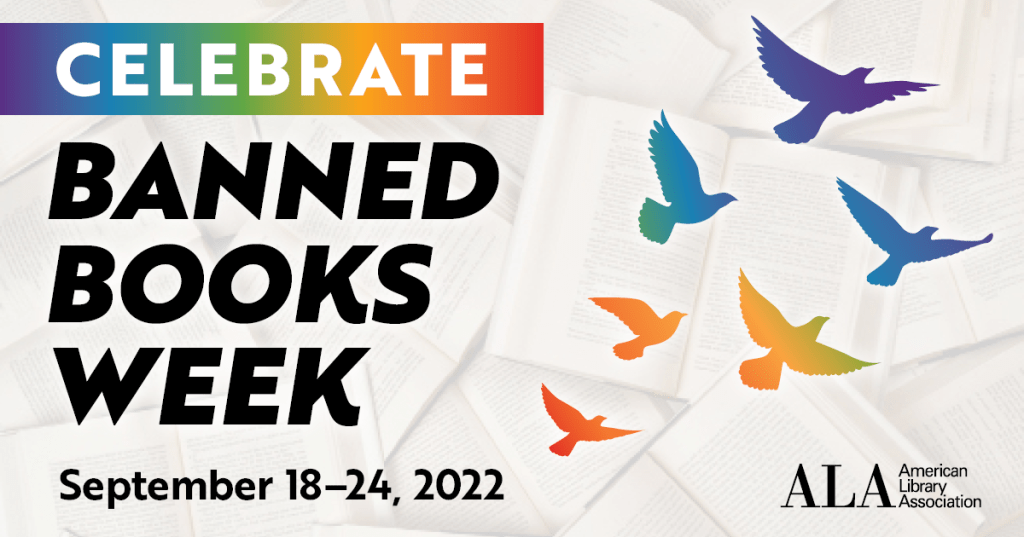
Ever since the first books were written, someone has been trying to ban them. It is a centuries old struggle to preserve the freedom to read against forces that try to stifle the spread of knowledge. This is why the third full week of September is annually celebrated as “Banned Books Week.” A USA Today article summarized the history of the week.

Banned Book Week started 40 years ago as a celebration of the freedom to read but the librarian-led movement is shifting into the world of grassroots organizing as an unprecedented number of book-ban efforts have emerged around the country.

This past year marked one of the busiest years for book challenges in recent memory. Deborah Caldwell-Stone, director of American Library Association’s Office for Intellectual Freedom summarized the current situation in the article.

The number of challenged books hit an all-time high last year. with 729 challenges, affecting a total of 1597 books – nearly triple the number of challenged books in 2019, according to the American Library Association, which has tracked the annual number of challenges through media and voluntary reports since 1990.

“We’re now seeing efforts to remove books en masse. In the past it might be one parent challenging a particular book in a library and now we’re seeing organized groups take lists of books to boards demanding their removal,” Caldwell-Stone said. “Demanding that elected officials censor these works because they find them offensive, which is the very antithesis of democratic freedom to read, a real attack on liberty.”  

Since most book challenges are local, it is important to support our local librarians by letting our elected officials know that the freedom to read is essential to democracy. Learn more about the topic through the USA Today article.

Censorship Battles in Public Libraries

Across the country libraries have seen an increase in book challenges, especially around race relations and LGBTQ-themed books. While these sorts of challenges have always been part of the landscape, during the past year they have intensified. The ALA Office of Intellectual Freedom recently reported that challenges quadrupled in 2021. The office also keeps a list of the top ten most recently challenged books on its web site.

An example of how this struggle is happening is encapsulated in a recent story about the Citrus County Library System and a battle by activists to get a seat on its Advisory Board. The Tampa Bay Times reported on the story of the battle that started over a small Pride Month display.

The yearly LGBTQ Pride Month display in the Citrus County library went largely unnoticed until 2021.

But last year, the small array of LGBTQ-themed books surrounded by rainbow hearts and signs saying “love is love” became a point of contention that has expanded into a larger partisan battle, pushed by the fringes of the conservative movement, over censorship and children’s education.

Last month, the library’s advisory board was inundated with candidates trying to replace five of the nine sitting board members. It was the first time the board, which does not control the content on the library shelves, had seen such interest.

Read the full story on the Tampa Bay Times web site.

Leading Your Team to Productivity

Back at this year’s Florida Library Association annual conference, the FLA Professional Development Committee released a video highlighting productivity practices, tips and tricks from three leaders in the library field. I was included along with Dr. Leo Lo, Dean and Professor of the College of University Libraries and Learning Services and Dr. Vanessa Reyes, Assistant Professor for the School of Information at the University of South Florida.

I was interviewed by Amy Harris, Instruction & Assessment Librarian at Saint Leo University. During my portion of the presentation, I discussed the basic principle of GTD and how to apply them in the workplace.

The full video can be found on YouTube.

Director’s Dialogue – A Public Libraries Podcast

The PLA Leadership Development Committee is always looking for ways to bring value to library workers across the profession. Earlier this year, the committee developed an idea to do a podcast series where current Public Library Directors would have a casual conversation about their work and offer insights into the profession. This led to the creation of a new Public Libraries podcast special edition episode called Director’s Dialogue.

The inaugural episode featured me and Kent Oliver, who recently retired as chief executive of the Nashville Public Library. Future episodes will aim to provide a diverse cross section of library leaders from both large and small systems.

The description for the twenty-minute episode was as follows:

From leadership and management matters to current public library hot topics to strategic planning, capital projects, collection development, program planning, and so much more, the Directors Dialogue episodes aim to share ideas, best practices, and lessons learned.

Both are also members of the PLA Leadership Development Committee and the idea for the Library Directors Conversation series came out of their committee discussions.

Listen online or through your favorite podcast app and watch for more episodes later this year.

Unite Against Book Bans

Across the country attacks on the freedom to read have multiplied. While there have always been attempts to remove books from library shelves, this time the movement is more organized and widespread. Most of the targeted items are children’s material covering LQBTQIA+ information and race relations, such as Black Lives Matter.

The American Library Association stands at the forefront to protect the right to read. For years they have tracked book challenges and compiled the top ten list of targeted titles. With the threat rising, they recently started a campaign called Unite Against Book Bans. The site contains the results of a nationwide poll that clearly shows book banners are a minority.

On both sides of the aisle, large majorities of voters and parents oppose book bans. 71% of voters oppose efforts to remove books from public libraries. 67% of voters oppose efforts to remove books from school libraries. And yet, attempts to ban books from libraries are rising at an unprecedented level across the country. The American Library Association reported more than 729 attempted bans of 1,597 individual books in 2021 alone.

Join the campaign to preserve the right to read and fight book bans. It is as simple as signing up through the ALA’s campaign page. The web site also includes an action kit and ways your organization can partner with the movement.

Don’t let a small minority ban books from our library shelves. Join the cause and unite against book bans.