There is Always Too Much to Do

Have you ever felt overwhelmed?  You know that feeling that there are too many things to do and not enough time to do them in?  This is especially true if you are an “ideas” person whose mind constantly generates new thoughts and insights that eventual lead to a string of projects.  How are we supposed to handle this overwhelm and stay sane?

design desk display eyewear

The first step is to understand that there is always more to do than time allows.  If you follow GTD practice, the generation of action lists and a robust project list will quickly demonstrate this fact.  Accepting that some things will never be done is a part of good mental health.  The trick becomes deciding what is essential to complete in terms of your larger mission and purpose.  Spending a lot of time completing small tasks with little payoff becomes exhausting.  It is far better to complete fewer tasks well that lead to bigger payoffs.

I was once asked this question in an Efficient Librarian workshop: “How often do you empty your action folder?”

I replied that as a functional folder the point wasn’t to empty it regularly like the inbox, but instead to corral actionable items together into one place.  In fact, in the last four years my work email action folder has only been completely empty once.  Since I am very active at work, it may never be empty again until I retire!

So, relax and remember that there will always be more to do than can be done.  The question you have to consider is what is the most important thing to do in the time you have.  That answer will lead you productively and efficiently forward.

Making Meetings Meaningful

It is common for people to dread meetings.  However, the game of knowledge work is played out not only at your desk but in the many different conversations we have with our colleagues, clients, and collaborators.  In that light, a meeting is simply a conversation that is scheduled for a specific time and place.  While important to getting work done, meetings can also be a source of confusion and conflict if not done effectively.  So, are there best practices to having better meetings?

gtdcoverIn a recent blog post, David Allen shares his insights about meetings and it starts from the top of the Natural Planning Model, that is defining purpose.

“An essential question to answer at the start of any meeting is, “What do we want to accomplish here, and by what time?” If purpose isn’t clear, no one has sufficient criteria by which to frame and monitor the ensuing conversation, nor the information to know whether he or she should participate in it. So, step one, make sure the purpose of each meeting is clear.”

Read the rest of the blog post at Getting Things Done.

The Strategic Value of Clear Space

DA-SmallAt the end of an Efficient Librarian training seminar or webinar, I like to close with a phrase from David Allen that has stuck with me for a long time.  To my mind this phrase encapsulates the power inherent in the GTD mindset.  The phrase is “The Strategic Value of Clear Space.”

In a recent blog post on the Getting Things Done web site, David Allen expands on “The Strategic Value of Clear Space” at length.  Here is a key takeaway:

“To tackle something most productively you must begin in clear space. Physically you need all your tools in order and an open space for spreading your raw elements and assembling structures. Psychically you need an empty head, clear of distractions and unfinished business holding your attention hostage. From this starting point you will have your best chances for creative thinking, optimal ability to deal with surprise, maximum flexibility to come up with workarounds and innovative solutions. You’ll be able to take advantage of serendipitous, potentially valuable ideas.”

Read the rest at the Getting Things Done web site.

Email and Your Job

davidallenIt seems like every year the email beast gets larger and hungrier.   According to the the web site Templafy, the average person receives 121 emails a day.  This sheer volume of electronic correspondence lead to a fascinating question that was posted to the Getting Things Done web site:  At what point did answering e-mail become my job? 

The answer from David Allen is very insightful:

“Well, at what point did answering anything—your mail, having conversations in your hallway—become your job? It’s all your job. You just have to decide what your work is. As the late, great Peter Drucker said, that’s your biggest job, to define what your work is.”

Read the rest of his response on the Getting Things Done web site.

The Weekly Review

Quick question: According to David Allen, what is the “critical success factor” in making your GTD practice stick?

Answer: The Weekly Review

In our fast moving times, it is very important to step away from the daily grind to get perspective on your work, goals, and mission.  The Weekly Review is that opportunity. The Review is typically done on the last day of the gtd-logowork week in order to reflect on your calendar, tie up loose ends, and make sure the everything that has your attention is captured for processing.  I know from my own personal experience that whenever I miss a Weekly Review, there is a feeling of incompleteness.  The Weekly Review is an excellent way to move into a stress free weekend.

Check out this free podcast and guide available on the GTD web site.


GTD For Teens

gtdteensMany people say, “I wish I had known GTD when I was in school.”  The problem was that Getting Things Done and other productivity books are encountered after they start their career, mostly because these books are primarily aimed at the business community.  However, this has changed with the release of the new book GTD for Teens. As noted on the GTD web site:
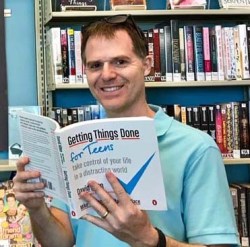
“The most interconnected generation in history is navigating unimaginable amounts of social pressure, both in personal and online interactions. Very little time, focus, or education is being spent teaching and coaching this generation how to navigate this unprecedented amount of “stuff” entering their lives each day. How do we help the overloaded and distracted next generation deal with increasing complexity and help them not only survive, but thrive?”

GTD for Teens take the system and explains it using language and situations common to teens.  Learn more about the book on the GTD for Teens web site.


My GTD Story @ GTD Online!

Idcrane-gtdt is an honor and a privilege to announce that I am currently featured on Getting Things Done!

About a month ago, the GTD team reached out to me to ask if I would share my story about how I discovered the system and use it.  Without any hesitation I jumped at the chance.  Here is an except from the story:

How long have you been practicing GTD?
I started in 2011. I am one of those excited people who dove in head first and did a total implementation of the GTD process within the first month. One of the best support tools for the early years of practice was the 10 CD set of David Allen’s complete GTD two-day seminar. I pretty much listened to it on repeat in my car. Each time I listened, it took me deeper into the GTD process. I still dive into seminar from time to time for a refresher.”

Read the rest of the story at the Getting Things Done web site.

The Weekly Review – A Time for Perspective

person holding turned on laptop

Weekly Review

For most people the world of work is fast paced.  Between meetings, deadlines, email, interruptions and more meetings, it seems like everything and everyone is vying for our attention.  It is like a roller coaster that never stops – leaving its riders dizzy and sick to their stomachs.  Thankfully, there is an antidote to this fast pace; one that is within anybody’s grasp.  It is called the Weekly Review.

In GTD, the Weekly Review a fundamental practice.  It is dedicated time to gain perspective.  In order for a knowledge worker to take advantage of the review, they must shut out the world for a few hours.  For many of us, this may seem like a tall order.  However, there are natural ebbs and flows to the week.  Typically, Friday afternoon is when most workplaces slow down and presents an opportunity to claim quiet time.

If you don’t think the Weekly Review is important, here is what David Allen himself says about the practice:  “Honestly, this is what I do to keep myself sane and in control. … It is the one factor upon which your success with Mind Like Water technology hinges.”

For the complete steps to the Weekly Review simply download this handy guide.


Why does Inbox Zero Matter?

inbox-zero“Why should I go to all the trouble to empty my email inbox?”

This is a question that I am sometimes asked during the Efficient Librarian seminars.  On the surface, all this fussing about with the “action” and “waiting for” folders seem like extra work, especially when the inbox is overflowing.  Participants want assurances that working towards Inbox Zero is not a futile endeavor.

I believe that the labor needed to reach Inbox Zero, as popularized by Merlin Mann, is exceeded by the rewards.  Off the top of my head, here are three reasons to live at Inbox Zero:

  1. An empty inbox clears the mind from reprocessing older messages to determine their value every time the inbox is viewed. The functional folders like “action” provide clarity and ease to workflow.
  2. Achieving Inbox Zero means that you are caught up on new input. This signals to the mind that it can move from processing to acting without worry that something important was missed.
  3. Emptying the inbox is a well-earned and clearly defined win. In the game of knowledge work we need to craft all the wins we can find.  Inbox Zero is a win that renews constantly!

If you have never seen your email inbox at zero, I challenge you to dig down and empty it out.  I expect it will be a victory you will savoir.  If you don’t believe me, listen to librarian Patrick Hoecherl of the Salt Lake City Library.  Upon reaching Inbox Zero last week he wrote to report that, “It feels even better than I thought it would!”  So go ahead, take the Inbox Zero challenge!