
In order to accomplish anything at work, you need to take action. This seems like an obvious concept, but without an organized system to identify and store actionable items it is very easy to become unproductive.
Actionable items are physical steps, such as making a phone call, drafting a memo, composing an email, or walking down the hall to speak to someone face-to-face, that are needed to move projects forward. All projects are accomplished through a series of distinct physical action steps. As a knowledge worker, one of your duties is to keep track of the next action needed to move projects to completion. Many people try to keep their actionable items in their inbox or stored in their head, both of which are routes that lead to dysfunction.
The Action folder is a fundamental tool to accomplish this task.  Having everything that is actionable in one place creates a simple menu of items that can be worked on whenever time allows. It creates efficiency because there is no longer a need to search around your work space for actionable items. The clarity of mind that comes from knowing where all your actions are stored is priceless.
Read David Allen’s book, Getting Things Done (2015 edition), Chapter 7 to learn all the best practices for creating and maintaining action folders.
 For most people, the default way to take notes and plan events is very linear. On a clean page in the top left corner they start to write things down in sentences one line after the other. The drawback to this linear approach is that it is challenging to connect thoughts and ideas quickly, especially when they are separated on the page. A great alternative approach for note taking and planning is a mind map.
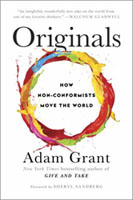 reveals insights into the link between creativity and procrastination in Chapter 4, Fools Rush In. While procrastination is mostly associated with laziness, it can also be defined as “waiting for the right time.” Adam writes that “Procrastination turns out to be a common habit of creative thinkers and great problem solvers.” The trick to meaningful procrastination is that one must start working on the project or problem in question first before setting it aside. Studies seem to show that leaving open loops active can spur original thinking as the mind slowly churns away on the project or problem in the background. This process may open up creative options that might not have been found if the situation was rushed. So the next time you feel procrastination setting in, it may be a sign that you are waiting for creative options to appear, in which case, procrastinate on!
 Think of the light on a telephone answering machine which turns on when a new message arrives. Failure to clear the message leaves the light on which means one will never know if another message has arrived after that one. The light ceases to have a function and becomes background illumination.
 In fact, I highly recommend listing to one podcast in particular:
  To be clear, this curse has nothing to do with magic or ancient mystical tombs. The Curse of Knowledge is a cognitive bias that occurs when individuals are unable to ignore the knowledge they have which others do not, or when they are unable to disregard information already processed. This is the reason why an expert musician can make a lousy teacher of novices, because the expert forgets what it is like to know so little.
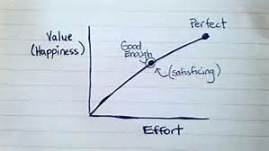 entails searching through the available alternatives until an acceptability threshold is met. (Satisficing = Satisfy + Suffice) Often this is a viable strategy since searching for the perfect product or solution would run into the law of diminishing returns where additional effort leads to fewer results. So a natural tendency is to find the first good choice and stop there. While satisficing can be a good short term option, it may result in long term inefficiencies. The quick purchase of running shoes now could produce regret over the colors and painful blisters a few days later.
 “Over the years many people have reported “transformational” experiences in working with the Getting Things Done® methodology. I have seen people lose pounds in just a few days, their faces brighten, their countenance and attitude swing way to the positive, and even make tremendous shifts in how they think and work for the rest of their lives.
 Efficient Librarian