Work/Life Balance Myth

davidallenIt has long been proposed that one of the secrets to a happy life is finding a work/life balance.  This is a magical equation where the right mix of meaningful work offset by an exact amount of normal life activity equals contentment.  However, is this really as true as it seems?
In a recent blog post, David Allen discusses this topic and comes to his own conclusions.

“There’s not really work/life balance, there’s just balance. I mean, work is anything you want to get done, right? It doesn’t have to be pejorative. Having a good vacation can be work. Just think of the affirmation: Wow, this really works! Is that a bad thing?”

Read the rest of his blog entry on the Getting Things Done web site.

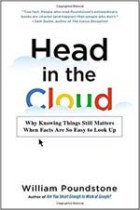
Head in the Cloud

There is an amazing paradox happening right now.  Due to the massive growth of the Internet, people have access to more information at their fingerprints than can ever be consumed in a thousand lifetimes.  However, it seems as if misinformation and lack of understanding are proliferating just as quickly as new Facebook accounts are activated.  In fact, people almost seem to have a worse understanding of the world than their pre-Internet grandparents had!

headinthecloudIn this book, Head in the Cloud, author William Poundstone explores the question of whether all this online information is only serving to make us less informed.  Online information is easier to skim, but hard to dive into deeply.  Poundstone specifically highlights a phenomenon known as the Dunning-Kruger effect which can lead people to overestimate their own level of knowledge in a subject area.

“Those most lacking in knowledge and skills are least able to appreciate that lack.  … The Dunning-Kruger effect requires a minimal degree of knowledge and experience in the area about which you are ignorant (and ignorant of your ignorance).” (p.10 & p.12)

In short, a little bit of knowledge can be a dangerous thing.

Read more by picking up a copy of the book from your local library.

Bad Choices

The word “algorithm” has a mysterious quality to it, as if only someone with an advanced degree in mathematics on computer science can understand its meaning.  However, an algorithm is actually a process or set of rules to be followed in calculations or other problem-solving operations. In fact, we use algorithms every day to make decisions in life, but we just don’t know it.

Inbadchoices his recent book, Bad Choices: How Algorithms can Help you Think Smarter and Live Happier, author Ali Almossawi cleverly and playful employs basic logic to solve real world daily task problems such as organizing socks, quickly finding your size in a rack of clothes, knowing when to visit the store for supplies, and solve a maze. Almossawi states:

“It is my hope that this book impresses on you the ability to better think about decisions throughout your life and better understand what trade offs they come with. … Much like critical thinking, algorithmic thinking is a highly capable tool that has the potential to impact behavior for the better.”

Pick up a copy of Bad Choices at your local library.

The Elephant and the Rider

There is a general assumption that we are in control of our own decisions.  It is often assumed that our conscious mind makes informed choices based on rational thought which then guides our life.  Unfortunately, this is far from the truth as our emotional mind is often far more powerful than we care to admit.

switchChip and Dan Heath discuss this dilemma in their book, Switch: How to Change Things When Change is Hard.  They use an image from the work of psychologist Jonathon Haidt of the “Elephant and the Rider.”  The Elephant is our emotional mind, which is big, strong, and reactive.  The Rider is the logical side which is purposeful, rational, and factual.  As the Heath’s explain on pg.7:

“Anytime the six ton Elephant and the Rider disagree about which direction to go, the rider is going to lose.  He’s completely over matched.”

The Heath brothers then present a three stage model to empower the Rider to move the Elephant in the right direction in order to make a switch.  The model is useful for changing habits, planning for the future, and making calm choices in the face of emotionally charged issues.

Check out Switch today.  You can also get resources from the Heath brothers web site following a free registration process.

Interrupting Interruptions

Think back to the last time you were hard at work on a project that required your full attention.  What happened when someone unexpectedly showed up at the door or called on the phone to interrupt your concentration?  How did you react?

I am sometimes asked how to handle interruptions.  This is not a trivial question.  According to a New York Times article, “Gloria Mark of the University of California, Irvine, found that a typical office worker gets only 11 minutes between each interruption, while it takes an average of 25 minutes to return to the original task after an interruption.”  Interruptions are a fact of life, so what is the best way to handle them effectively?  I see the solution as a series of executive decisions.

The first decision is to identify if the interruption is an emergency.  If so, handle it.

The next decision is whether the interruption will take less than two minutes to resolve (2 minute rule).  If so, clear it out of the way.

The third decision is the trickiest.  Does the interruption carry more value to your work world than the item you are engaged in right now?  If so, follow the interruption.  If not, ask the interrupter to schedule a time to meet later in the day or week to address the issue.  You can sooth any sore feelings by stating that scheduling a time to speak will allow you to give their item your full attention.

Interruptions are a fact of life.  How we handle them is the art of work.

Optimal Stopping

San Francisco is a hot rental market.  Most apartments are snatched up within a few days of being listed.  Imagine you are moving to San Francisco and want to find the ideal apartment.  You only have one opportunity to view each apartment and must decide on the spot if you want it.  If you reject it the apartment will be taken by the next renter.  How long should you spend on the apartment search in order to feel confident that you have found the ideal spot?  This is an example of the optimal stopping problem.

algorithmsAccording to the book Algorithms to Live By, “the crucial dilemma is not which option to pick, but how many options to even consider.”  The San Francisco situation is an example from the book which demonstrates that a person must gather enough information to become familiar with the market before selecting.  Pick too early and you risk taking a lousy apartment when the next one would have been superior.  Pick too late and you will regret all the great apartments you passed on. Is there an ideal solution to this dilemma?

Yes! According to the authors it is 37%!  This means you should spend 37% of your allotted time or the first 37% of the potential selections just looking.  This will calibrate you to the market.  After that point, take the first option which exceeds everything else you have looked at so far.  For example, if you have only one month to find an apartment, spend the first eleven days just looking.  On day twelve be ready to commit to the next apartment that is better than all the other ones you viewed up to that point.  This is claimed to be a mathematically provable optimum solution.

To learn more about optimal stopping, pick up a copy of Algorithms to Live By: The Computer Science of Human Decisions by Brian Christian and Tom Griffiths.

Explore / Exploit

Quick question: when it is time to select a spot for a special dinner would you rather return to an old favorite restaurant or take a chance on a new place that no one has been to before?  This choice is an example of a classic decision making challenge known as the Explore / Exploit trade off.

algorithmsIn order to discover new and exciting things in life, we have to be willing to explore options.  This will naturally result in some failures, but the treasures out there waiting to be discovered can be worth the effort.  However, once we have found a great resource it is tempting to keeping going back to the well to get as much of it as possible.  In the book, Algorithms to Live By, the authors sum up the trade off in this way: “Exploration is gathering information, and exploitation is using the information you have to get a known good result.”

In general, the research shows that at the beginning of a given time frame it is much better to focus energy on exploring.  After the halfway point it makes more sense to exploit the good stuff you have found.  I recently used this logic with my daughter on a trip to the Legoland theme park.  I encouraged her to try out as many new rides as possible on the first day of our visit, and then use the second day to go back to the rides she enjoyed the most and do them as often as she could.  It made for a very enjoyable experience as she braved new exciting roller coaster experiences, but still had time for her old calmer favorites.

So don’t be shy, go out and explore!  However, plan to enjoy the fruits of that exploration by saving time to exploit your favorites.