Is Life Better When You’re Busy?

Are you busy right now?

I ask because our modern life seems designed to offer too many options for things to do such that it is impossible to ever do them all. Yet there is a persistent fear of missing out (FOMO) that drives people to chase one thing after another, filling up every hour of the day with stuff. All this running around raises an important question: does being busy make life more fulfilling?

That is the question Scott Young addresses in his article Is Life Better When You’re Busy? In order to answer it he first focuses on the possible reasons why people are busy, of which none have to do with the actual volume of necessary work to be done.

  • Busyness as signaling. Busy people are important. Complaints about busyness are like complaints about paying too much in taxes—something that allows you to subtly communicate your status.
  • Busyness as dodging commitment. Claiming busyness is a socially acceptable way to decline social obligations. “I wish I could, but I’m too busy,” is more polite than, “No, your nephew’s piano recital doesn’t interest me very much.”
  • Busyness as self-deception. When you work on things, your goal is always to move toward a state of having less stuff left to do. Since less outstanding tasks is better within the context of your goal, you may incorrectly extend that to assume that having no outstanding tasks in life is ideal.
Photo by Alexander Dummer on Pexels.com

We seem biologically driven to be busy, perhaps as an evolutionary trait to ensure we keep on the lookout for food and avoid dangers. Boredom is viewed as a problem that must be resolved. Young takes time to consider whether this is a sweet spot where business and idleness meet for maximum satisfaction.

Later in the article, he considers if being busy is really a function of having too little time to complete our tasks.

Strictly speaking, we all have the same amount of time each day. Nobody has more or less. What feels like a lack of time is, more accurately, a conflict between priorities.

One problematic form of busyness occurs when your activity has low intrinsic enjoyment. If you’re forced to work long hours at a job you hate, then you need to somehow meet your psychological needs in the little time you have left. This can be tricky.

Read the entire article on Scott Young’s web site.

Pay Yourself First and Do It With Time

If you have ever tried to save money for retirement, you might be familiar with the “pay yourself first” strategy. This approach recommends that people take the first portion of their pay check and set it aside for savings. The rationale behind this strategy is that we have so many opportunities to spend money that relying on leftovers at the end of a month will lead to little savings or none at all. While this approach works for money, does it work for time?

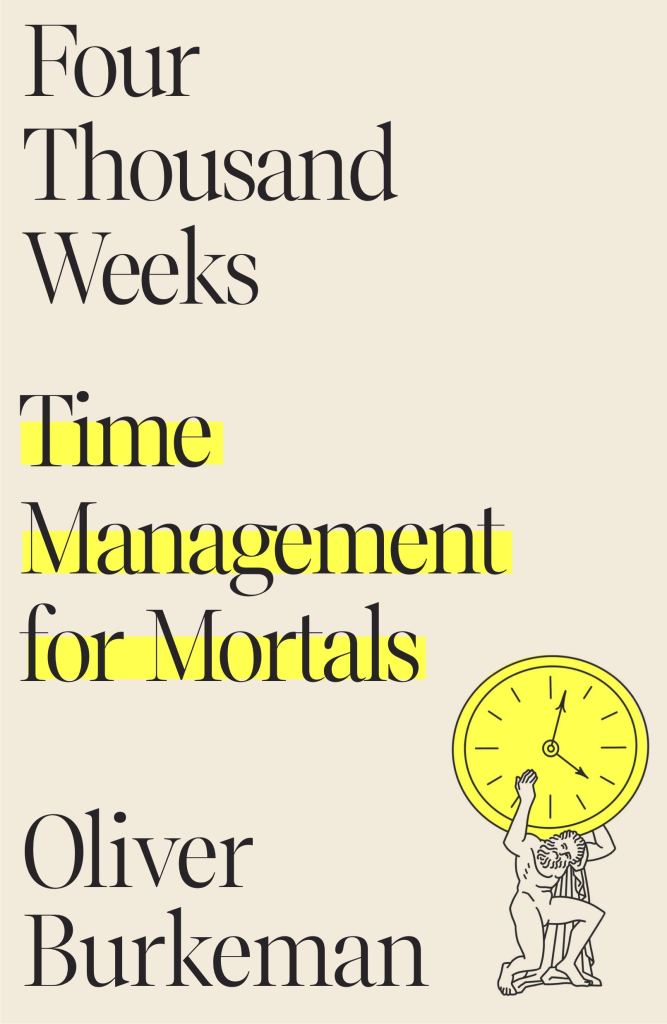
In his book Four Thousand Weeks: Time Management for Mortals, author Oliver Burkeman argues that many people spend their limited time on this earth doing things the feel they need to do, not what they want to do. As David Allen has long pointed out there is always more to do than we can ever do. If a person want to accomplish the things that matter most to them, their time must be preserved for those things. As he writes:

If you try to find time for your most valued activities by first dealing with all the other important demands on your time, in the hope that there’ll be some left over at the end, you’ll be disappointed. So if a certain activity really maters to you – a creative project, say, through it could just as easily be nurturing a relationship, or activism in the service of some cause – the only way to be sure it will happen is to do some if it today, no matter how little, no matter how many other genuinely big rocks may be begging for your attention. (pg 74)

Four Thousand Weeks

Now reflect on this question: what project or cause in your life do you want to give more attention to on a daily basis?

Once you know what it is dedicate a sacred time period each day to do it. Whether it is an hour in the morning to write that novel, or your lunch hour to attend a Toastmasters meeting to work on your public speaking, or even two nights a week to make phone calls to raise money for your favorite charity, these priorities only happen when you block off the time to do it.

So, how much time to do you want to pay yourself first?

Are We Too Busy?

How busy are you?

Often in America being seen as busy is a badge of honor. There is an assumption that we need to fill our days with as much work as possible. This formula can lead to extra stress and exhaustion.

The pandemic has given many people a chance to pause and reconsider their work day. In a recent article by Shayla Love on Vice, she notes how this unusual year has allowed many workers a chance for reflection.

The pandemic offered a rare window of opportunity for some people to become literally less busy, and perhaps more importantly, to get perspective on their cultural beliefs about busyness. Instead of being caught up in the inertia of always projecting a busy life, they had time to reflect on how they used busyness to define themselves—and how it led to stress and the conflation of productivity and self-worth.

Photo by energepic.com on Pexels.com

Later in the article, she explores the how people view business and happiness. It actually interferes with how they use their downtime. Looking at a recent study on the topic, Love notes:

But the paradox and masochism of busyness is also laid bare: the study found that while people aspire to be more like a busy person, they also consider the busy person to be less happy. An obsession with busyness also taints how people spend what little leisure time they have, … by wanting leisure to accomplish as much as possible in as little time as possible—called “productivity orientation.”

Read the rest of the article online at Vice.

Can you have purpose without passion?

There is a long standing idea that if you are not excited about doing something, then it is not for you. Passion for our work is said to drive us to do it better and stick with it when we are in rough times. How true is this idea?

According to David Allen, passion and purpose may be misunderstood. In a recent blog post titled, Go beyond passion to peaceful purposefulness, he shares thoughts about the connection between the two. To begin, he points out his resistance to passion.

I have been attempting to understand why it bugs me to hear professional motivators talk about the necessity for “passion” to be successful. Perhaps I’m just getting too old and lazy to be interested in jacking up my emotions about anything. (Getting passionate about something usually seems to me like hard work.) Or perhaps it’s the fact that jacked-up emotional states are not something you need or even want, to be successful.

Instead of passion, Allen shifts the mindset to the concept of identification.

I think I know what the motivators are referring to. There is a quality of intensity of commitment that resides with successful people. But rather than “passion” I would suggest the word “identification.” When you really identify with something, whether it is some intended outcome or some internal standard about your reality, it creates a true motivational energy to make it happen. But that does not at all mean a hyperemotional state.

Read his full post on the Getting Things Done web site.

4000 Weeks

It is easy to think that with enough time we will be able to accomplish anything we want. However, the truth is that our days on this earth is limited. Some of it is restricted by commitments that others put upon us, but most comes from those we place on ourselves. With limited time, most of the items on our Someday/Maybe list will never be completed. This may seem grim, but it also serves as the inspiration to do great things.

In a recent article in The Atlantic, reporter Joe Pinsker shares an interview with author Oliver Burkeman about his new book, Four Thousand Weeks: Time Management for Mortals. In the book, Burkeman states that the average life span of a person lasts around 4000 weeks, roughly to about the age of 80. With this finite perspective in place, a person can tackle the challenge of determining what is most important to them.

“The average human lifespan is absurdly, terrifyingly, insultingly short,” he writes. Given this limitation, it makes sense that the typical approach to time management is to seek ways to cram ever more into our finite number of days.

But Burkeman argues that this is the wrong way to manage time. Rather than looking outward to productivity strategies and hacks, Four Thousand Weeks encourages an inner shift in perspective. It confronts a series of comforting illusions that many of us hold onto instead of internalizing colder truths: that we will die not having done a tremendous number of things we care about; that every commitment we make to a person, place, or line of work rules out countless others that may fulfill us; that our lives are already ticking away.

Later in the article, Burkeman makes a statement that seems to sum up his philosophy.

The only way to get around to the important things is: Instead of trying to eradicate all the other stuff, [make progress] on the important stuff first. You just have to let the other chips fall where they will.

Read the full interview on The Atlantic web site.

Critical Thinking – The Smart Thing to Do

Have you ever known someone who was very intelligent, yet made dumb mistakes? Take the story of Jonah Lehrer. He was an up and coming New York Times journalist whose career collapsed after a plagiarism scandal. Then it was discovered he fabricated quotes he attributed to Bob Dylan then lied about the source. All around the world smart people fall for scams, conspiracies, and tricks. It seems that having a PhD, membership in Mensa, or honored credentials from prestigious organizations does not prevent foolishness.

Scientific American journalist Heather A. Butler explored the intersection of intelligence and decision making in an article titled Why Do Smart People Do Foolish Things? In it, she points out that intelligence is not about being wise.

The most widely known measure of intelligence is the intelligence quotient, more commonly known as the IQ test, which includes visuospatial puzzles, math problems, pattern recognition, vocabulary questions and visual searches.

Image from Pixabay.com

Butler contrasts it to the skill of critical thinking.

Though often confused with intelligence, critical thinking is not intelligence. Critical thinking is a collection of cognitive skills that allow us to think rationally in a goal-orientated fashion and a disposition to use those skills when appropriate. Critical thinkers are amiable skeptics. They are flexible thinkers who require evidence to support their beliefs and recognize fallacious attempts to persuade them. Critical thinking means overcoming all kinds of cognitive biases (for instance, hindsight bias or confirmation bias).

Butler goes on to share why it is important to understand the difference since it is hard to increase intelligence, but one can train to improve critical thinking skills. Read her article to learn more.

Disagreeable Feedback

It is a simple fact that in order to improve in any skill, whether it be management, communication, or computers, feedback is needed. Great feedback happens when it is very specific, given timely, and in a way that is supportive of the recipient. However, we have all experienced feedback that doesn’t work for us. In fact, some feedback may simply be inappropriate or wrong. What is the best way to respond?

Kim Scott, author of Radical Candor, is one of the leading experts on effective workplace communication. In a post on her blog, 5 Tips for When You Disagree with Feedback, Kim is very straightforward with the notion that you do not have to agree with feedback.

You can and should tell the person that you disagree. If you just say, “Thank you for the feedback” through gritted teeth, you seem Manipulatively Insincere. Better to take the time to explain why you disagree. Once, a CEO to whom I’d offered criticism told me the next day, “I reject that feedback — but I love that you told me what you think! Do you want to hear why I disagree?” Of course I did — and I actually felt better about my coaching of him after that because he’d been so totally open to criticism before that moment that I wondered if he was really hearing it.

Kim Scott

Kim wants to ensure that the person providing the feedback is honored for doing so. That way they understand you appreciated the effort even if you disagreed with their assessment. She then provides five tips on how to deal with feedback. The first is to check your understanding.

Repeat back what you think you heard, and say, “Did I understand correctly?” or “Did I get that right?” This is a good opportunity to show you care about the person, and what they think.

Learn more tips about how to respectful respond to disagreeable feedback on the Radical Candor web site.

What Your Brain Really Does

The human brain remains one of the deepest mysteries in biology. It is the most important part of our body, but even with all the advances in neuroscience we still don’t fully understand how it works. In productivity circles it is often assumed that better knowledge of brain function might improve efficiency and creativity.

Photo by meo on Pexels.com

In a recent interview in GQ magazine, neuroscientist Lisa Feldman Barrett reveals surprising facts about how our brains really work. For starters she reveals what the brain’s most important role is:

The brain’s most important job is not thinking or seeing or feeling or doing any of the things that we think of as being important for being human. Its main job is running a budget for your body—to keep you alive, to keep you healthy. So every thought you have, every emotion you feel, every action you take is ultimately in the service of regulating your body. We don’t experience mental life this way, but this is what is happening under the hood.

Read the rest of the article on the GQ web site or pick up her new book: Seven and a Half Lessons about the Brain.

Make a habit about not worrying about your habits

Developing great habits is one way to succeed at life. Whether it is being productive, healthy, or financially free, our habits drive our daily behavior towards the longer term goals that inspire us. However, there are many days, especially this year, where sticking to good habits is a struggle. Whether it is the temptation to watch TV instead of work, eat a big bowl of ice cream, or splurge on a fancy new toy, it is easy to slip out of our desired habits. When they happen should we feel guilty about these indulgences?

In a recent blog post, Darius Foroux argues that we should stop worrying about missed habits. Being too strict around them is actually counter productive. He writes:

We humans have this tendency to take everything to the extreme. And when it comes to habits, I found that majority of my friends, family, readers, and students have an all or nothing mentality.

You either work out every day or you do nothing. You either write every day or you do nothing. Why so serious? The reason for this is negative self-talk. We assume that we messed up if we miss our habits for a few days.

Darius Foroux

Foroux advises that we not worry about missing one day of a habit.

If you practice true mindfulness, there are no streaks. There’s only now. You shouldn’t care about what you did yesterday. Only care about what you’re doing today. And always try to make the best of it.

Every day is a new day that has nothing to do with yesterday.

Read the full post on his web site.