
There is an amazing paradox happening right now. Due to the massive growth of the Internet, people have access to more information at their fingerprints than can ever be consumed in a thousand lifetimes. However, it seems as if misinformation and lack of understanding are proliferating just as quickly as new Facebook accounts are activated. In fact, people almost seem to have a worse understanding of the world than their pre-Internet grandparents had!
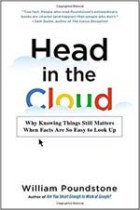 In this book, Head in the Cloud, author William Poundstone explores the question of whether all this online information is only serving to make us less informed. Online information is easier to skim, but hard to dive into deeply. Poundstone specifically highlights a phenomenon known as the Dunning-Kruger effect which can lead people to overestimate their own level of knowledge in a subject area.
“Those most lacking in knowledge and skills are least able to appreciate that lack. … The Dunning-Kruger effect requires a minimal degree of knowledge and experience in the area about which you are ignorant (and ignorant of your ignorance).” (p.10 & p.12)
In short, a little bit of knowledge can be a dangerous thing.
Read more by picking up a copy of the book from your local library.
 This is a question of great interest to behavioral economist Dan Ariely. So much so that he did several experiments which aimed to probe deep into how people assign value to the work they do. The results of the experiments were shared in a TED Talk. From the video description:
 Illusory Superiority is a cognitive bias whereby individuals overestimate their own qualities and abilities relative to others. It is sometimes called the Lake Wobegon Effect after
  Optimal stopping : when to stop looking
 To be clear, this curse has nothing to do with magic or ancient mystical tombs. The Curse of Knowledge is a cognitive bias that occurs when individuals are unable to ignore the knowledge they have which others do not, or when they are unable to disregard information already processed. This is the reason why an expert musician can make a lousy teacher of novices, because the expert forgets what it is like to know so little.
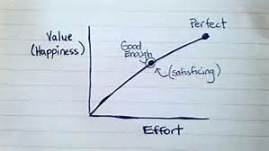 entails searching through the available alternatives until an acceptability threshold is met. (Satisficing = Satisfy + Suffice) Often this is a viable strategy since searching for the perfect product or solution would run into the law of diminishing returns where additional effort leads to fewer results. So a natural tendency is to find the first good choice and stop there. While satisficing can be a good short term option, it may result in long term inefficiencies. The quick purchase of running shoes now could produce regret over the colors and painful blisters a few days later.
