
The Endowment Effect

yellowcupThe pursuit of efficiency often requires a cleanup of our physical spaces.  While clearing out clutter should be easy to do, in practice it is hard to throw away objects we own.  For example, maybe you got a mug at a conference six years ago.  The conference was unmemorable and the mug is an awful yellow color.  As you are considering parting with it, a colleague asks if they can have it.  You quickly decline and put it back on the shelf.   This is a direct experience of the Endowment Effect.

The Endowment Effect is the hypothesis that people ascribe more value to things merely because they own them.   In studies, people want more money to sell an an item they own than they would ever be willing to pay for it new.  Plus, there is often a sentimental value attached to the item, which makes it even harder to part with.

If the Endowment Effect is an obstacle when clearing out clutter, it might be useful to adopt a strategy similar to the one used to avoid the Sunk Cost Effect.  Look at the item as if it were on a store shelf and ask yourself if you would buy it today.  If not, get rid of it.  Another approach is the KonMari Method.  Hold the object in your hand and ask yourself it is sparks joy within you.  If not, discard it.

In order to experience the strategic value of clear space, it is necessary to discard unused items from your world.   Consider these strategies for your next office cleaning session and see the results.

The Order of Organization

So you finally decided to start organizing your home or office.  At first it can be a tall task, especially if the space is full of clutter.  You may ask yourself, “Where do I start?”  It can be tempting to identify a corner of the room or a particular desk or table as a starting point.  But, could there be an ideal way to approach the task?

mariekondoIn “The Life Changing Magic of Tidying Up” author Marie Kondo advises that all organizing proceed by category.  Her system guides people to work from things with the least sentimental value to the most by specific types of items.  She explains:

“Start with clothes, then move on to books, papers, komono (miscellany), and finally things with sentimental value.  If you reduce what you own in this order, your work will proceed with surprising ease.  By starting with the easy things first and leaving the hardest for last, you can gradually hone your decision-making skills, so that by the end, it seems simple.” (pg. 65)

See more at her web site Konmari.com and check out the book from your library.

Are You Overdue for a Weekly Review

overtop-desk-photoWhen did you last do a complete weekly review?  Work life moves fast, so it is important to take time to reflect on what has happened and what is coming soon.  The weekly review is a valuable opportunity to tidy up loose ends, assess progress, and prepare for the upcoming week and months ahead.  It allows for a refocusing of attention onto the things that matter instead of the latest and loudest.
A few tips for a successful weekly review:

  • Schedule it for the last day of your work week in order to enter your weekend with a clear head.
  • Block out 1-2 hours.  Close the door and ask your colleagues to honor this time of solitude.
  • Get clear – Process any last minute items that have found their way into your inbox  and do a quick mind sweep to empty out anything found only in your head to get it into your system
  • Get current – Tidy up your action folders, identity outstanding waiting for items, review your calendar going two weeks back and then as far forward as necessary.
  • Get creative – Review your someday/maybe folder for new projects to trigger, peruse your read/review pile, and reflect on the higher horizons of focus to gain perspective on your work.

To modify an old saying, a weekly review today keeps workplace stress away.  Try it and experience the difference it makes.

The Life-Changing Magic of Tidying Up

The basic idea of organizing is to get rid of stuff you don’t need, and then place the items to keep in an appropriate spot out of the way where they can be found again when needed.  However, mental attachments to our belongings can trick us into retaining items long past their usefulness or value, which leads to clutter and confusion.

mariekondoIn her best-selling book, The Life-Changing Magic of Tidying Up, Marie Kondo created a systematic approach to organizing home and office spaces that can be quickly implemented by anyone.  While most people read the book for the nuts and bolts of how to organize a closet or drawer, the book shares a deeper Zen-like philosophy which resonates beyond the mere allocation of our stuff.  Marie calls it the KonMari Method™.  From her web site:

The KonMari Method™ is a way of life and a state of mind that encourages cherishing the things that spark joy in people’s lives.

Belongings are acknowledged for their service and thanked before being let go of, if they no longer spark joy.

People are drawn to this philosophy not only due to its effectiveness, but also because it places great importance on being mindful, introspective, and optimistic.

See more at her web site Konmari.com and check out the book from your library.

Why is there stuff on my chair?

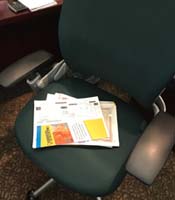
Have you ever come back to your desk to discover that someone left a note on your chair?  I am sure most office workers regularly encounter this situation.  I believe the reason people leave notes on their colleague’s chairs is that they do not trust that person’s inbox.

messy-chairThe inbox is designed to capture new information and works best when new input is regularly processed and organized. Once an inbox fills with clutter, new input quickly gets lost. People see that messy inbox as a graveyard and avoid it like a real one. Therefore, they will find ways around the dysfunctional inbox and a favorite option is to use the chair.  They assume that the person will see it before they sit down!
To avoid having your colleagues turn your chair into an inbox, try working the one on your desk more efficiently.  Clean it out every 24-48 hours to stay fresh for new input.  Be warned, some people are now programmed to bypass even a clean inbox and automatically go for the chair. When this happens to me, I tell that colleague that I will sit on the item, literally and figuratively. Then I politely point them to my inbox and ask that they place it there instead for timely processing.  It keeps the chair much more comfortable that way.


Searching vs. Sorting

Question – where should reference emails be stored?  Many people follow a strategy derived from paper filing by creating a large number of subject based folders into which they sort their messages.  Another strategy is to have only one reference folder for everything and power search it.  Is either approach better than the other?

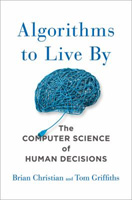
algorithmsAccording to the book, Algorithms to Live By: The Computer Science of Human Decisions, there is an answer to this question.  On page 72 of the paperback copy, they explain the dynamic at work:

“And one of the most central tradeoffs is between sorting and searching.  The basic principle is this: the effort expanded on sorting materials is just a preemptive strike against the effort it’ll take to search through them later.”

On page 73 they state:

“Filing messages by hand into folders takes the same amount of time as filing physical papers in the real world, but emails can be searched much more efficiently than their physical counterparts.  As the cost of searching drops, sorting becomes less valuable.”

Therefore, the advice is to get by with as few email reference folders as possible.  Save the time you would have spent sorting emails for something more useful, like watching adorable kitten videos on YouTube …

What Does It Mean To Be Organized

Many people gravitate to a system like Getting Things Done to help develop basic organizational skills.  This is true for me.  Years ago I recognized that my messy desk and inbox was a detriment to my productivity.  I badly needed a system to get myself organized so I could handle more workflow and meet my deadlines.

In a recent blog post on GTD Times, Marian Bateman, Certified GTD Coach, explores what it really means to be organized:

cleandesk“What does it mean to be organized? It used to be the definition was clean and neat. You know the offices–you walk in the door and it looks likes no one works there. The desk has nothing on it, except for a cool object and a photo. Is this what being organized really means?

My answer is we need to update our definition of what the term organized means.”

Read the rest of the blog entry at: http://gettingthingsdone.com/2017/02/what-does-it-mean-to-be-organized/

Inbox Zero

inbox-zeroEmail provides for many people their most difficult productivity challenge.  The sheer volume of messages can overwhelm an inefficient processing system very quickly.  While some people may be tempted to declare email bankruptcy and delete all their messages, there are better ways to process all that incoming electronic data.  One approach that is based in part on GTD methodology is Inbox Zero, developed by Michael Mann and found on his web site 43 Folders.  The site hasn’t been updated in a while, but the information is still useful.  From the web site:

“43 Folders is focused on an arc about how to improve the quality of your career and life by managing your attention in a way that allows you to work your ass off on the creative projects that matter most to you.”

His web site is most famous for the Inbox Zero posts.  The component of Inbox Zero that is most powerful for me is the idea to reduce the number of email reference folders down to one or a very few and then relying on your email app’s power searching tools to search for archived material.  This saves time on the front end while sorting email and on the back end when retrieving it. Take up the 43 Folders Inbox Zero challenge by reading all the posts on this topic, compiled on one page.  See if it makes a difference to your electronic world.

Purge Your Files

paper-filesAs we approach the end of the year regular work flow often slows down as colleagues take vacation for the holidays.  For me, I have found this to be an ideal time to tidy up by purging my paper files.

Filing is a beast that needs to be kept tame or it will slowly eat away at your productivity.  The surest way to let it run wild is to never purge old files, leaving your cabinets filled with stuff that is no longer needed.  Remember, if your file cabinets get over three quarters full the desire to file will diminish and piles will begin to appear all around you.

So make an appointment over the next few weeks to spend quality time with your files. You can even create space by digitizing files and then tossing the paper copy. I invite you to end your year by purging unneeded paper from your file cabinets and see how good it feels to have a clean start for 2017.