
 I’m a big fan of the British SF series, Doctor Who. In the show, an alien called The Doctor flies around the universe in a time machine called the TARDIS. While The Doctor has a deep knowledge of temporal mechanics, alas we humans have a very poor understanding of time. In fact, we often underestimate how much time tasks take to do even when we should know better.
In his book, Thinking Fast and Slow, Daniel Kahneman discusses the “planning fallacy.” This fallacy occurs when someone routinely underestimates the amount of time it takes to do a task. For example, if on one occasion we got all the lights and made it to work in 20 minutes, a part of our mind now believes we can always make the trip in that time. This is despite the fact we know from our prior experience that it normally takes 30 minutes or more.
The repercussion in our daily lives is the tendency to assume we can get more done in a day than is actually possible. This typically manifests in lengthy to do lists that never get completed. A practical way to combat the planning fallacy is to make our to do lists shorter. In her book, 52 Simple Ways to Get Organized, Claire Tompkins suggests the following:
“The problem with underestimating is that you believe you have more time for those things on your list that aren’t getting done, and then you feel discouraged. Everyone’s daily to do list needs to be a lot shorter.”
She then suggests that we time our regular tasks to determine exactly how long they take. With this knowledge in hand, we can then carefully plan our day and combat the planning fallacy.
The other way to solve the problem is procure your own time machine, but that might be hard if you don’t have a Time Lord for a friend.

 As someone who teaches
 When you travel home from work, do you ever feel a small sense of anxiety coming along for the trip? With input coming fast and furious throughout the day, it is a challenge to process everything during our 9-5 day. It is tempting to let it all pile up and resolve to handle it tomorrow. However, when a part of your mind lingers on unprocessed work, it can be a source of deep unease at home.
 Tiago Forte of

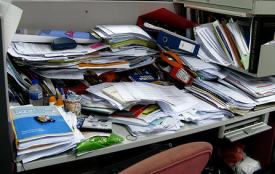 While this observation is also applicable to our childhood and teenage years, most of us have a tenancy to pile belongings throughout our living and work spaces. This is because we have not taken the short time required to consider the value of that item, if we want to keep it, and the proper place it should reside. For home and office, the contexts are different. At work, the two GTD questions at the top of the
  Efficient Librarian