
(This is a sequel to my original article on games show probabilities.)
The Misconceptions of Airplane Safety
When are airplane comes in for a landing there are two possible outcomes: a safe landing or a crash landing. Therefore, what is the probability that the plane will crash?
Recently during a presentation of my seminar, Why Did I Make that Dumb Decision? Understanding Common Fallacies of Decision Making and How to Avoid Them, I asked this question to the audience. Immediately, someone answered 50%.
Of course this was not accurate. Commercial airplanes rarely crash. The website, FlyFright, shares government statistics that show odds of a plane crashing are 0.000001%. Also, there is a 1 in 816,545,929 chance of dying in a plane crash.

In fact, the most dangerous part of air travel is driving to and from the airport! Data from the Florida Highway Safety and Motor Vehicles department shows 3,454 fatal motor vehicle crashes in 2021. That is only one state out of 50! Given the higher frequency of car crashes, why are more people afraid of flying than driving? One reason is that we are primed to hear about plane crashes since these rare incidents are covered widely in the national media. Car crashes by contrast only get brief mention on the local news.
This example highlights the simple fact that possibilities are not probabilities. In the majority of cases where there are multiple possible outcomes, they are not equally likely to happen. Yet, our minds often default to thinking all possibilities are equally likely. This can lead to poor decision making.
Deal or No Deal Revisited
The most popular article on my Efficient Librarian website is Deal or No Deal Mr. Hall – How We Misunderstand Probability. That article was framed with a real story from Deal or No Deal. For those unfamiliar with this game show, the premise starts with twenty-six briefcases containing values from 1 penny to $1 million. The contestant picks a case and leaves it unopened next to them. They proceed to eliminate a set number of cases in each round. Based on the prize amounts left in play a mysterious banker offers the contestant a cash payout to quit. This goes on until the player accepts a banker offer or they eliminate all briefcases except their initially chosen one.
A contestant named Luis once reached the final round of Deal or No Deal with only two values left in play, $5 and $750,000. From his interview on the podcast Choiceology, Luis believed the chance that he the $750,000 case was 50%. Was that true? In this case, did possibilities equal probabilities? The complexities of the Deal or No Deal game is reflective of the fundamental challenge our human brains have to understand probability. This can be seen clearly by turning Deal or No Deal into another game show, Let’s Make a Deal. Therefore, let’s reflect on the Monty Hall Problem.

Briefly, the Monty Hall Problem is a scenario named after the popular host of the show. A contestant is given the option of picking one of three doors. Behind one is a brand new car, the others have goats. After the constant picks a door, Monty Hall, who knows which door has the car, opens up an unchosen door to reveal a goat. He then gives the contestant the option to change to the other unopened door or keep their original door.
Should the contestant switch doors?
The answer is yes. Switching changes the chance of winning from 33% to 66%. (To understand why, please read this examination of the problem.) Yet most people believe that the odds change to 50% because there are only two doors left. In short, they assume possibilities equal probabilities. However, it is a fallacy to believe that probabilities change after the initial choice is made. In the Monty Hall problem, the chance that the contestant chooses the winning door is 1 in 3. Revealing a dud door changes nothing because it was already known that one of the two unchosen doors had to have a goat.
Let’s take the Monty Hall logic and apply it to Deal or No Deal. Since there are 26 cases, let’s consider the values of the lower 17 cases (everything from 1 penny to $25,000) as minor prizes. The remaining cases (valued $50,000 to $1 million) are major prizes. Therefore, when a contestant makes their one and only choice at the start of the game, they have approximately a 65% chance of choosing a briefcase with a minor prize. That’s almost a 2 in 3 chance, very close to the Monty Hall Problem. As the contestant eliminates cases, they might randomly remove more major prizes than minor ones early on, making for a dull game. However, Deal or No Deal is designed to heighten the tension by making it probabilistically more likely the more numerous minor prizes are eliminated first. No matter which way it plays out in terms of eliminating cases, the contestant’s initial odds of picking a major prize never change because they always retain their original case.
The only way the final round could become 50/50 is if the host took back the contestant’s initial briefcase, mixed it with the remaining case, and had the contestant blindly pick again. New odds can only happen with new picks. That’s why in the Monty Hall Problem the odds change once the contestant is given the option to pick again.
As a thought experiment, let’s change the rules of Deal or No Deal by NOT having the contestant pick a briefcase at the start of the game. As before, the contestant eliminates cases off the board in the same round structure. However, at the end of any round they can pick a case, open it and win that prize, game over. In that scenario, the odds would change each time cases are eliminated. For example, there is a 1 in 26 chance at the start of the game to pick the million-dollar prize. If a contestant got down to six cases and the million was still in play, then the odds of picking the grand prize would be 1 in 6. Remember, even if the host revealed the values in the remaining cases before opening the player’s choice, it would not change the odds after the pick is made.
Surviving Cases – Is it Destiny?
Let’s consider the Survivorship Bias fallacy. This is where people erroneously give higher probabilistic weight to something that has managed to linger around by pure chance. For example, if a deck of normal playing cards was laid out on a table face down, the odds of randomly picking a face card (Jack, Queen, or King) is 12 in 52, simplified to 3 in 13. Now imagine a player randomly removing cards, turning them face up, until only 13 remain. If 6 face cards were left, the player might assume that destiny kept those cards in play. Instead, it was simply a matter of chance. Repeating the experiment could create a situation were no face cards remained in the final thirteen. Survivorship is often random.

Let’s return to Deal or No Deal. If the player goes to the last round of the game, there is roughly a 1 in 3 chance that a remaining non-selected briefcase is a high value prize ($50,000 or above). Therefore, in Luis’s game, the fact that the $750,000 prize survived is not surprising. In addition, a player is far more likely to play to the last round if a very large prize randomly survives to the end.
Now, imagine a simplified version of Deal or No Deal that has only three cases with the prize amounts of $1, $10, and $1 million. The player chooses their initial case, and then picks a case to eliminate. Again, we have the Monty Hall Problem, except the tension can be blown by the player accidentally eliminating the million-dollar case! Even if the player successfully eliminates one of the low values, the probability that the million-dollar case was originally chosen remains 1 in 3. Expanding the number of briefcases makes it appear more complicated, but the underlying logic of the game is similar to the Monty Hall problem.
One important factor not included in my prior article on Deal or No Deal was the Banker’s offer. This is a key feature of the game and a repeated source of dramatic tension. When a player is presented with an offer, they have to guess whether the guaranteed money is higher than the value in their briefcase. According to this analysist of real game play, the Banker’s offers are always less than half the value of the largest prize still on the board. In the early rounds they are pathetically low, but rise significantly as the game progresses, assuming a large prize remains in play.
In the game from Choiceology, Luis was offered $333,000 to quit in that final round. Unless he was totally committed to go for it no matter what, what was the best way to make a decision? I suggest that Luis should have considered the probability that his randomly selected case contained a value higher than the Banker’s final offer. Only 4 out of 26 briefcases contain a value higher than $333,000. Therefore, Luis had a 15.4% chance of selecting one of those very high value cases at the start of the game. Rationally with such small odds Luis should have taken the Banker’s offer, but he rejected it. Sadly, it was revealed he had the $5 briefcase.
Takeaways
You might be wondering how puzzling over these odd problems is relevant to daily living. After all, very few people get on a game show. However, the Monty Hall and Deal or No Deal problems are useful tools to demonstrate how our minds are bad at understanding probabilities.
Here’s a common scenario we all encounter: buying insurance. Whether it is home, auto, or health, we face bewildering sets of plans with co-pays, deductibles, and conditions. How do we determine which options are financially best to provide the ideal amount of coverage? Or is it wise to forgo insurance entirely? In hurricane prone areas, some residents are forsaking home insurance because the premium cost is too expensive. Without insurance they risk losing everything in a disaster. How can they determine if the gamble is worth taking?
(Please note that resolving this problem is beyond this article. A good insurance broker can walk a client through the options.)
To end, let’s discuss gambling. Almost everyone has played a game of chance to win money. Whether it is a lottery ticket or a casino slot machine, easily calculated probabilities show these games a losing proposition. Yet millions of people visit casinos every year and many millions more buy lottery tickets. Gambling habits can drive people into debt and bankruptcy. Why does anyone do it?
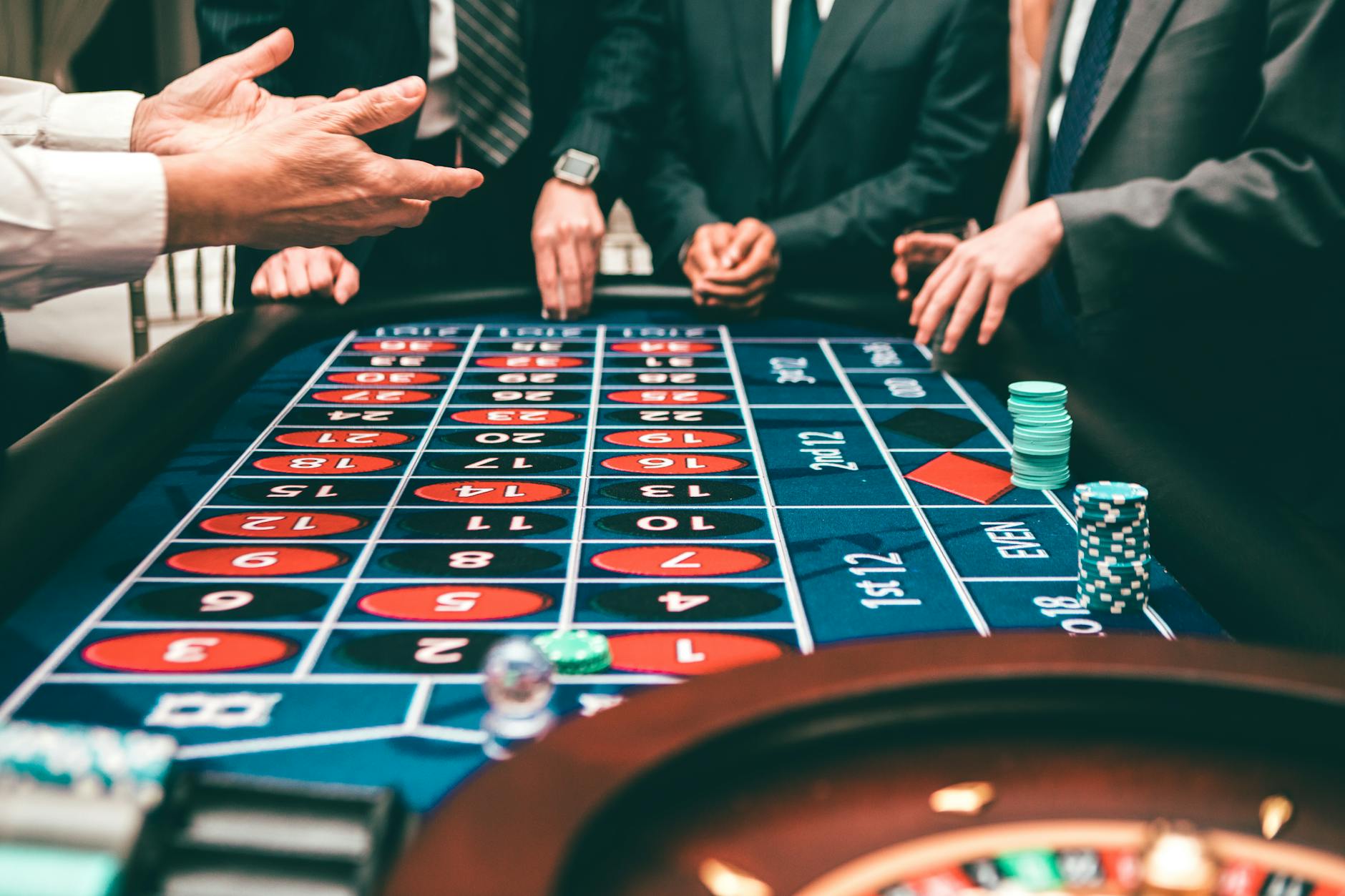
On the surface it seems foolish to play lottery or casino games since the odds of winning are very small. Part of what drives people is the fantasy of big prizes, enhanced by the marketing prowess of the gaming companies. The free alcohol in casinos certainly plays a role. Yet, what sells people to make the initial purchase of a ticket or to walk in the casino door is their misguided belief that winning big is statistically likely. After all, there are only two possibilities: winning or losing.
Alas, in this case we can be certain that possibilities are not probabilities. So do yourself a favor. Avoid buying lottery tickets and don’t go into casinos, unless there is a really good dinner show! And if you get on Deal or No Deal, please consider the Banker’s offers wisely.
 Efficient Librarian