Living Through Strange Times

On my list of all-time favorite films and books is the Lord of the Rings trilogy by J.R.R. Tolkien. The core of the story is about a Hobbit named Frodo Baggins who is tasked with destroying the dangerous One Ring to prevent it from falling into the hands of the dark lord Sauron. During the first book/movie, The Fellowship of the Ring, while traveling through the dark and dismal Mines of Moria, Frodo confides his despair to the wizard Gandalf. (Watch the clip.)

Frodo: “I wish the Ring had never come to me. I wish none of this had happened.”

Gandalf: “So do all who live to see such times, but that is not for them to decide. All we have to decide is what to do with the time that is given to us.”

I find myself revisiting Gandalf’s advice as we move deeper into these strange times. Often I find it easy to be like Frodo and wish this invisible enemy would go away so that we can resume life as normal. But Gandalf’s words remind us that while we all must endure bad times, the best way to get through them is to decide how we will respond to them.

Recall the formula, E+R=O from our friends at Focus 3. It stands for: Event plus Response equals Outcome. It acknowledges that we are always impacted by external events beyond our control. However, we can mindfully take control of our response to those events in order to get a better outcome. This is essentially what Gandalf is sharing in that moment and it is a wisdom that has profound implications.

Across the world we see normal people stepping up to make a difference in seemingly small but amazingly meaningful ways. Whether it is shopping for those who are home bound, sewing masks for first responders, or giving free food to those out of work, the ways to contribute are endless. For me, an amazing example came out of Spain where a fitness instructor lead quarantined residents of the neighboring apartment buildings through an exercise routine from their balconies. Everyone has the capacity to impact lives. As with Frodo, the small Hobbit in a big and dangerous world, it is ultimately through his perseverance and his friendships that he succeeds. As we walk this path together (in a socially distanced way of course) we can commit to make small differences that will have profound positive impacts on all of us.

So I invite you to consider what you will do with the time that is given you to make the world a better place.

Tips to Relax

Staying productive and calm are challenging in normal times. This past week the country saw a health care crisis kick into a higher gear, deepening our sense of stress. There is no doubt it is very important to take the situation seriously. However, since we do not know for certain how long the COVID-19 threat will affect us, it serves no purpose to burn out early.

Therefore, this week, I bring to you a couple of simple relaxation tips from our friends at WebMD.

1. Meditate

A few minutes of practice per day can help ease anxiety. “Research suggests that daily meditation may alter the brain’s neural pathways, making you more resilient to stress,” says psychologist Robbie Maller Hartman, PhD, a Chicago health and wellness coach.

It’s simple. Sit up straight with both feet on the floor. Close your eyes. Focus your attention on reciting — out loud or silently — a positive mantra such as “I feel at peace” or “I love myself.” Place one hand on your belly to sync the mantra with your breaths. Let any distracting thoughts float by like clouds.

Photo by Elly Fairytale on Pexels.com

2. Breathe Deeply

Take a 5-minute break and focus on your breathing. Sit up straight, eyes closed, with a hand on your belly. Slowly inhale through your nose, feeling the breath start in your abdomen and work its way to the top of your head. Reverse the process as you exhale through your mouth.

“Deep breathing counters the effects of stress by slowing the heart rate and lowering blood pressure,” psychologist Judith Tutin, PhD, says. She’s a certified life coach in Rome, GA.

WebMD offers eight more easy tips to reduce stress. I invite you to review the rest of them.

Above all, I wish you all safety and good health in these trying times.

Is Your World Outrunning You?

Are your ready for the next surprise? Did you know there is a surprise coming? It is inevitable that something will occur in the next week or so that you were not expecting to happen. It could be a pleasant surprise, or a shocking and jarring one, but it will happen. So, how will you handle it?

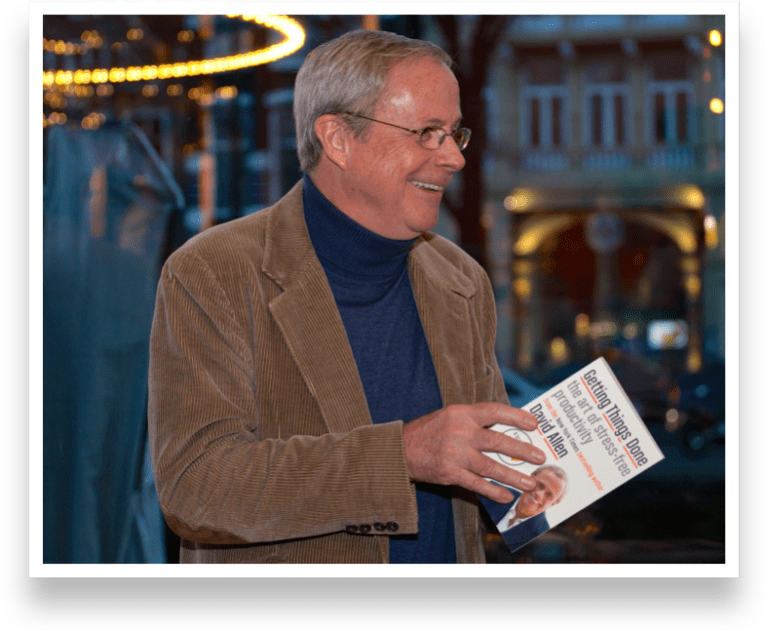
David Allen built his GTD system with the understanding that life moves quickly and we can not possibly anticipate everything that is going to happen. In a recent blog post called “Is Your World Outrunning You?” he considers how we came to this point and why systems like GTD help us navigate these fast-changing times:

David Allen – Founder of GTD

There is nothing new in the world, except how frequently things are new, and the number of people having to accept and adapt consistently to that reality. The difference between your world and that of your parents is in how much less you can count on anything providing stability in your life and work, for any significant length of time. Perhaps your father and mother had to totally reconfigure their worlds two or three times in their adult life, if that. You might have to do that two or three times this year.

(Why is GTD successful?) Quite simply, the need people have to create more room in their heads, less stress in their lives, and more control over all the facets of life and work that now impinge on most all of us.

Read the rest of his article on the GTD web site.

The Zen of Bridgewater

“The traditional relationship between “leaders” and “followers” is the opposite of what I believe is needed to be most effective, and being maximally effective is the most important thing a “leader” must do.” – Ray Dalio

Although I have been a librarian for over twenty-two years, it still amazes me that certain books can have a deep impact on our view of the world and ourselves.  This is happening to me right now with a remarkable book called Principles by Ray Dalio.  

Ray Dalio founder, co-chairman and co-chief investment officer of Bridgewater Associates, has written a book that seeks to encapsulate the amazing culture that he built in his company.  Bridgewater is designed as an idea meritocracy, where seeking the truth is paramount to all else. It is believed that a culture which prizes openness and vigorous debate above authoritarian structures is the key to success.

Dalio’s views on leadership were so intriguing to me that I wrote an article to explore them deeper. The excerpt below discusses why Dalio believes that leaders should not be afraid to ask questions.

Dalio places a high premium on asking questions.  While some leaders may hesitate to ask questions out of concern that they may look ignorant or uninformed, Dalio believes that asking questions is, “necessary in order to become wise and it is a prerequisite for being strong and decisive.”  Taking it even a step further, he believes that leaders should not hesitate to seek out those who are smarter and wiser then themselves, and even let staff who are better equipped in an area take the lead.  Ego and self promotion have no place in a true meritocracy.  As Dalio states, “The objective is to have the best understanding to make the best possible leadership decisions.”

Read the entire article and let me know your thoughts on this challenging approach to leadership.

Stoic Time Management

Given the high speed of modern life, it would seem that the need for daily time management skills is a recent development. However, a look through history shows that busy people in every age were concerned about making effective use of their time.

In Ancient Greece and Rome a simple but profound philosophy of life developed called Stoicism. An article on the Daily Stoic web site defines stoicism as this:

“The philosophy asserts that virtue (such as wisdom) is happiness and judgment should be based on behavior, rather than words. That we don’t control and cannot rely on external events, only ourselves and our responses.

Stoicism has just a few central teachings. It sets out to remind us of how unpredictable the world can be. How brief our moment of life is. How to be steadfast, and strong, and in control of yourself. And finally, that the source of our dissatisfaction lies in our impulsive dependency on our reflexive senses rather than logic.

While browsing the Daily Stoic, I came across an article on stoicism and time management. The five principles highlighted in this article show that the wisdom of the ancients still has value in our busy 21st Century society. For example:

Take Your Time On Things That Matter

Nothing great is created suddenly, any more than a bunch of grapes or a fig. If you tell me that you desire a fig, I answer you that there must be time. Let it first blossom, then bear fruit, then ripen” Epictetus, “Discourses”

Sometimes we’re forced to rush things. Maybe our boss is putting pressure on us to meet certain deadlines, or maybe it’s our own internal pressure; our own internal deadlines. We live in a fast-paced world where everything is an emergency. But if we truly wish to improve our time management skills, it’s more important that we slow down and be still.

Read more about this principle and four more on The Daily Stoic web site.

Moments of Kindness

For my staff newsletter this week I tried something different. In addition to the usual updates about system-wide projects and County Commission items, I included a short piece on kindness. The feedback was strong, so I thought it would be worthwhile to share it here.

In this day and age, it seems like our society is more politically divided than ever. Thankfully, libraries remain one of the few non-partisan institutions supported across our communities. I believe part of that reason is that we are an organization built on kindness. This kindness is expressed by our willingness to help anyone who walks in our doors and by providing our residents with books and other items for their educational and entertainment needs. While we demonstrate kindness every day to our members, it is equally important to share this kindness with our colleagues. Kindness is free to give and its benefits outlast the moment in which it happens.

Yet, as we move through our day, kindness can seem elusive. When things go wrong, it is easy to point fingers and criticize others. In times when our emotions are raw, the temptation to say or write hurtful things can be tempting. In those times it is important to press pause and take a breath. If we remember that our colleagues are human and trying their best, our response can be more measured. At that point we can offer a helping hand and an encouraging word instead. Our strength comes from the bonds of teamwork and trust. Kindness is the glue that holds all this together.

So I invite you to spend a few moments writing a kudos to your colleagues. Thank them for their hard work and support. You may even want to nominate someone or a team for an ERA to recognize their outstanding work. Small moments of kindness create peak experiences that truly make someone’s day.

To that end, I thank you all for the work you do every day to connect communities, inspire thought, and enrich lives. Your combined efforts help make our library system the best place to work.

Photo by Helena Lopes on Pexels.com

Where to Find Good Ideas

When was the last time you had a good idea?

Think about that question for a moment. Does something strike you as odd? Most obvious is the problem of how can we judge if the idea was “good.” What seems awesome in the moment can turn out to be faulty later. Conversely, what was dismissed as so-so now could have great merit when applied.

Most striking for me, the question implies that each person is solely responsible for creating their own ideas. But the funny thing is that ideas are not commonly born straight out of divine inspiration. Even if it seems that the idea come from nowhere, it likely has mundane origins. The truth is that ideas require other ideas to give them form and to evolve.

After all, fires don’t start just by thinking about them. They originate from the combustion of different elements, be it two sticks rubbed together or a match and lighter fluid. It is the same with originality. New ideas do not appear on its own, but show up when different ideas are combined together to produce something new.

Photo by Vlad Bagacian on Pexels.com

This means the fastest way to create “good” ideas is to expose yourself to as many ideas as possible. Whether they come from books, articles, conversations, or observations, having an abundance of ideas to work with greatly increases the chance of finding one that is transformational. Like puzzle pieces, pick up as many as possible and place them together in different combinations. Play long enough and you soon end up with a beautiful picture.

Photo by Pixabay on Pexels.com

So when was the last time you had a good idea?

Don’t worry about answering that question. Instead ask, “Where will I find the next great idea?”

Then expose yourself to as many ideas from as many different fields as possible to see what sticks. Don’t wait, this post has ended, so start looking now!

The Secrets of Strong Cultures Revealed!

For the past month, I have been studying the O.C. Tanner Institute 2020 Global Culture Report.  It contains valuable insights for leaders everywhere:

Below is a summary of my top takeaways from the report.

  1. To create a better overall employee experience, organizations need to focus on high-impact, daily micro-experiences that define an employee’s life at work.
  2. Micro-experiences connect employees to purpose, opportunity, success, appreciation, well being, and leadership.
  3. If you want to build a thriving workplace culture, create great micro-experiences.
  4. Great workplace cultures generate energy that fuels people to innovate, to wow customers, to draw in the best people, and outperform competitors in virtually every aspect of business.
  5. Diagnose if burnout is a problem in the organization and then find the cultural issues causing it.
  6. The outdated leader-knows-best style and lopsided power structure are not working. Encourage a model of shared leadership with their teams.
  7. Build connections by utilizing regular one-to-one conversations between leaders and their team members.
  8. Successful teams feel a strong sense of autonomy and psychologically safe.
  9. Actively listen to understand your people—don’t ask for feedback just to “check the box.”
  10. My biggest takeaway: Extra time spent at work with employees improved company performance, while extra time at work spent with people outside the company didn’t make a difference.  While CEOs are expected to be the public face of their company, the reality is that interacting with and supporting employees is a more effective use of time.

Thanks to Peter Bromberg, Director of the Salt Lake City Public Library for bringing the report to my attention.  Read the full O.C. Tanner Institute 2020 Global Culture Report for free online or in a downloadable pdf version. It is not a long read, but well worth it.

Why People Cooperate

Think of the last time you cooperated with someone? It was probably a friend, family member, or work colleague. If we want to retain good relations with close individuals, cooperation is the natural thing to do. However, our lives lead us into situations where we interact with strangers. How do we decide if we should cooperate then?

In an article on his blog, David Perell explores why we cooperate with others. While pursuing the question, he came to this discovery:

“Cooperation is determined by the length and frequency of interactions. If two individuals are likely to meet again, they will likely cooperate. If not, they likely won’t. “

David Perell

Regardless of the situation, there is a research tested scientific strategy for cooperation. It is a classic conflict model known as Tit for Tat.

“Believe it or not, there’s an optimal way to behave in repeated interactions.  This simple strategy is called Tit for Tat. Reciprocity is the name of the game. Under the rules of Tit-for-Tat, players cooperate on the first move in a series of repeated interactions. Then, they mirror the other player in every subsequent move. After the first interaction, if the other person cooperates, they cooperate. If the other person defects, they defect. It’s simple.”

I was drawn to this article for a very personal reason. In my college days at the University of Toronto I studied Tit for Tat under one of its premier researchers, Anatol Rappaport. He was an amazing college professor and remains today one of my favorite teachers ever. Rappaport developed computer simulations that proved the power of Tit for Tat. Unfortunately, the Professor passed away many years ago.

Read the rest of David’s article on his blog.