A Power Public Speaking Tool

When we think about great public speakers, we often focus on what they say. From “I Have a Dream” to “Four Score and Seven Years Ago” history’s orators spent many hours searching for the perfect words to highlight their message. However, the content of speeches, while important, can be easily overshadowed by poor delivery. Speaking too quickly or packing too much information into a speech can deaden its appeal.

Paradoxically, the most powerful part of any speech may be the moments of deliberate silence. The strategic pause is an underutilized public speaking tool; despite the many useful roles it can serve for a speaker to connect with the audience.

In a recent article on the Enthusziastic website titled, The Power of Pauses in Public Speaking, the authors share why people need to add more moments of silence to their speeches. They open the article with this statement:

We rush through sentences trying to sound confident, sharp, and impressive. But in that speed, something important gets lost, the emotion behind the words. And in public speaking, that loss is costly. The truth is simple: the most impactful public speakers aren’t the ones who speak the fastest; they’re the ones who know exactly when to stop.

Photo by Kerim Isazade on Pexels.com

Strategic pauses can be used to accomplish many goals.

A pause allows important points to sink into the audience’s minds.

A pause slows down delivery to combat nerves that lead to fast speaking.

A pause signals authority, as it shows the speaker is confident enough to embrace silence as they command the stage.

Additionally, the authors share that a pause deepens emotional connection.

A pause is not just a technique, it is an emotional doorway. It is the moment when your message stops being noise and starts becoming truth. In public speaking, that shift is everything. Words might fill the air, but pauses fill the heart. When you pause at the right moment, you give your audience a gift, the space to feel. And that space is rare in today’s world. We live fast, we listen fast, we respond fast. But we feel slowly. Emotion needs room. It needs stillness. It needs silence.

Mastering the pause is an excellent way to improve public speaking skills. To learn more about the power of pause and the many ways to deploy it, please read the rest of the article on the Enthusziastic website.

Social Skills – Key to an AI World?

It seems like every day there is a magazine article or news report detailing how AI is leading to layoffs across many industries. Powerful algorithms are able to collapse knowledge work projects down from weeks to days or even hours. Pretty soon, it seems like there will be no reason to hire an actual human ever again. Is that truely our fate?

A recent article in the New York Times may provide a hopeful answer for workers. Journalist Noah Scheiber explored what roles AI is taking over versus the ones that humans still do better. One key finding from his research is that people are still indispensable for is the one thing that most people try to avoid: meetings!

As A.I. makes the production of knowledge work more and more efficient, the job of presenting, debating, lobbying, arm-twisting, reassuring or just plain selling the work appears to be rising in importance. And the need for those sometimes messy human tasks may limit the number of people A.I. displaces.

Photo by Theo Decker on Pexels.com

Scheiber argues that human interaction is vital, as customers still prefer talking to people over machines. In fact, being able to make friends with clients and develop relationships remains invaluable. Scheiber shares the following:

Other management consultants also underscored the growing value of social skills. Consultants at Accenture often use A.I. to help make slides for presentations, a manager there said, but the ones who excel have absorbed the preferences of clients over many hours of meetings. They know how the target of persuasion likes to consume information. Is he or she a metrics-driven person? Does the client like case studies or personal anecdotes?

The article contains several insightful interviews with professionals adapting to the new environment. If you want to read more, please be aware that this article is behind the New York Times paywall. The good news is that setting up a free account will get you access to it. However, your local public library, such as the Palm Beach County Library System, may subscribe to the New York Times online, for which you only need a valid library card number. Check out your local library’s website to learn more.

How Libraries Make Life More Affordable and Why It Matters More Than Ever

Are you worried about affordability? Nowadays many people are concerned about inflated costs for life’s necessities as pay checks fail to grow. What can be done to help those caught in this financial crunch?

I recently posted a new article to highlight the important role that libraries have in the affordability crisis. Based on a Medium post authored by a group called Reimagining the Civic Commons, I highlight five distinct ways that libraries help make life more affordable for communities. Here’s the opening of the article.


With gas, housing, and food costs rising, affordability is on everyone’s mind. Yet, in the quest to save money, is the solution to invest in our social infrastructure? In the April 2026 article 5 Ways Public Spaces Make Everyday Life More Affordable, the writers at Reimagining the Civic Commons reframe that conversation by highlighting how shared spaces like parks, community centers, and libraries reduce household costs in meaningful and often overlooked ways.

Photo by cottonbro studio on Pexels.com

If you’re a lifelong library lover, this won’t come as a surprise. The article explicitly positions public spaces as shared infrastructure that helps families navigate financial pressure and improve quality of life at limited expense. Let’s break down what that really means.

1) Libraries Are Cost-Avoidance Engines

When Reimagining the Civic Commons notes that public spaces can “meaningfully lower the cost of living,” it’s recognizing how much households save when they don’t have to buy what can instead be borrowed. Think about the resources available with a library card: books, movies, digital subscriptions, databases, and even streaming. These are items most families would otherwise purchase, subscribe, or have to go without if libraries did not exist. This is affordability in action by avoiding expenses before they ever occur.

2) Libraries Expand the Idea of “Access”

One of the article’s strongest insights is around shared assets. These are things households don’t need to own because they’re available in the public realm. Many libraries operate a “libraries of things” where residents can check out tools, equipment, and technology. This saves a household from buying and storing items used only occasionally. Another example are the Birding Backpacks at the Palm Beach County Library System. Accessibility is an essential element of affordability.


Discover the other three ways that libraries help with affordability, along with the name of a great book that explains the concept in further detail, by reading the rest of the article.

Is It Worth Doing a Weekly Review?

When was the last time you took a full inventory of all your open projects, next actions, calendar appointments, and waiting for items?

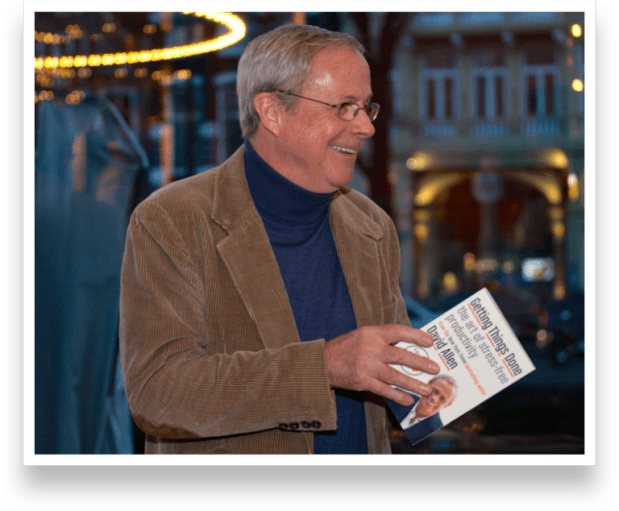
The GTD Weekly Review is an important way to keep on top of your work. In fact, GTD Founder David Allen considers it a “critical success factor” for achieving your objectives. For those not familiar with the practice, the weekly review is done at the end of a work week and consists of going through all your action folders, tracking projects, and otherwise keeping your workflow and space clean.

However, not everyone sees the value in committing to a weekly review. Some believe that the energy put into a weekly review is best spent actually doing meaningful work on projects. Is that true?

In a recent post, David Allen lays out the argument that the time spent in a weekly review is time well spent.

I asked if it was worthwhile doing the review, and he admitted that it was critical to stay on top; but that it was “work” to keep it up. It didn’t seem to be saving him time.

The truth is, it probably won’t save you more time–well, it will, but you will need that extra time to do the reviews and keep lists and categories of items current. Yes, you can get better and faster at how you do it. But it requires investment, no matter how good you are at it. As a matter of fact, the less you have time to do it, the more time you usually need to spend with it! 

For David Allen, no matter what system is used to keep track of work, without regular maintenance it will fall apart, forcing its user to try and keep track of everything in their head.

That’s why it becomes critical, once these are somehow objectified into an external system, that they be put in front of our conscious thinking process at least once a week, to get it all recalibrated to match our reality. And I guarantee that there are some intuitive “aha’s” and “I could’s” and “I ought to’s” lying dormant, only to be triggered by putting reminders and triggers about all the aspects of our life and work in front of our face on a regular basis. That could be daily, weekly, monthly, depending on the complexity of your life at the moment.

To learn more about the importance of the weekly review, please read the rest of his post.

Can You Manufacture Your Own Luck?

Having experienced St. Patrick’s Day a few weeks ago, you may have heard the phrase “The Luck of the Irish.” Perhaps you know people who say they are naturally lucky or unlucky. Most importantly, do you believe that fortune plays an active role in your life and if so, is there anything you can do to change fate?

Over at Forte Labs, Tiago published a guest post from Nir Eyal, author of the book, Beyond Belief. In the book, Eyal explores whether luck is an actual thing. What he discovered is that it is not a gift or curse from the Gods, but instead a specific way to view and interact with the world. In short, luck is not chance. As he describes in his Forte Labs post.

Dr. Richard Wiseman spent over a decade studying why some people feel perpetually “lucky” while others always feel “unlucky.” His research revealed something startling: so-called lucky individuals don’t actually experience more good fortune. They simply see more of it.

Nir Eyal

Assuming this is true, Eyal claims there are three specific powers that everyone has to generate their own form of luck. The first one is to increase attention on the world around you by noticing what you see.

Your beliefs act as perceptual filters, determining what information makes it through to your conscious awareness and what gets dismissed as irrelevant.

Lucky people train themselves to look wider. They notice the peripheral. They stay curious about the unexpected.

Beyond the three specific powers (read the post to learn what they are), Eyal lists five practices that will help generate more luck in your life. One of them is to prime your attention daily.

Each morning, ask yourself: What opportunities might I overlook today? This simple question shifts your attentional filter from narrow task-focus to broader opportunity-awareness.

To improve your fortune, learn about the other two powers and the remaining four practices by reading the rest of the post on Forte Labs.

Six Skills to Survive AI

Will AI take over the world, or at the very least, take your job?

With the rise of all manner of AI tools and agents, it is fair to ask how humans will compete against machine learning. Will all the degrees and job skills destined to be replaced by a computer? Is there anything we humans can do better than AI?

In his recent newsletter, author Daniel Pink wrote and shared a video about the Six Skills You Need to Survive AI. Pink is not an AI doomer, as he sees a future where people and AI collaborate in ways never before seen. To that end, he believes that there are specific skills and talents that humans have that AI cannot master. In the video, he shares six abilities that complement each other.

• Asking better questions
• Developing good taste
• Iterating relentlessly
• Composing pieces into something meaningful
• Allocating human and machine talent
• Acting with integrity

Let’s dive into the first one that he calls asking better questions. Pink points out in his video that AI is great at generating answers. In fact, it can provide dozens and dozens of potential answers to any inquiry. However, answers are worthless unless the questions are meaningful. It calls back to the old computer maxim of “garbage in, garbage out.” He believes that humans have the intrinsic ability to consider the meaning and objectives of a idea or problem in a way that computers simply are unable to do. To ask better questions, Pink suggests several starters, such as beginning inquiries with words such as, “What Does”, “What If”, “Why Not” and perhaps the most important question of all, “What are we trying to solve here?”

To strengthen your questioning skills, Pink suggests using a simple exercise known as The Five Whys. It is technique developed by Sakichi Toyoda for Toyota. The Lean Enterprise Institute has a good explanation of this approach.

5 Whys is the practice of asking why repeatedly whenever a problem is encountered in order to get beyond the obvious symptoms to discover the root cause. … Without repeatedly asking why, managers would simply replace the fuse or pump and the failure would recur. The specific number five is not the point. Rather it is to keep asking until the root cause is reached and eliminated.

I invite you to consider the recent questions you are asking at work, at school, or anywhere in your private life. What techniques can you use to improve the quality of your questions? Also, be very clear on the problem you are trying to solve when you ask them. By being very deliberate, the questions you ask today could lead to a groundbreaking insight tomorrow.

To learn more from Pink about the skill of asking better questions, along with the other five abilities, please see his video in the Pink Report.

Is It Ever Too Late?

Have you ever heard someone say, “It’s too late to pursue that dream.”

When we are young, it seems like there is an abundance of time and energy to complete every goal set, finish every project started, and see the entirety of the world. Then as we grow older, time slips away and those youthful dreams feel unobtainable. And while some avenues may realistically close up as we age (like becoming an Olympic athlete in your fifties) is it really ever too late to chase most dreams?

According to Shola Richards, the answer is an solid “NO!” In a recent post on his website titled It’s Never Too Late, he explores why people give up on goals.

It’s never too late to do anything. So, why do we often think that it is?

Sure, those dreams can be pushed aside, discouraged or ignored, but if you think that by saying “it’s too late” will succeed in killing those dreams, then I’ve got some really bad news for you.

Our dreams are persistent AF, and as long as you live, …

Shola clearly states that the only time your dreams die is when you do! In other words, so long as there is breath in the body there remains a path forward to obtain the goals that inspire and excite. He says:

Your dreams didn’t come to you so that you could throw your weakest excuses at them. They came to you so that you could literally do the damn thing.

If nothing else, remember this: persistent dreams only visit the souls who have the ability to transform them from imagined reality to actual reality.

With this clarity in mind, why not put this advice into practice.

Take a few minutes to consider the goals, projects, and dreams that have been shelved in your mind. Are you working under the misconception that they are no longer obtainable? Consider them one by one and ask two questions for each:

1/ Does this goal, project, dream, still excite me?

2/ Is there a very specific, undeniable, hard truth, no arguments about, scientifically valid reason this goal, project, dream is no longer obtainable?

If the answer is YES on question one and NO on question two, then I invite you to reengage. Write down exactly what success would look and feel like for this endevour. Then create ONE actionable item that can be done to move it forward in the next 24 hours.

Once that’s complete, decide on the next step and the next one after that. Before you know it, the dream will be realized.

Enjoy the journey!

Temptation Bundling – A Way to Get Things Done

One of the biggest struggles in our lives is wanting to do things we enjoy versus the doing the things we resist but are good for us. Some days it feels like we have the proverbial angel on one shoulder and devil on the other. Is there any way to get past this struggle?

In a recent newsletter, Charles Duhigg pointed to a research study titled: “Holding the Hunger Games Hostage at the Gym.” Beneath the playful framing is a serious idea with powerful implications. The study explores a concept called temptation bundling. The study authors define it this way:

Temptation bundling involves the coupling of instantly gratifying ‘want’ activities… with engagement in a ‘should’ behavior that provides long-term benefits but requires the exertion of willpower.”

The researchers tested this concept at a university gym. Study participants were given access to high quality audiobooks, but only while physically at the gym. If they wanted to hear the next chapter, they had to show up to the gym and exercise

The result? Gym attendance jumped dramatically compared to the control group. Even more telling was that when the experiment ended, a majority of participants were willing to pay to keep the restriction in place. The study points to an intriguing finding. We often frame productivity challenges as moral ones: “I need to be more focused.” “I need to stop procrastinating.” But temptation bundling suggests a different framing. Instead of trying to suppress the “want,” we can strategically attach it to the “should.” Packaging the reward and chore together will maximize results.

The key is exclusivity. The temptation has to be contingent on the productive behavior. If you can binge the audiobook anywhere, the gym loses its leverage. Temptation bundling isn’t about tricking yourself. It’s about acknowledging how motivation actually works and building systems that cooperate with human nature rather than fight it.

Although it is written in a scholarly style that doesn’t make for easy reading, I invite you to view the full article to learn more. Then go ahead and figure out how to use temptation bundling in your own life.

Support Florida Libraries! Support the Florida Library Association!

In 2026, Florida’s libraries are facing new challenges and unprecedented opportunities. From protecting intellectual freedom to expanding digital access and workforce development, library professionals across the state are stepping up in powerful ways.

Now is the time to stand together and tell your story about why libraries matter.

The Florida Library Association (FLA) has a bold goal: building a stronger, more connected community of library workers and advocates. As a Past President of FLA, I personally invite you to join Florida’s premier professional association for library employees, supporters, and champions. This year, FLA President Allision Grubbs is inspiring us to tell our story about how libraries change lives. The best way to share your story is to join with colleagues across the state to build a better future.

Why Join FLA in 2026?

FLA has made membership more accessible with reduced and flexible membership rates, ensuring that every library worker at every stage of their career can participate. Don’t work in a library? Membership is also open to library supports and retirees. In short, anyone who loves libraries is invited to share their story and join the association.

I’ve been a proud FLA member for over twelve years. Through the Association, I’ve grown as a leader and built lifelong professional relationships with amazing people from across the state. As well, I’ve strengthened my advocacy for the essential work libraries do every day to connect communities, inspire learning, and protect access to information.

When you become an Individual Member, you gain:

  • Leadership Opportunities – Serve on committees or the Executive Board and develop valuable leadership skills
  • Timely Advocacy Updates – Stay informed on fast-moving legislative and policy issues impacting Florida libraries
  • Continuing Education – Access webinars, trainings, and professional development opportunities
  • Statewide Networking – Connect with colleagues from public, academic, school, and special libraries
  • Recognition & Awards – Celebrate excellence at the FLA Annual Conference
  • Voting Rights – Help shape the future direction of the association
  • Conference Discounts – Save on registration for our Annual Conference
  • Member Groups – Join or form communities centered on your professional interests
  • Member Communications – Stay informed through exclusive mailing lists and updates
  • Publication Opportunities – Access Florida Libraries journal and opportunities to be featured
  • Exclusive Online Resources – Including the member directory and professional tools

Whether you’ve never joined, or are considering returning, or are ready to renew, 2026 is the year to take that step.

Your Membership Matters More Than Ever

Libraries are essential infrastructure for democracy, education, and community resilience. Your membership strengthens FLA’s ability to advocate effectively, provide professional support, and ensure that all types of libraries across Florida can thrive. For more than 100 years, the Florida Library Association has championed our state’s libraries. Now we’re building the next century of access and empowerment, and we need you with us.

Don’t Wait. Join Today!

Commit to your profession. Invest in your growth. Stand up for Florida’s libraries.

Visit the FLA membership website and become a member today. Together, we are stronger. Together we will shape the future of libraries in Florida by telling our story. In 2026, I look forward to welcoming you as an FLA Member.