What Does the Science Say?

There are many methods and techniques to become organized at home and work.  The list is long and includes GTD, Building a Second Brain, KonMari, and many others.  However, have you ever thought that the gains made by these approaches are only illusionary?   Perhaps they are all simply feel-good methods that work for a short time and then fade away?  In short, is there any science to back up the claims of these systems?

In a blog post on the revamped Getting Things Done web site, David Allen provides a brief overview to explain why methods like GTD have an impact that relates directly to cognitive science.

“Recent cognitive science research shows that the number of things you can mentally prioritize, manage, retain, and recall is . . . (hold on) . . . four! If you park any more than that in your head, you will sub-optimize your cognitive functioning. You will be driven by whatever is latest and loudest—rather than by strategy, intuition, or objective assessment.”

Read the rest of David’s thoughts along with his book suggestions on the Getting Things Done blog.David-Allen-GTD
The Office Martial Art – GTD!

For many years I was yoga teacher at a local studio in West Palm Beach, FL.  I was drawn to yoga for the exercise and the peace of mind that came from this meditative practice.  Later on, when I discovered GTD and related productivity principles, I saw them as the yoga of office work.  That is, skills and techniques that would provide calm in the face of workplace stress.

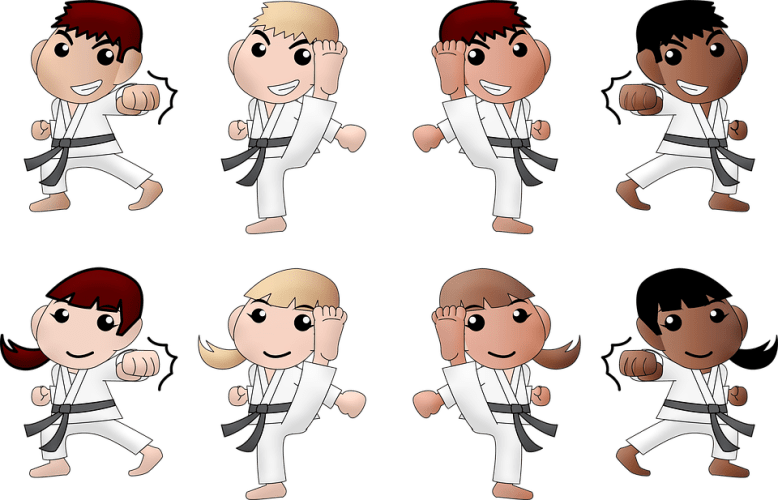
David Allen as long used a similar metaphor for GTD in his talks.  He views it as the martial art of work and in a recent blog post, offered ten ways that GTD and karate were similar.

1. There are no beginner’s moves.
You begin in karate learning moves that you will practice as a third-degree black belt. A roundhouse kick or knife-hand block is the same, whether you are just learning it or you are a sensei. Being responsible for your internal commitments, deciding what next physical action is required on something you want to do or change, clarifying your intention and vision—those are true from beginning to end, no matter how mature you are in life or its process. There’s no elementary way to process your inbox to zero.

2. It feels counter-intuitive and unnatural when you start.
Trying to stand and move gracefully in a karate “front stance” feels initially like one of the more unnatural things the body has ever attempted. It’s almost as weird as writing everything down that you commit to do something about, as it occurs to you. Or spending valuable time cleaning up non-critical open loops on the front end. Weird science.”

Read the remaining eight similarities at the Getting Things Done blog.

karate

Does Technology=Productivity?

DA-SmallWill a new iPhone make you more productive?  Perhaps the latest app can keep you on track to complete projects?  Is a digital calendar more effective than an old fashioned paper one?  With the constant cycle of technology there is always a new tool or software version coming out that promises to improve our efficiency and make life easier.  However, is this promise simply untenable?
In a recent blog post, David Allen addresses the intersection between technology and productivity.  He starts with a nuanced approach to the topic.

“Despite my thirty-five years of consulting, coaching, and training in hundreds of organizations, I don’t have an easy answer to that question. The digital tools we need and like require more intensive labor than they should. It would be great to have a digital dashboard that integrated all apps, allowed you to manipulate information in a single location, and then sent the revised data back to its original location. And all upgrades would happen automatically! Doubtful, in my lifetime.”

Despite this conflicted opening, David goes on to offer some straightforward advice on the topic.  Read the rest of the post on the Getting Things Done web site.

The Two Problems in Life

davidallenSome days it seems like our lives are full of problems.  They appear to come at us in all shapes and sizes, adding stress and tension to our days.  But perhaps all these problems are not really different from each other.  Maybe they all have something in common.

According to David Allen, we only have two types of problems.  In his recent blog post at Getting Things Done, he shares his theory.

“You only have two things you ever need to be concerned about. Not only are there only two problems—they are really quite simple. Ready?

Problem #1: You know what you want, and you don’t know how to get it.

Problem #2: You don’t know what you want.

“Anything you can define as a problem can be reduced to one or both of those statements.

“Now, since there are only two problems, it follows that there are only two solutions that you will ever need. You need to make it up, and make it happen. You must decide and clarify what outcome you’re after; and you must then determine how you get from here to there.”

Learn in more detail how you can solve either of these two problems by reading the rest of David’s blog post.

South Central Library System

A big thank you goes out to the South Central Library System in Wisconsin for hosting two Efficient Librarian webinars.  Jean Anderson and her team were great to work with.  We had excellent attendance and the participants asked very thoughtful questions.

SCLS has posted the presentations to their continuing education web site.  If you want to view a recording of the two webinars, both one hour in length, here are the links:

sclslogo
Thank you again to Jean the SCLS team.  I hope to work with you again in the future.

The Power of Completion

DA-SmallDo you know how many projects lie unfinished in your world?  As we move through life there is a natural force in us that creates new things as they spark our interest.  Unfortunately, I have found this creation often results in lots of projects that quickly lose focus and instead become a source of stress.  It seems that the catch to managing all the stuff we create is finding a way to bring closure to them.

In his latest blog post, David Allen delves into the entwined powers of completing and creating and how their dance affects our lives.

“Seems that we’re here on the planet to learn about and do two things—complete and create. We are responsible for what we have put into motion on all levels, and we must manage the process of what we are putting into motion every moment. 

“Though both aspects are primary, I think a lot of people could use a good bit more emphasis on the complete part. Our cultural personality seems bent on limitless expansion and not necessarily cleaning up after itself.”

Read the rest of the post at the Getting Things Done web site.


Do You Know the Purpose?

We all got them.  Sometimes they are fun and other times they are a struggle.  Truth be told, they are a fundamental fact of work life that will never go away.  What are they?  Projects!

I was reminded at the NEFLIN workshop this past week that many people tend to think of a project as something big and complicated.  However, most of our projects are actually very small.  David Allen defines a project as anything that requires more than one action to complete.  By that count we have dozens and dozens of projects underway!  Unfortunately, it is far too easy for projects to stall and grow stagnant.  Is there a way to move them along?

flat lay photography of macbook pro beside paper

One approach is to follow the Natural Planning Model from Getting Things Done.  (In the latest edition of the book, it can be found on pages 60-63.)  Every project starts for a reason.  When that reason becomes obscured or forgotten, the energy behind a project can fade.  That is why the first part of the Natural Planning Model is all about purpose.   If you and your team do not clearly understand why the project even exists there will be little energy to see it through.  Another way to think about purpose is to ask the question, “What problem am I trying to solve?”

So what projects are on your plate that have lost focus and energy?  It might be time to take a good long look at the purpose of those projects to see if a little clarity might be the spark to move them forward.

Addressing Anxiety

DA-SmallWhen you travel home from work, do you ever feel a small sense of anxiety coming along for the trip?  With input coming fast and furious throughout the day, it is a challenge to process everything during our 9-5 day.  It is tempting to let it all pile up and resolve to handle it tomorrow.  However, when a part of your mind lingers on unprocessed work, it can be a source of deep unease at home.

In a recent blog post, David Allen shares that even a black belt GTDers like himself is not immune from this source of stress.

“I still have to work with myself to ensure I’ve captured, decided, and tracked all the commitments and creativity that happen with phone calls, meetings, social interactions, and even random communications in passing. I do know that this is one of the sources of much of the free-floating anxiety many professionals experience relative to the gnawing sense of overwhelm that is so pervasive. It seems that there is an unconscious part of us that hangs onto all of those incomplete creations. It is a part that will not let go until it can trust those agreements have been kept or re-negotiated with ourselves.”

Learn how David resolves this tension in his own life at the Getting Things Done blog.

GTD + BASB = Better Person

Personal productivity and knowledge management are related skill sets required for most of us to perform our best at work.  While they are both mostly thought of as functional efficiency tools, did you know their practice can also build virtue?

forteTiago Forte of Forte Labs recently shared his thoughts on how productivity and knowledge management skills can increase our own potential to do good in the world.  By committing to Getting Things Done (GTD) and his own Build a Second Brain (BASB) course, Tiago believes that we will become not only more efficient, but also a better person as a result.  He explains how we start the journey this way:

“Often, when we embark on this journey – learning digital fluency, task management (GTD), personal knowledge management (BASB) and beyond – our motivation is primarily one of utility. We want to stop procrastinating, to get more things done, to excel at our work, and have a vibrant, flourishing career. GTD and BASB will absolutely help you meet those goals.

While on this journey, however, we start to realize that GTD and BASB can serve another purpose: sheer pleasure.”

Learn how this eventually leads to mastering higher virtues by reading the rest of the article at Forte Labs.