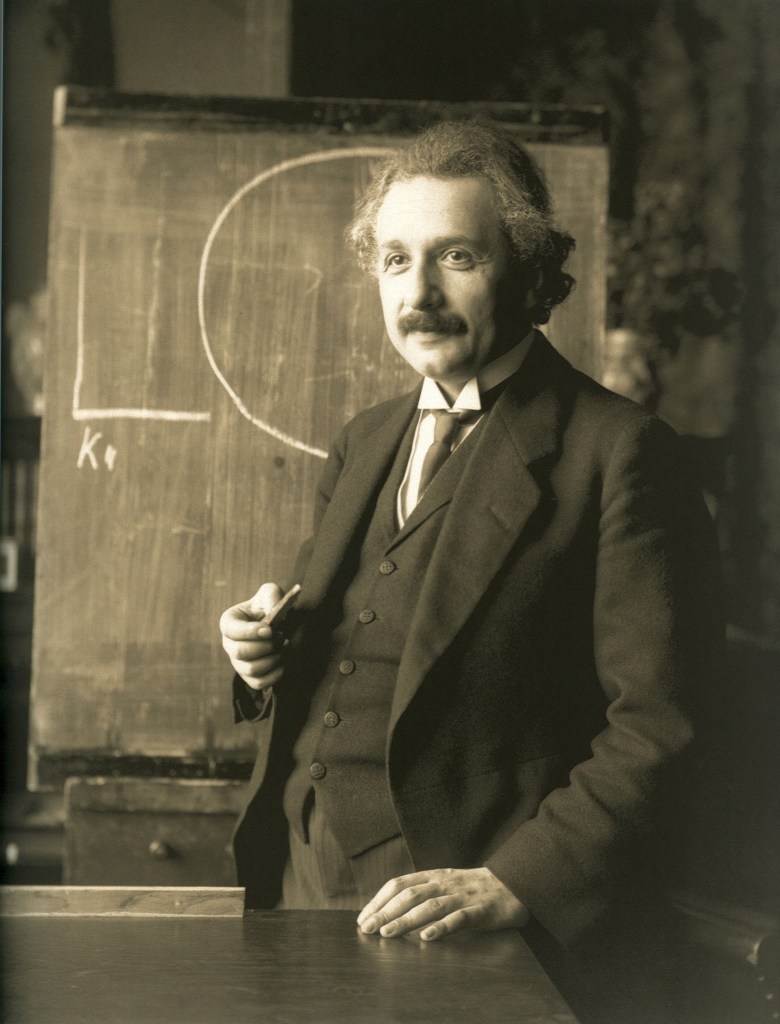
Einstein’s 7 Rules for a Better Life

E=MC2

The most famous equation in all of physics was developed by arguably the best-known scientist ever, Albert Einstein. While that equation had to do with calculating energy, Einstein was not just a student of theoretical physics, but also a great study of how to live a good life.

In a recent article on The Big Think, Ethan Siegel explores Einstein’s 7 Rules for a Better Life. Taken from a recent biography on the great scientist, Siegel shares life lessons which served Einstein well. For example, take Rule #3, Have a Puzzle Mindset.

Einstein was pretty much the prototype individual for someone who viewed every difficulty he faced as a puzzle to be solved: in physics and beyond.

Consider his oft-misunderstood but most famous quote, “Imagination is more important than knowledge.” While many people had looked at the puzzle of objects moving near the speed of light before — including other geniuses like FitzGerald, Maxwell, Lorentz, and Poincaré — it was Einstein’s unique perspective that allowed him to approach that problem in a way that led him to the revolution of special relativity. With a flexible, non-rigid worldview, Einstein would easily challenge assumptions that others couldn’t move past, allowing him to conceive of ideas that others would unceremoniously reject out-of-hand.

Rule #4 carried on this thought by sharing the advice to: Think deeply, both long and hard, about things that truly fascinate you.

Over the course of his long life, Einstein received many letters: from those who knew him well to perfect strangers. When one such letter arrived on Einstein’s desk in 1946, asking the genius what they should do with their life, the response was as astute as it was compassionate. “The main thing is this. If you have come across a question that interests you deeply, stick to it for years and do never try to content yourself with the solution of superficial problems promising relatively easy success.”

Learn about the remaining five rules by clicking over the The Big Think website.

Parrells Between Money and Productivity

Have you heard the admonishment that “Time is Money?”

It is an old saying that exhorts us to make best use of our daily actions in order to reap financial rewards. Taken to heart, it would also imply that being productive will increase the amount of money we acquire. Is there truth to this conclusion?

Tiago Forte believes that there are similarities between productivity practices and budgeting. In an article on his website, Tiago shares thirteen parallels that define successful application of both skills. The first one has to do with aligning with a deeper purpose.

“What do I want my money to do for me?” Everything else depends on the answer: if you value freedom and autonomy, your decisions will look very different from someone who values security and stability.

It’s likewise very valuable to ask yourself, “What do I want my work to do for me?” Besides the obvious answer of “provide a paycheck,” the conclusion you come to has profound implications for where, when, and how you work.

If you value creativity and self-expression, but an ever greater proportion of your to do list is filled with administrative tasks, you will eventually experience dissatisfaction and burnout, regardless of how many hours you work or how much it pays.

Another parallel he shares has to do with shifting our thinking. Tiago believes we should let go of what “should be” and honestly accept what is actually happening.

There is a deeply seated human tendency, when things aren’t going how we believe they “should go,” to simply deny reality. We can make up justifications, rationalizations, and excuses effortlessly, and maintain them even when the impact on our health, happiness, and relationships becomes unbearable.

Simply knowing what is happening is half the battle when it comes to money or productivity. Getting a hold on the “current state” requires letting go of the lenses and stories we use to buffer reality and protect our ego. This is why making a comprehensive Project List is so powerful – it lays out the current state of affairs in objective detail, allowing us to make fully informed decisions.

Learn about the other eleven parallels by reading the rest of the article.

The Tyranny of Small Choices

Have you ever stopped to consider how many choices you make during the day?

Often when we think about decision making our minds consider the big operational decisions we make at work or in our lives. Yet the vast number of decisions we make every day are small. These choices range from what shirt to wear in the morning, to choosing a restaurant for lunch, down to what TV show to watch at night. Most of us pay little heed to these types of decisions, as they seem inconsequential beyond the moment they are made. However, sometimes these small decisions have outsized impact due to the fact that thousands or millions of people are making similar choices. This leads to the tyranny of small decisions.

In a recent article on the Big Think website, author Jonny Thomson explores how small choices can have oversized impacts. Early in the article, he explains the concept of the tyranny of small decisions.

In 1966, the economist Alfred E. Kahn first coined the term ‘tyranny of small decisions’ in an article of the same name. Kahn used this concept to describe how a series of small, individual choices could lead to an end point no one really wanted. It’s when various discrete and minor actions string together into something not desired by the decision-makers as a whole.

Kahn used as an example a train service that has lots of passengers in the winter, but little ridership in the summer. The choice the passengers make about when to take the train, seemingly inconsequential to each individual person, add up to impact the train service to the point where it could shut down.

Later on in the article, Thomson offers some examples of ways that the tyranny of small decisions can immediately impact your life and business. This first example is about skimping on training days, especially around cybersecurity.

Sixty percent of small businesses go out of business within six months of a cyberattack. Cyber-vigilance matters, and small decisions to skimp can have huge ramifications. Buying only basic internet security might save some money. Missing or having irregular cyber-awareness training might make you popular with your team. But few businesses can survive an $80 million hack.

Learn more about the tyranny of small decisions and ways to avoid them by reading the rest of the article.

Beginner vs Advanced

Have you ever got advice? Of course, you have. The real question is how often has that advice been useful?

The problem with advice is that it may be good for some people, but not for all. Also, some advice is helpful at the start of an endeavor but could be restricting as experience is gained. Tiago Forte recently thought about this problem and wrote his conclusions on his blog at Forte Labs. His primary insight concerns the crucial difference between beginner and advanced advice.

In any given pursuit – tennis, chess, jiu-jitsu, painting – there is a hierarchy of skills that you have to acquire one by one to progress. More fundamental skills lie at the bottom, like the base of a pyramid, and serve as a foundation for more advanced skills to be gained later on.

I’ve noticed that people often want to skip the beginner stages and go directly to the advanced ones. That’s an understandable desire – why spend more time as a novice than you have to? But if you don’t have a strong foundation and try to build too high, your efforts will inevitably crumble.

How do we determine the difference between beginner and advanced advice? Tiago suggests the following:

Beginner advice tends to take the form of an extremely simple, impossible to misunderstand, black-and-white rule.

The more advanced you become, the more options and pathways become available to you, each one tailored to a specific scenario. In other words, you have to choose which advanced strategy is right for you.

How what does this mean for productivity skills? Read the full article on the Forte Labs blog to find out.

The Overlooked Secret for Work Satisfaction

What drives people to do their best work every day? Is it a big paycheck? How about impressive benefits? Perhaps it is awards and other types of recognition? While all that is nice, none of these factors is the most important to a sense of meaningful work.

In fact, the secret to workplace satisfaction costs nothing.

It is simply a sense of progress.

There is an ancient Greek myth about a cruel king named Sisyphus, a mortal cursed by Hades to roll a boulder up a hill for all eternity. The catch was that just before he reached the top, the boulder would slip from his grasp and roll back to the bottom, forcing him to start over. For too many people their workday is Sisyphean in that they put in hours of effort with no sense of progress to claim for it.

According to Teresa M. Amabile, and Steven J. Kramer, authors of The Progress Principle: Using Small Wins to Ignite Joy, Engagement, and Creativity at Work, the best way to find satisfaction at work is to have a sense of daily, meaningful progress. In their surveys of workers, they found that 76% of people’s best days involved progress, while only 13% involved setbacks. As they summed up:

“Of all the positive events that influence inner work life, the single most important is progress in meaningful work.”

What was more surprising to them was how little management understood and appreciated this fact. According to their surveys, a sense of progress was dead last in a list of possible motivating factors. This demonstrates a strong disconnect between perceived and actual reality. On the positive side, it means that managers who pay attention to workflow, clear barriers and set out clear goals will help their employees feel more successful and fulfilled.

A sense of progress is important to authors. There is an old adage that authors succeed by writing something every day. Even if the work they produce is ultimately not used, the dynamic of forward progress in the task of writing is essential to eventually finishing that novel or long essay.

To learn more about how a sense of progress can improve your everyday work, read The Progress Principle: Using Small Wins to Ignite Joy, Engagement, and Creativity at Work.

How to Tell What Kind of Procrastinator You Are

You do it. Your work colleagues do it. I did it before starting this post. What is it?

Procrastination!

Throughout the day, we all experience that lack of desire to move forward on projects or tasks. Yet, the question is why does this happen? According to journalist Lindsey Ellefson, writing in Life Hacker, procrastination comes in at least six different flavors. In her recent article, she highlights each one, starting with perfectionism:

The perfectionist. You’re worried that your work might not meet a high expectation, so you don’t finish your work or, in some cases, don’t even start it at all.

For each of the six types of procrastination, Ellefson offers a possible solution. For example, with perfectionism:

If you’re the perfectionist, remind yourself that it’s your own personal standards that are stressing you, not necessarily the work itself, and you can do the work by setting realistic, incremental goals before getting started. I struggle with this one, and a tactic that helps me is working out what the absolute worst possible outcome might be if I don’t do well on a task. Even if I get a zero on a test, what will it do to my overall grade? When I think realistically about how I’m almost certainly going to get way higher than a zero—but even if I didn’t I’d be okay—I feel better, and get to work.

To discover the other five types of procrastination, please read the rest of the article. Of course, you could always put off doing this for later …

The Last-Minute Mindset

Do you only work when a deadline is right in your face? For example, if there is two weeks until the work needs to be completed, do you wait until the final 24 hours to start. For the determined procrastinator it often takes an outside factor to get work done. It begs the question, why do they let this happen?

In an article from Stylist magazine, Katie Rosseinsky explores the procrastinator’s mindset to learn why they behave the way they do and how they can improve. The question is important as it relates to her own experience.

My last-minute mindset is something I’m well aware of, and yet whenever I’m presented with a deadline, I follow the same pattern: put the work off for as long as humanly possible, then cram it all into a condensed, chaotic period of ’productivity’, which often involves working late into the evening. Even if I make time, say, in the week coming up to the cut-off point to focus on getting this task done, I inevitably waste it.

Photo by KoolShooters on Pexels.com

Proving she is not alone; she then points out the wide-spread reality of the procrastinator mindset.

A 2007 study published in Psychological Bulletin found that 15-20% of people chronically procrastinate, with 25% describing this as their dominant personality trait. And it doesn’t have to be confined to a work context; as Christmas approaches, many of us will once again come face to face with our last-minute tendencies when we end up doing all of our present shopping in a panicked 24th December dash.

For the rest of the article, Rosseinsky proceeds to explore why how this mindset works before sharing a few ways to avoid the temptation to wait until the last minute, such as:

So, how can hardened last-minute scramblers find a way to break out of this cycle, and is there any way of turning these tendencies into a positive? In the short term, Dignan suggests trying out the ‘two-minute strategy’. “If you can do something in two minutes, you’ve got to do it now.” Another tactic she often recommends to clients involves the humble egg-timer.

To learn more, please read the rest of Rosseinsky’s article.

Hot Summers and Cautious Decisions

Chances are that wherever you have living, it has been a hot summer. In fact, heat records have been shattered across North America and Europe. Surprisingly, hot weather has an unexpected consequence beyond our health or comfort, it can actually lead us to make risk adverse decisions.

In Matthia Sutter’s book, Behavioral Economics for Leaders, the author looks at data which seems to indicate that the outside weather affects our decision-making process. This is true even if we make our decisions in a climate-controlled environment. Sutter notes:

Conventional models of human decision-making behavior completely ignore the factor of heat. According to these modes, referred to as neoclassical in economic theory, only the costs and benefits of specific decisions and the choices they are based upon play a role, while things such as heat, tiredness, or general mood are seen as insignificant. However, psychological research shows that heat reduces general wellbeing, mood and a willingness to perform.

Photo by Oleksandr P on Pexels.com

Sutter goes on to reference studies that show how judicial decisions become more risk adverse as outside temperatures rise. Specifically, a judge was less likely to give a defendant a favorable ruling on hotter days. But it is not only temperature that had an effect. Sports scores would also influence decisions.

For example, if the local football team wins big, there are more judges’ decisions favorable to the defendant. This again is a question of predominant mood.

As we move through the remaining hot summer days, take a moment to consider your own decisions. If the heat outside has risen, or your favorite team has lost, you may want to take extra care with your choices or defer them entirely for another day.

Practicing Radical Open-Mindedness

It is commonly understood that no one person has all the right ideas.

However, it is also very easy for most people to believe that they always have the best idea.

How do we overcome this paradox of thinking? According to Ray Dalio in his best-selling book, Principles, one aspect of the solution is practicing radical open-mindedness.

Why is this so important? His company, Bridgewater Associates, is famous for creating an idea meritocracy, designed to encourage the best ideas, not the most persuasive or good-enough ones, to rise to top. Radical open-mindedness is key to making this happen. According to Dalio:

Radical open-mindedness is motivated by the genuine worry that you might not be seeing your choice optimally. It is the ability to effectively explore different points of view and different possibilities without letting your ego or blind spots get in your way.

On pages 187-190 of Principles, Dalio proposes seven steps to keeping one’s mind open. They are listed below:

  • Sincerely believe that you might not know the best possible path and recognize that your ability to deal with “not knowing” is more important that whatever it is you do know.
  • Recognized that decision making is a two-step process: First take in all the relevant information, then decide.
  • Don’t worry about looking good: worry about achieving your goal.
  • Realize that you can’t put out without taking in.
  • Recognize that to gain the perspective that comes from seeing things through another’s eyes, you must suspend judgement for a time – only by empathizing can you properly evaluate another point of view.
  • Remember that you’re looking for the best answer, not simply the best answer that you can come up with yourself.
  • Be clear on whether you are arguing or seeking to understand, and think about which is most appropriate based on your and other’s believability.

For the last point, Dalio explains the idea of believability:

I define believable people as those who have repeatedly and successfully accomplished the thing in question – who have a strong track record with a least three successes – and have great explanations for their approach when probed.

To dive deeper into these seven concepts, grab a copy of Principles and jump to pages 187-190.