Florida Library Association Membership Drive – Join Today, Grow Today

This year there is a great opportunity to join a collection of dedicated library professionals in their quest to grow, serve, and enhance libraries across the state.

The Florida Library Association has launched a membership drive. The goal is to get the organization up to 1,000 members by January. As Immediate Past President of FLA, I invite you to join Florida’s premiere Assocation for library workers and professionals.

To reach that goal, FLA has reduced its membership rates to make them more affordable for all library workers and supporters.

I have been a proud member of FLA for over a decade. Membership allowed me to expand my professional horizons, make lasting friendships, and voice my advocacy for the great work our libraries do every day to connect communities, inspire thought, and enrich lives.

Here are benefits that Individual members receive.

  • Participate on committees and the Executive Board – develop leadership skills
  • News and Support on fast breaking issues
  • Continuing Education Webinars and Trainings – professional development
  • Networking Events – meet people from across Florida
  • Awards presented at our FLA Annual Conference
  • Eligibility to vote in association elections
  • Discounts on registration to our Annual Conference 
  • Eligibility to form or join Member Groups on topics of interest
  • Access to member communications and mailing lists
  • Florida Libraries journal and eligibility to be featured in the publication
  • Exclusive online resources, including our member directory

Never been a member before? Thinking of returning as a member? Or simply renewing your membership?

All the information you need to commit to membership can be found on the FLA membership website. Please consider joining today!

Your support will go a long way in ensuring that libraries of all types will continue their mission to serve the residents of Florida. In return you will be part of a proud organization that has supported Florida’s libraries for over 100 years.

I look forward to seeing you as an FLA Member!

Three Reasons to Call a Meeting

You may have heard the not so old saying: “That was another meeting that could have been an email.”

People detest meetings when they feel unproductive. This is especially true when the reason for calling the meeting is unclear. Based on my experience, there are three major reasons to call a meeting that will keep participants engaged and come to productive conclusions.

1/ Sharing Important Information

Sharing information is a base-line function of all meetings. However, face-to-face is very useful for these types of situations:

  • Sharing Important/Timely News – Sometimes breaking news must be shared with everyone together at the same time. For example, when an organization is set to issue a controversial press release a quick all hands-on deck meeting may be the fastest way to inform the team in advance and at the same time.
  • Immediate Q&A – Instead of letting confusion linger, questions about an important or complicated topic can be quickly addressed in a face-to-face meeting. Answers are heard by the entire team at the same time, avoiding repetition.
  • The “Look Them in the Eyes” Factor – Whenever there is bad or sad news to share or an apology
    to be issued, doing so in person conveys respect for the team.

2/ Making a Presentation

While presentation can be sent by email, something might be lost without a presenter to emphasize or clarify items. Presenting in person can improve comprehension and increase engagement in the material. Types of presentations best suited for face-to-face meetings include:

  • Complicated Items – Presentations can break down complex subjects for easier understanding. In a live situation, the presenter can adjust on the fly to match audience’s perceived understanding and level of engagement.
  • Clear up Misunderstandings – Presenters can address questions as they come up, allowing the whole group to benefit while the topic is fresh in their minds.
  • Swaying Opinion – If people need to be convinced on a course of action, face-to-face “sales” type
    presentations are preferred. In this format, a presenter is able to access a wide range of public speaking tools to make their case for a course of action.

3/ Facilitating Discussion

Bringing people together creates an opportunity to dive deeply into a topic that non-
synchronized formats cannot duplicate. Talking together in the same room can be very stimulating and help build up a team. Examples of meetings designed for discussion include:

  • Problem Solving – Coming together in person is often the fastest way to solve a problem. Teammates share different viewpoints and build on each other’s ideas. This can develop innovative ways to resolve issues that could not be thought of individually.
  • Strategic Visioning – Bringing together people from different parts of the organization for long-
    range planning meeting is a beneficial exercise. Small-scale, in-person discussions can surface facts or concerns from across the organization.
  • Finding Consensus – When a critical decision must be made, face-to-face discussions can be
    the fastest way to get the team into agreement. An open discussion allows all parties to share
    their concerns and increase the potential to come to a meaningful decision.

If you are considering calling a meeting think about whether it falls into one of these three reasons. Otherwise, start drafting that email.

When to Check Your Tech & How to Stop

Have you ever checked your phone for a social media update in the middle of a meeting? Or started looking at news headlines in the middle of a group lunch? Or got distracted by unimportant texts while doing deep work on a project?

It is very easy to be drawn into looking at our phones. This can lead to unproductive behavior and sloppy work. A recent article by Liz Fosslien on the Pocket website wonders why we have allowed these habits to become socially accepted.

I used to do nothing in the face of indiscriminate gadget use. Now, I’ve come to believe that doing nothing is no longer O.K. Staying silent about bad technology habits is making things worse for all of us.

Photo by iam hogir on Pexels.com

How do we as a change these habits to make them less desirable? Perhaps we need to develop what investor Paul Graham calls “social antibodies.”

He uses the example of cigarette smoking: smoking in public became taboo over the span of just one generation after social conventions changed.

Like cigarettes, our personal technology use can become a bad habit. People enter a zone when they use their gadgets. Checking email or scrolling through Facebook can be intoxicating and disorienting. Tech makers design these products using the same psychology that makes slot machines addictive. The variable rewards built into apps make time pass quickly and can make people oblivious to what’s happening around them.

How can we build up social antibodies in the workplace? One way is to set up well articulated standards.

The best way to prevent this waste of time is for someone senior to mandate a “no-screen meeting.” In my experience conducting hundreds of workshops, the discussions declared device-free are by far more productive. Setting expectations up front is equivalent to administering a distraction vaccine.

Learn more about how to build social antibodies by reading the rest of the article.

To Solve a Problem, Take Something Away

There’s a funny thing about the human mind when it comes to problem solving. Usually, we look for solutions that add something to the equation, whether it be another resource, person, or strategy. Yet is it easier to solve problems by removing things?

In an article by Diana Kwon for Scientific America, she explores the reason that removing something is a often the more efficient problem-solving strategy. She uses the example of teaching a child to ride a bike.

For generations, the standard way to learn how to ride a bicycle was with training wheels or a tricycle. But in recent years, many parents have opted to train their kids with balance bikes, pedal-less two-wheelers that enable children to develop the coordination needed for bicycling—a skill that is not as easily acquired with an extra set of wheels.

Photo by Leeloo The First on Pexels.com

Later in the article she explores research done at the University of Virginia. Observational studies of people solving problems highlighted some interesting patterns.

The researchers first carried out a set of observational studies, assessments without a control group, to see whether this bias existed at all. In one, they asked 91 participants to make a pattern symmetrical by either adding or removing colored boxes. Only 18 people (20 percent) used subtraction. In another, the team scanned through an archive of ideas for improvement submitted to an incoming university president and found that only 11 percent of 651 proposals involved eliminating an existing regulation, practice or program.

Is there a way to guide people to consider removing items rather than adding? Turns out a little nudge in the right direction can do the trick.

The researchers also observed that people were more likely to remove features when they were given more opportunities to consider alternative ways to address a problem: when participants were asked to create a symmetrical pattern by adding or eliminating colored blocks, they opted for removal more often if they were given practice trials than if they had just one chance to tackle the problem. On the other hand, having to simultaneously juggle another task—such as keeping track of numbers on a screen—made individuals less likely to subtract elements to solve the same problem, suggesting that it requires more effort to think up subtractive solutions than additive ones. 

Read the full article to learn more about how to consider subtractive solutions.

Don’t Fall into the “McNamara Fallacy”

The 21st Century is a time of unlimited data points! Statistics and statical analysis are available for every topic under the sun. Whether it be Sabermetrics in baseball, or detailed demographic political polling of electoral candidates, or the circulation of library books by branch location, numbers are readily available to explore any situation. However, what happens when people rely too much on the data? In that case they may fall into the “McNamara Fallacy.”

In a recent article on the Big Think website, columnist Jonny Thomson explores how we can get so caught up looking at data points that we fail to take into account the bigger picture. He names this the “McNamara Fallacy”.

The fallacy is named after Robert McNamara, the U.S. Secretary of Defense during the Vietnam War, where his over-reliance on measurable data led to several misguided strategies where considering certain human and contextual elements would have been successful.

Thomson goes on to explain why numbers are not the be all and end of analysis.

The “McNamara Fallacy” is not saying that using data is bad or that collecting as much information as you can is wasted time. It’s saying that fixating only on numbers blinds us to the rich stories and subtle details that truly shape experiences, resulting in choices that miss the heart and soul of the situation. If we spend too long looking at spreadsheets and data points, we forget to look around.

To avoid getting caught in the fallacy, Thomson offers a few options to expand one’s viewpoint. The first is digging into details.

In many companies, employee performance is measured solely by quantitative metrics like sales numbers or the number of tasks completed. While these figures provide some insight, often the important information is buried in the details. Let’s imagine two people, Jane and Jack, who need to bring in a client. Last year, Jack secured 20 and Jane 15. Good job, team! But, behind the numbers, there’s more to be seen. Jack’s clients really didn’t like him. He had a sleazy, insensitive manner that was off-putting. Within a year, most of his clients had left. Jane, on the other hand, wooed and won her clients by dint of personality. She cared about the person she met. Her clients all stayed around. So, who is the better employee?

To learn about the other strategies to avoid the fallacy, please read the rest of the article.

Do Our Projects Define Us?

What projects do you prioritize with your free time?

Whether we spend the time on entertainment, home maintenance, or personal development, the choice of our personal projects impacts our lives. But do these projects end up shaping the nature of who we are?

Tiago Forte believes that our projects shape our identity. In a recent article on his website, Tiago looks at recent research into the topic, first by explaining exactly what a personal project is according to the researchers.

“Personal projects” by his definition include not just formal ones you might focus on at work, but informal ones as well. Toddlers are pursuing a project as they learn to walk. Lovers are pursuing a project as they fall in love. All the way to the highest reaches of human achievement, like landing on the moon.

The key factors in making them “personal” are that they are personally meaningful and that they are freely chosen, not imposed from the outside. Little’s research has shown that such “intrinsically regulated” projects tend to be more successful and lead to greater well-being than “externally regulated” projects.

In fact, Tiago believes that our choice of projects demonstrates who we are at our core.

This is a fundamentally different view of “personality”: We are not limited to a collection of traits fixed at birth, or shaped in childhood. We evolve over time through personally meaningful pursuits we decide to take on. This opens up the possibility that we can purposefully choose the ways we want to change, by choosing projects that give us new skills, perspectives, and ways of thinking.

In other words, by changing what you do, you can change who you are.

To learn more, please visit the Forte Labs website to read the rest of the article.

Tips for Staying Focused While Stressed

Are you stressed?

It is common to hear people say that we live in anxious times. Whether this stress comes from politics, relationships, or simply making ends meet, it is easy to lose focus while worrying about life. Yet if we are unable to purposely bring our attention to the important things we need to do the stress will only build. The catch then is to figure out how to focus when stressed.

Scott Young has looked into the problem and recently published an article titled 5 Tips for Staying Focused (When You’re Stressed). If you are looking for ways to help yourself move forward when things seem tough, then you will enjoy his insights. The first one is a bit philosophical. Scott suggested applying Socratic questioning to our reflexive thoughts.

Cognitive behavioral therapy (which I review in-depth here) is the gold standard for psychotherapy for anxiety disorders. A basic tenet of this therapeutic approach is that a combination of situational factors and our background beliefs triggers automatic thoughts. If you’re stressed, those thoughts often fixate on potential dangers that are out of proportion to the actual risks.

Photo by RDNE Stock project on Pexels.com

So how do we change our thought patterns?

One way to break this cycle of anxiety spurred by reflexive thoughts is to question the content of those thoughts. Notice a thought you’re having, and give yourself some reasons it might be true and some reasons it may not be. Ask yourself if you think it’s 100% true, 0% true, or somewhere in-between.

Questioning our reflexive thoughts can help stop irrational behaviors we often fail to interrogate. 

Learn the other four ways to stay focused while stressed by reading the rest of Scott’s article.

What Does “Organized” Mean?

Have you ever said to yourself that you need to get organized?

It is common for people after looking at the mess covering their desks to want better organization in their spaces. However, very few stop to ask an important question: what does it mean to be organized?

Does it require fancy software? Do you need high priced planners and office supplies? Does it mean throwing everything out and keeping almost nothing? Or none of the above?

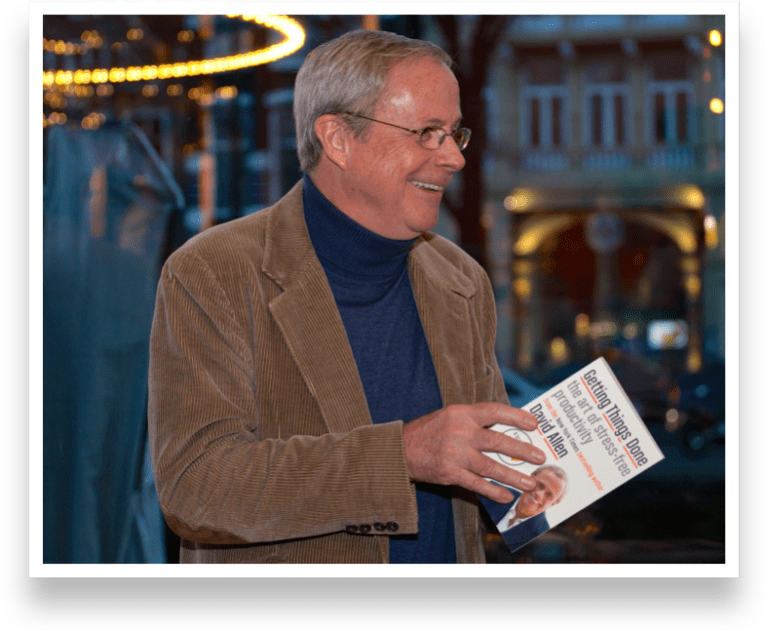
Not surprisingly, David Allen of Getting Things Done fame has thought deeply about what it means to be organized. He even has a simple definition which he shared in a recent article on the GTD website.

You are disorganized if you need something somewhere that you don’t have or have something somewhere that you don’t need. 

David then shares a fun challenge that he does with audiences.

An exercise I’ve done in my seminars is to have everyone reach into their purses or wallets and get something that doesn’t belong there permanently, and which has been there longer than a few hours (besides money). Almost all have at least one thing in that category—a receipt, a business card, a scrap of paper with scribbled notes, an old parking ticket. These are things whose location does not map to their meaning to the person who has them. If the item has no further usefulness, it is trash, but it’s not in the trash. Often it is something they need to store somewhere else—it is reference, but it’s not appropriately accessible as such. Sometimes it’s something that they need to do something about, but it is not in a place to remind them to do it. There is lack of coherence between what the thing is and where it is.

So how does one decide what items should go where? David created a cheat list to decide what to do with any item. Here are a few examples.

  • I don’t need or want it = trash
  • I still need to decide what this means to me = in-tray item
  • I might need to know this information = reference
  • I use it = equipment and supplies

To see the rest of the list, please read the entire article on the Getting Things Done website.

Possibilities are Not Probabilities – Comprehending Chance

The most popular article on my Efficient Librarian website is Deal or No Deal Mr. Hall – How We Misunderstand Probability. That article was framed with a real story from the game show Deal or No Deal. This week I published a follow up article to dive deeper into the Deal or No Deal problem to demonstrate the fact that possibilities are not probabilities.

Below is the start of the article:

When are airplane comes in for a landing there are two possible outcomes: a safe landing or a crash landing. Therefore, what is the probability that the plane will crash?

Recently during a presentation of my seminar, Why Did I Make that Dumb Decision?  Understanding Common Fallacies of Decision Making and How to Avoid Them, I asked this question to the audience. Immediately, someone answered 50%. 

Photo by Sheila Condi on Pexels.com

Of course this was not accurate. Commercial airplanes rarely crash. The website, FlyFright, shares government statistics that show odds of a plane crashing are 0.000001%. Also, there is a 1 in 816,545,929 chance of dying in a plane crash.

In fact, the most dangerous part of air travel is driving to and from the airport! Data from the Florida Highway Safety and Motor Vehicles department shows 3,454 fatal motor vehicle crashes in 2021. That is only one state out of 50! Given the higher frequency of car crashes, why are more people afraid of flying than driving? One reason is that we are primed to hear about plane crashes since these rare incidents are covered widely in the national media. Car crashes by contrast only get brief mention on the local news.

This example highlights the simple fact that possibilities are not probabilities. In the majority of cases where there are multiple possible outcomes, they are not equally likely to happen. Yet, our minds often default to thinking all possibilities are equally likely. This can lead to poor decision making.

Read the rest of the article on the Efficient Librarian website.